01. Edit your form online
Type text, add images, blackout confidential details, add comments, highlights and more.

Type text, add images, blackout confidential details, add comments, highlights and more.

Draw your signature, type it, upload its image, or use your mobile device as a signature pad.

Send it via email, link, or fax. You can also download it, export it or print it out.
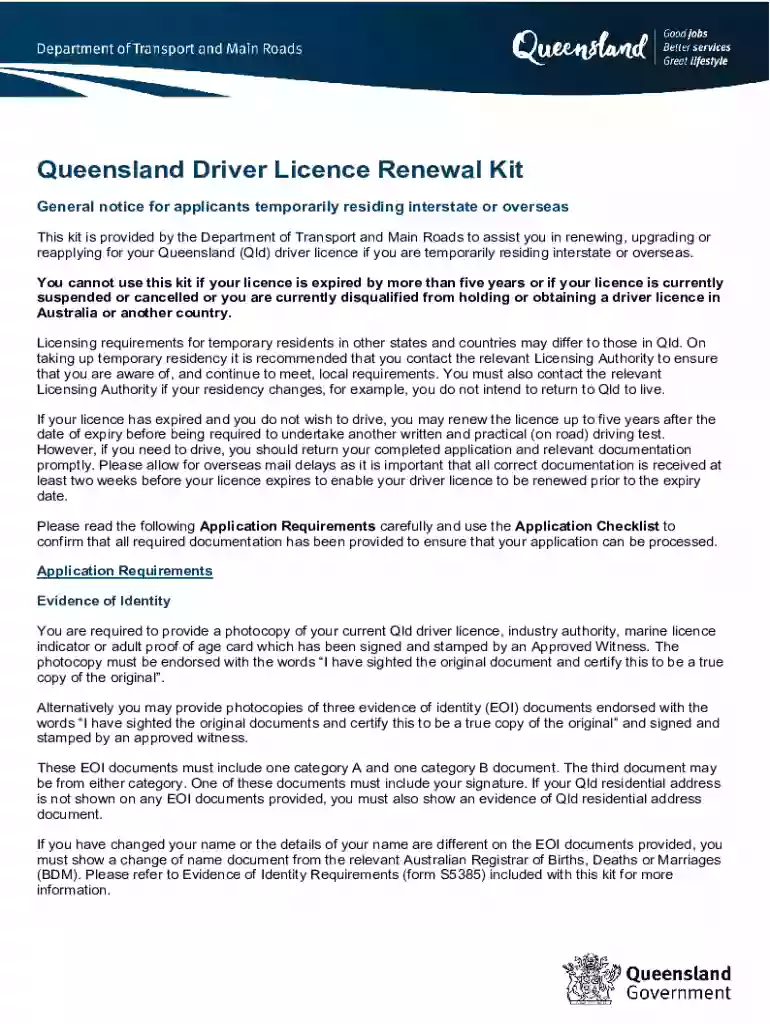
The licensing process through the Department of Transport and Main Roads (TMR) refers to the official procedure for obtaining, renewing, or managing various types of licenses needed for operating vehicles, businesses, or activities governed by transportation regulations. The agency is responsible for ensuring that applicants meet the necessary legal and safety standards, verifying their eligibility, and maintaining comprehensive records. The licensing scope includes driver licenses, commercial licenses, and permits required for special vehicle operations. The goal is to ensure public safety on roads by certifying that all license holders are qualified and informed about related responsibilities and obligations.
Using the licensing services from the TMR involves several key steps, starting with the identification of the specific type of license you require, whether it is a driver's license renewal, a new application, or a specialty license for commercial drivers or particular vehicle categories. After selecting the appropriate service, it's important to gather the necessary documentation, such as proof of identity, residency, and any specific qualifications required for the license type. Once prepared, you can access the department's services through their online portal, in person at a service center, or via mail, depending on the service and your location. It's crucial to follow the detailed instructions provided by TMR to ensure successful processing of your request.
Identify Your License Needs: Determine the exact type of license you require, such as a standard driver's license, a learner's permit, or a commercial driver's license.
Prepare Required Documents: Gather essential documents like proof of identity, proof of residency, and any specific documents required for specialty licenses. This may include medical reports or training certifications.
Complete Application Form: Fill out the appropriate application form completely and accurately. Forms are available online or at local service centers.
Submit Application: Submit your application via the method that best suits your needs, whether it's online, by mail, or in person.
Schedule and Attend Tests: If required, schedule and pass any necessary tests, such as written exams or driving tests, applicable to the license type.
Pay Applicable Fees: Ensure all processing fees are paid as required. Fees vary depending on the license type and duration.
Await Processing: Wait for your application to be processed. TMR provides estimated processing times and will notify you upon completion.
The eligibility criteria for obtaining a license through the TMR depend on several factors, including age, residency, and specific credentials related to the license type. For example, individuals applying for a standard driver's license must typically be a minimum age, possess valid identification proving residence in the state, and pass a series of knowledge and practical driving tests. Specialty licenses, such as those for commercial vehicle operations, may require additional qualifications, such as medical certificates or endorsements. It's essential to review the specific eligibility requirements for your desired license type on the TMR's official website or through their customer service centers.


A comprehensive list of required documents is critical for a successful licensing application with the TMR. Typical documentation includes:
Ensuring that all documents are up-to-date, accurate, and meet the department's standards will facilitate the application process.
The TMR offers multiple avenues for form submission, allowing applicants flexibility and convenience.
Each method has its pros and cons, with online submission generally being the quickest way to process applications.
Licensing through the TMR is a legal requirement for the operation of vehicles and certain businesses, ensuring compliance with local laws and safety standards. The licenses serve as official proof of an individual's or entity's authority to perform specific actions, such as driving a vehicle or operating a transportation-related business. Adhering to these legal requirements helps maintain order and safety on roads, reducing accidents and ensuring all drivers and operators are knowledgeable of traffic rules and regulations. Misuse or non-compliance with TMR licensing can result in penalties, fines, or revocation of driving privileges.
Failure to comply with TMR's licensing requirements can result in a range of penalties, depending on the severity of the violation. Common non-compliance issues include operating a vehicle without a valid license, failing to renew an existing license on time, or providing false information during the application process. Penalties can range from fines and citations to suspension or revocation of driving privileges. For businesses, non-compliance could lead to legal actions or closure. It is crucial for applicants and license holders to remain informed and adhere to all licensing regulations to avoid these punitive measures.
We've got more versions of the Licensing (Department of Transport and Main Roads) form. Select the right Licensing (Department of Transport and Main Roads) version from the list and start editing it straight away!
At DocHub, your data security is our priority. We follow HIPAA, SOC2, GDPR, and other standards, so you can work on your documents with confidence.