Definition and Meaning
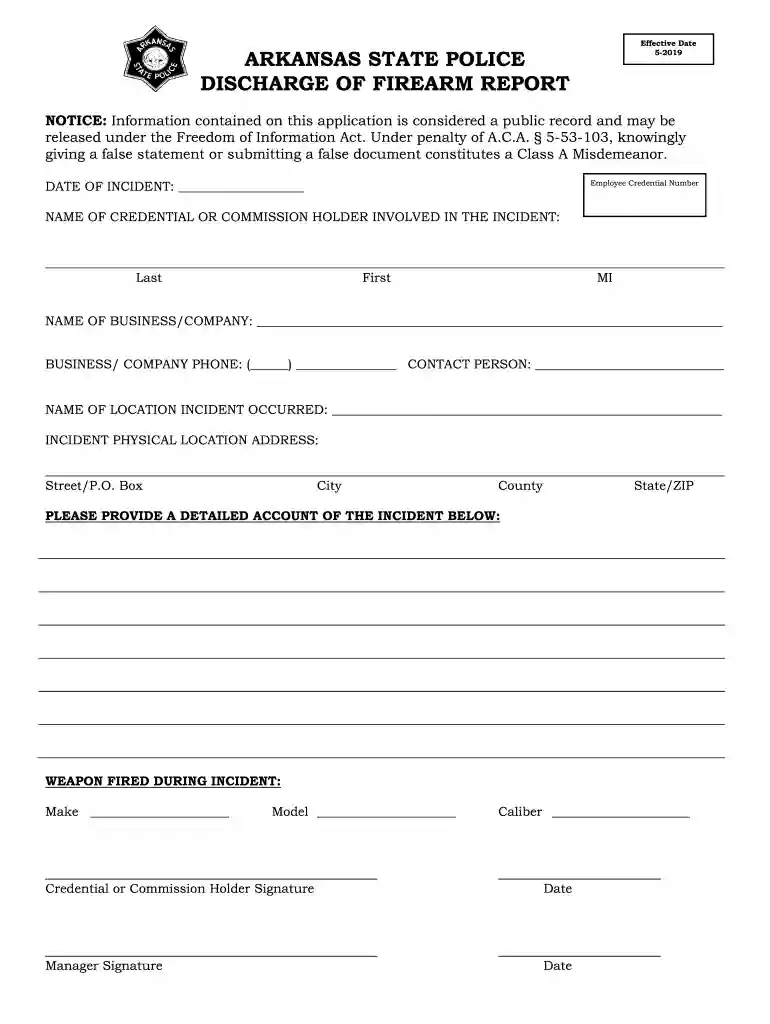
The "state police investigating officer involved shooting - Arkansas" is a formal document used by the Arkansas State Police to thoroughly document incidents where a firearm is discharged by a police officer. Essential for maintaining transparency and accountability, this form is considered a public record under the Freedom of Information Act. It collects detailed information about the event, including those involved, weapons used, and other pertinent details to provide a comprehensive overview of the incident.
How to Use the Form
To correctly utilize the state police investigating officer involved shooting form in Arkansas, law enforcement officers must adhere to specific guidelines:
- Identify the Incident: Clearly determine the event involving firearm discharge by an officer.
- Gather Necessary Details: Collect all relevant information, including date, time, location, weapon specifics, and personnel involved.
- Complete Each Section: Ensure every section of the form is filled out accurately, covering narrative descriptions and any required incident analysis.
- Verification: Review the completed form for accuracy and comprehensiveness before submission.
- Seek Supervisory Approval: Obtain necessary signatures from credential holders and managerial authorization for validation and further processing.
Steps to Complete the Form
Filling out the state police’s shooting incident form requires the following steps:
- Capture Date and Time: Note the precise moment of the shooting incident.
- Detail Participants: List all officers and civilians involved, highlighting roles and actions.
- Location Description: Provide specific location details where the incident occurred.
- Weapon Information: Document all weapons used, including type, serial numbers, and condition immediately following the incident.
- Narrative Section: Write a comprehensive narrative of the event, including any preliminary assessments and witness statements.
- Confirmation and Signatures: Secure signatures from the involved officer(s) and the overseeing manager to verify the form's integrity.
Legal Use of the Form
The legal application of this form ensures that every incident where an officer discharges a weapon is meticulously recorded to adhere to legal standards and transparency expectations:
- Compliance with FOIA: By following the Freedom of Information Act, the form provides transparency, allowing public access where applicable.
- Evidentiary Use: The document may serve as evidence in legal proceedings or internal investigations, holding police accountable.
- Procedure Verification: It verifies adherence to law enforcement protocols and procedures during and after an incident.
Key Elements of the Form
Key components of this document include:
- Incident Summary: Brief overview of the occurrence.
- Participant Identification: Names and roles of all individuals involved.
- Detailed Weapon Analysis: Comprehensive data on firearms used during the event.
- Signatures and Authorization: Verification from participating and overseeing authorities confirming the report’s accuracy.
State-Specific Rules
Arkansas mandates specific regulations concerning officer-involved shootings:
- Uniform Reporting Standards: Standardized formats for consistent reporting across various jurisdictions within the state.
- Transparency Mandates: Obligatory disclosure of certain details to the public, unless restricted by ongoing investigations.
- Training Requirements: Officers are required to undergo periodic training on accurately completing such reports.
Who Typically Uses This Form
Typically, the form is employed by:
- Law Enforcement Officers: Particularly those directly involved in the shooting incident.
- Supervisors and Investigators: For oversight, verification, and further investigative purposes.
- Public Information Officers: When required to disclose information under public records requests.
Important Terms
Understanding vital terminology in the context of this form can aid comprehension:
- Credential Holder: The officer whose credentials are logged for accountability.
- Freedom of Information Act: Legislation ensuring public access to records.
- Discharge of Firearm: Any instance when an officer fires a weapon.
Examples of Using the Form
Real-world applications illustrate multiple scenarios:
- Internal Review: Post-incident review by a dedicated team to determine the necessity and outcome of the shooting.
- Judicial Proceedings: Used as documentation in court cases evaluating officer conduct.
- Public Reporting: Providing information in layman's terms for public transparency initiatives after an investigation concludes without immediate threat to involved personnel or national security.