







Definition and Purpose
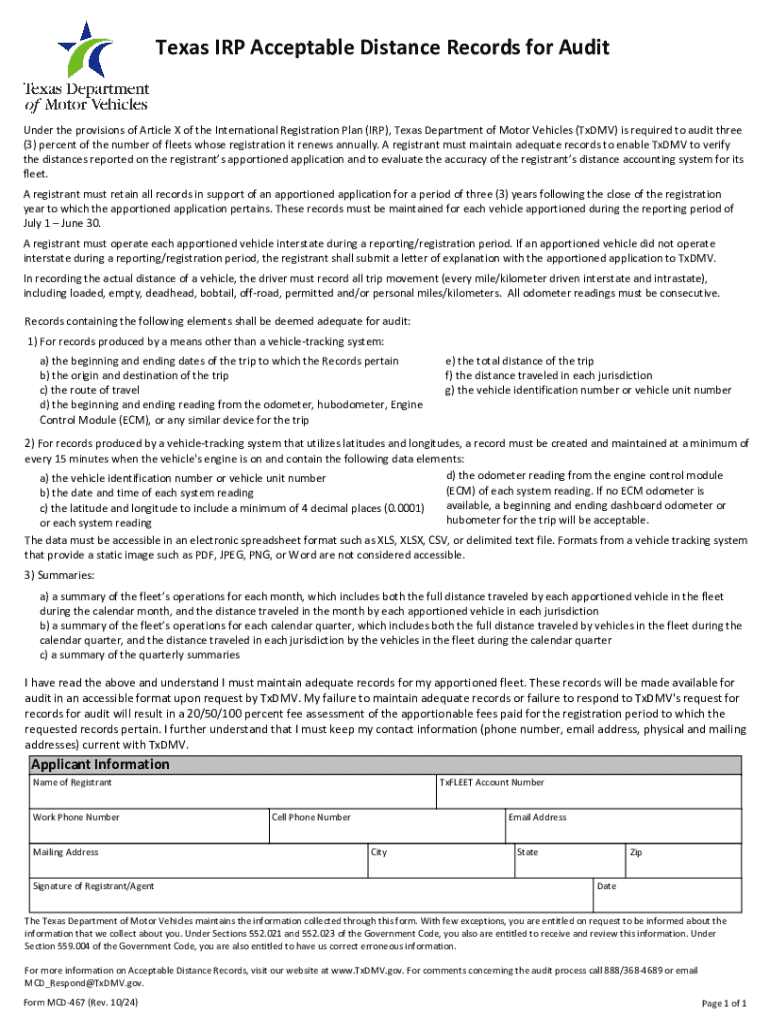
The Texas IRP Acceptable Distance Records for Audit refers to a set of requirements for maintaining detailed distance records under the International Registration Plan in Texas. Registrants must document both interstate and intrastate travel for auditing purposes. This ensures transparency and compliance with regulations, aiding in accurate assessment of vehicle registration fees.
- Purpose: Facilitates accurate reporting of vehicle mileage for proper tax and fee allocation across jurisdictions.
- Scope: Applies to commercial vehicles traveling across state lines, requiring adherence to specific documentation standards.
Key Elements
Accurate record-keeping is mandated to include:
-
Trip Details:
- Starting and ending location
- Dates of travel
- Total miles traveled per trip
- Routes taken
-
Vehicle Information:
- Vehicle identification number
- Fleet number, if applicable
Importance of Texas IRP Records
Maintaining comprehensive IRP records is crucial for avoiding penalties and ensuring compliance with the Texas Department of Motor Vehicles' requirements.
Reasons for Maintenance
- Facilitates verification during audits to prevent financial discrepancies.
- Ensures proper distribution of registration fees among states.
- Provides a legal framework for compliance with state and federal regulations.
Steps to Complete the Records
Completing the Texas IRP records involves adhering to specific procedures to ensure compliance:
- Collect Data: Gather information from each vehicle's odometer readings, GPS data, or other tracking systems.
- Document Trips: Record details of each trip, ensuring all mandatory data is included.
- Compile Monthly Summaries: Create monthly and quarterly summaries to provide a comprehensive overview of fleet operations.
- Review & Update: Regularly audit records for accuracy and completeness, making necessary updates.
Legal and Compliance Standards
Maintaining meticulous records is not merely a best practice but a legal requirement under the IRP framework.
Compliance Requirements
- Minimum Retention Period: Records must be kept for three years from the end of the registration year.
- Data Accuracy: Both manual logs and electronic tracking should present precise, verifiable data.
- Penalties for Non-Compliance: Significant fee assessments and legal action may occur if records do not meet standards.
Who Utilizes These Records
Typically, these records are used by:
- Fleet Managers: Oversee record collection and maintenance.
- Accountants: Ensure proper documentation for tax purposes.
- Legal Teams: Provide defense in case of audits or disputes.
State-Specific Regulations
While the IRP is a North American agreement, Texas maintains unique requirements to align with state regulations.
Texas Requirements
- Proof of Residency: Businesses registering vehicles must demonstrate a Texas base.
- Certification of Proper Mileage: Businesses must certify accuracy, subject to audits.
Examples of Use Cases
Practical examples demonstrate the necessity of maintaining acceptable records:
-
Audit Scenario: A Texas-based logistics company is selected for an IRP audit. By maintaining accurate distance logs, they successfully avoid penalties and prove compliance, thereby maintaining operational continuity.
-
Tax Assessment: A fleet operating interstate trucks accurately estimates its tax liability by analyzing distance data, ensuring correct payment of registration fees.
Software and Digital Solutions
Incorporating technology enhances the accuracy and efficiency of maintaining IRP records.
Software Tools
- Vehicle Tracking Systems: Implement GPS-based systems for automated data collection.
- Digital Logs: Use cloud-based record-keeping for accessible and secure documentation.
- Integration: Ensure compatibility with tools like QuickBooks to streamline financial reporting.
Understanding these components can greatly enhance compliance with the Texas IRP Acceptable Distance Records for Audit, ensuring businesses remain on the right side of the law while optimizing their operations.




