




Definition and Meaning of the Illinois Application for Waiver of Court Fees
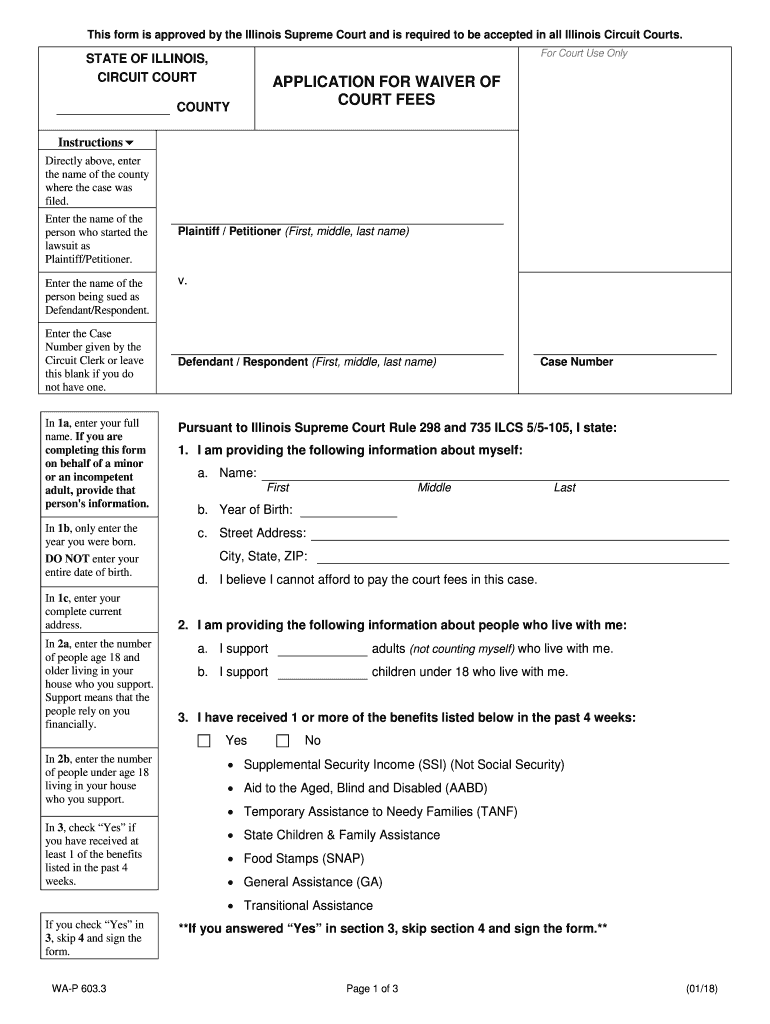
The Illinois Application for Waiver of Court Fees is an official document provided by the Illinois Supreme Court. It enables individuals who cannot afford court-related expenses to request a fee waiver. This application considers the applicant’s financial situation, requiring details such as income, expenses, and dependents. The objective is to assess eligibility for financial relief based on financial necessity.
Steps to Complete the Illinois Application for Waiver of Court Fees
-
Gather Required Information: Compile your personal information including income details, dependents, and living expenses.
-
Access the Form: Obtain the application form from the Illinois Circuit Court's website or courthouse. Check for any state-specific instructions.
-
Fill Out Personal Details: Enter your full name, address, and contact information. Ensure all entries are clear and accurate.
-
Report Financial Information: Provide a comprehensive breakdown of your income sources, monthly expenses, and any financial assistance you receive.
-
Declare Assets and Liabilities: List your assets, such as owned property and vehicles, as well as any outstanding debts or liabilities.
-
Sign the Application: Verify all information provided, then sign and date the form. In some cases, a notarized signature might be required.
-
Submit the Form: Depending on the court's instructions, submit the form either in person, by mail, or online. Retain copies for your records.
Eligibility Criteria for Fee Waiver
-
Income Thresholds: Eligible applicants typically have income below a specific threshold, reflective of state or federal poverty guidelines.
-
Dependents: Consideration for dependents can impact eligibility, with larger household sizes potentially qualifying for greater relief.
-
Financial Hardships: Demonstrable financial hardships, such as unemployment or medical expenses, may be pertinent in determining eligibility.

Required Documents for Submission
-
Proof of Income: Pay stubs or tax returns from recent months.
-
Expense Documentation: Bills or receipts for housing, utilities, medical, and other expenses.
-
Proof of Dependents: Legal documentation for any dependents, such as birth certificates.
-
Asset Verification: Assessments of owned assets, like property tax statements or vehicle registration.
How to Obtain the Illinois Application for Waiver of Court Fees
-
Online Access: Visit the Illinois Circuit Court's website to download the form. Some jurisdictions may also offer an online submission feature.
-
Courthouse Availability: Physical copies can typically be requested in person from local courthouse clerks.
Possible Submission Methods
-
Online Submission: Many courts provide electronic submission avenues through official portals.
-
Mailing Option: Completed forms can often be mailed to the court address, ensuring that it is postmarked by any applicable deadlines.
-
In-Person Delivery: Direct submission at the courthouse is commonly available, offering an opportunity for immediate clarification of any submission doubts or issues.
Legal Use and Compliance
The Illinois Application for Waiver of Court Fees must be submitted with truthful, complete information. Legal use implies not altering or misrepresenting any disclosure for unjust benefit. Misrepresentation may lead to legal penalties or disqualification from waivers.
Important Terms Related to the Application
-
Affidavit of Indigence: A sworn statement asserting inability to pay court fees based on indigence, typically accompanying the fee waiver application.
-
Fee Waiver Eligibility: Criteria under which applicants may qualify for exemption from court fees, usually based on financial need.
State-Specific Rules and Variations
-
Local Court Policies: Some jurisdictions might have additional requirements or offer specific guidance particular to local legal practices.
-
Submissions Deadline: Different regions may have varying cutoff dates for waiver applications, often aligned with court schedules.
Key Elements of the Form
-
Applicant Information Section: Captures basic personal data and contact details for the applicant.
-
Financial Disclosure Areas: Detailed areas requiring income, expense, assets, and liabilities information.
-
Declaration and Signature: A critical section where applicants affirm the truthfulness of the information provided.
Examples and Scenarios
-
Students Seeking Waivers: Often, students with part-time employment or dependent financial situations may qualify.
-
Retirees on Fixed Income: Those on pensions or social security might meet eligibility thresholds due to limited income.
-
Unemployment Situations: Applicants recently unemployed can benefit by showcasing their temporary financial hardships.
These elements all contribute to a comprehensive understanding of the Illinois Application for Waiver of Court Fees, ensuring that those eligible can navigate the process efficiently.