






Definition and Meaning of "Get the Motion and Affidavit in Support of Request to Proceed"
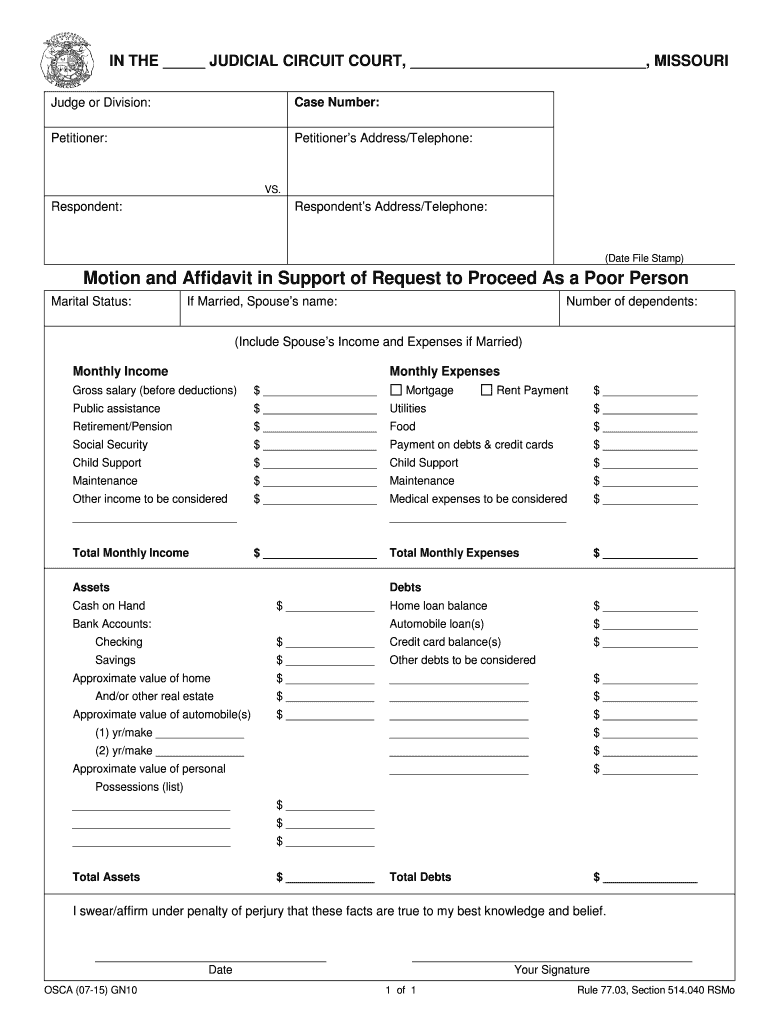
The "Get the Motion and Affidavit in Support of Request to Proceed" is a legal form used predominantly in the Missouri Judicial Circuit Court. This form is critical for individuals who are seeking the court's permission to proceed as a poor person, meaning they cannot afford the requisite court fees. The document requires petitioners to provide comprehensive personal information, including financial details like monthly income, expenses, assets, and debts. This information is essential for the court to assess the petitioner’s financial status and determine eligibility for fee waivers or financial assistance. Understanding the form's purpose is vital, as it reflects the intersection of legal frameworks and support systems designed to ensure access to justice regardless of financial barriers.
How to Use the "Get the Motion and Affidavit in Support of Request to Proceed"
Using the "Get the Motion and Affidavit in Support of Request to Proceed" requires careful attention to the details specified by the court. First, ensure that all sections of the form are completed accurately, as incomplete forms may delay or nullify the application process. Users should:
- Gather necessary financial documentation such as pay stubs, bank statements, and receipts to accurately fill in the income and expense sections.
- Fill out personal identification details, ensuring accurate spelling and addresses as listed on legal documents.
- Use clear, legible writing if completing a physical version of the form.
Once completed, it's advisable to review all entered data to prevent errors that could hinder the court's assessment. Legal assistance can be beneficial in ensuring the form is completed correctly, particularly if there are complexities in the financial or personal data being provided.
Steps to Complete the "Get the Motion and Affidavit in Support of Request to Proceed"
Completing the "Get the Motion and Affidavit in Support of Request to Proceed" involves several steps:
- Personal Information: Enter full personal details, including your name, contact information, and any relevant identification numbers.
- Financial Information: List detailed monthly income, including wages, social security benefits, and other income sources. Clearly document expenses such as rent, utilities, and medical costs.
- Assets and Debts: Provide a comprehensive overview of your current assets, such as property and vehicles, and list outstanding debts.
- Review and Sign: Thoroughly review the completed form to ensure accuracy. Sign the affidavit under oath, acknowledging the truthfulness of the provided information.
Following these steps ensures that the form is prepared correctly, minimizing potential issues during court proceedings.
Key Elements of the "Get the Motion and Affidavit in Support of Request to Proceed"
Several critical elements constitute the "Get the Motion and Affidavit in Support of Request to Proceed":
- Petitioner Identification: Clear identification of the petitioner is crucial, including name, contact details, and any associated legal identifiers.
- Financial Disclosure: Accurate representation of income and expenses to justify the need for financial assistance or fee waivers.
- Legal Oath: The petitioner must attest to the truthfulness of the submitted information, understanding the legal implications of false declarations.
These elements are foundational to the form, enabling the court to make an informed decision about the petitioner's financial capabilities.
Eligibility Criteria for Using the "Get the Motion and Affidavit in Support of Request to Proceed"
Eligibility to use this form generally depends on the applicant's financial status. The petitioner must demonstrate insufficient financial resources to cover court fees. Criteria include:
- Income Level: The applicant's income must be below a certain threshold, which may vary by jurisdiction.
- Asset Ownership: Limited assets that cannot reasonably cover court costs.
- Debt Accumulation: A significant amount of debt compared to income and assets may support the request.
Eligibility assessments are based on a holistic view of the applicant's financial situation, often requiring supportive documentation to verify claims.


Legal Use of the "Get the Motion and Affidavit in Support of Request to Proceed"
The legal application of this affidavit is primarily to ensure that financial hardship does not impede an individual's access to the court system. It is employed when petitioners seek exemption from standard court fees due to their inability to pay. Legal use entails:
- Court Fee Waivers: Petitioning for exemption from fees that are otherwise barriers to proceeding with legal actions.
- Supporting Evidence: Submission of credible documentation that substantiates the financial claims made in the affidavit.
Utilizing the affidavit ensures that justice remains accessible, promoting fair legal processes for economically disadvantaged individuals.
State-Specific Rules for the "Get the Motion and Affidavit in Support of Request to Proceed"
Rules governing the use of this form can vary based on state-specific regulations. Notably:
- Threshold Levels: Different states may establish varying income thresholds or asset limits to qualify for fee waivers.
- Documentation Requirements: States may require specific types of documentation as supporting evidence.
Awareness of these variations is crucial for applicants, and consulting state-specific resources or legal counsel can aid in compliance with local standards.
Form Submission Methods (Online / Mail / In-Person)
The "Get the Motion and Affidavit in Support of Request to Proceed" can be submitted through multiple channels depending on the user's preference and the court's facilities:
- Online Submission: Some courts offer electronic submission through secure portals, streamlining the process and ensuring timely receipt.
- Mail: Traditional mail submission remains an option, requiring attention to deadlines to ensure timely processing.
- In-Person: Direct submission to the court can provide added assurance and instant confirmation of receipt.
Selecting the appropriate submission method is crucial for adhering to court deadlines and ensuring the form's processing within the judicial system's timeframe.