01. Edit your form online
Type text, add images, blackout confidential details, add comments, highlights and more.

Type text, add images, blackout confidential details, add comments, highlights and more.

Draw your signature, type it, upload its image, or use your mobile device as a signature pad.

Send it via email, link, or fax. You can also download it, export it or print it out.
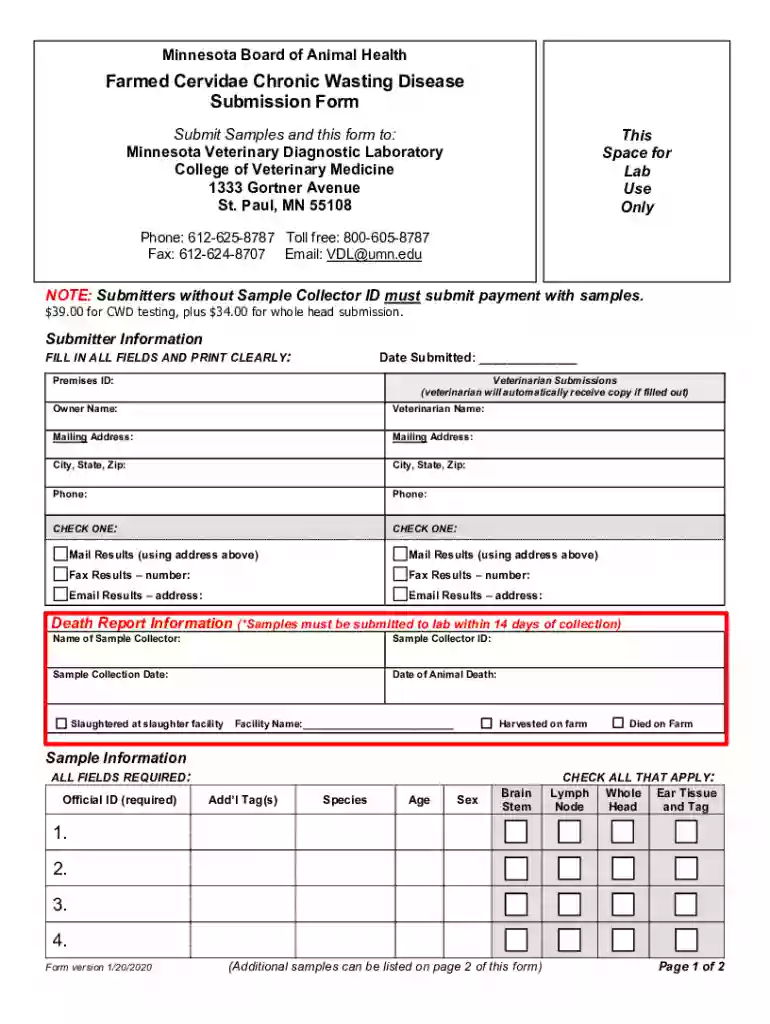
Chronic Wasting Disease (CWD) Sampling by the Minnesota Board of Animal Health involves collecting and testing samples from farmed cervidae to identify the presence of this disease. CWD is a transmissible spongiform encephalopathy affecting deer, elk, and moose. This form provides critical instructions for stakeholders such as farmers and veterinarians for submitting samples to the Minnesota Veterinary Diagnostic Laboratory. The primary aim is to monitor and control the spread of CWD among cervidae populations in Minnesota, thus safeguarding wildlife health and supporting regulatory compliance.
Using the form requires clear adherence to defined protocols to ensure proper sample submission and testing. Users must first obtain a physical or digital copy of the form, which provides detailed submission instructions. It's essential to fill out all fields accurately, as incomplete information may result in processing delays. Specific sample identifiers must be provided, and all documentation should accompany the biological samples sent to the laboratory. The form outlines the process step-by-step, guiding you through from sample collection to laboratory submission.
Collect the Sample: Gather tissue samples from cervidae according to the guidelines specified in the form. Ensure you're using sterilized tools and following safety precautions to prevent contamination.
Fill Out Required Information: Provide details of the cervidae and the farm or facility from which the sample is collected. Include unique identification numbers and relevant documentation of the animals.
Label Samples Correctly: Each sample must be clearly labeled with corresponding identifiers as outlined in the instructions on the form.
Include Payment: Attach any required fees for diagnostic testing services as specified in the form.
Submit Samples: Send the collected samples to the Minnesota Veterinary Diagnostic Laboratory within the 14-day timeframe specified.
Confirm Submission: Retain copies of all documentation for your records and confirm receipt with the laboratory if needed.
The submission of this form and accompanying samples for testing is a legal requirement for certain farm operations within Minnesota. The form is designed to align with state regulations that aim to monitor and mitigate Chronic Wasting Disease. Compliance ensures the health of cervidae herds and prevents potential penalties associated with non-compliance. Use the form following all state guidelines and submit within the legal timeframe to ensure that operations abide by health and safety regulations.
Engaging in the sampling process is crucial for several reasons:
Stakeholders such as deer and elk farmers, veterinarians, and wildlife management professionals are primary users of this form. Individuals involved in the care, management, and sale of farmed cervidae in Minnesota are required to ensure their animals are free from CWD. The form aids in the official documentation and submission of necessary information and biological matter required for testing.
Minnesota mandates specific protocols regarding CWD sampling and testing. The form specifies standards for sample collection and submission logistics unique to the state's regulatory framework. Participants must conform to these requirements to ensure that their sampling submissions are processed without hindrance. Non-compliance with these rules can result in penalties or nullification of test results, emphasizing the importance of understanding and adhering to state-specific guidelines.
Consider a hypothetical deer farm 'Green Pastures.' The owners need to test their herd for CWD to comply with state regulations. Post-sample collection, they accurately complete the form, detailing all necessary information and securely package the samples. Following the instruction, they submit the paperwork and samples to the veterinary laboratory. The lab receives and tests the samples, providing Green Pastures with results, thus maintaining compliance and ensuring the health of their livestock. This form thus serves as a critical tool in managing and controlling CWD within their operation.
We've got more versions of the Chronic Wasting Disease Sampling - Minnesota Board of Animal form. Select the right Chronic Wasting Disease Sampling - Minnesota Board of Animal version from the list and start editing it straight away!
At DocHub, your data security is our priority. We follow HIPAA, SOC2, GDPR, and other standards, so you can work on your documents with confidence.