01. Edit your form online
Type text, add images, blackout confidential details, add comments, highlights and more.

Type text, add images, blackout confidential details, add comments, highlights and more.

Draw your signature, type it, upload its image, or use your mobile device as a signature pad.

Send it via email, link, or fax. You can also download it, export it or print it out.
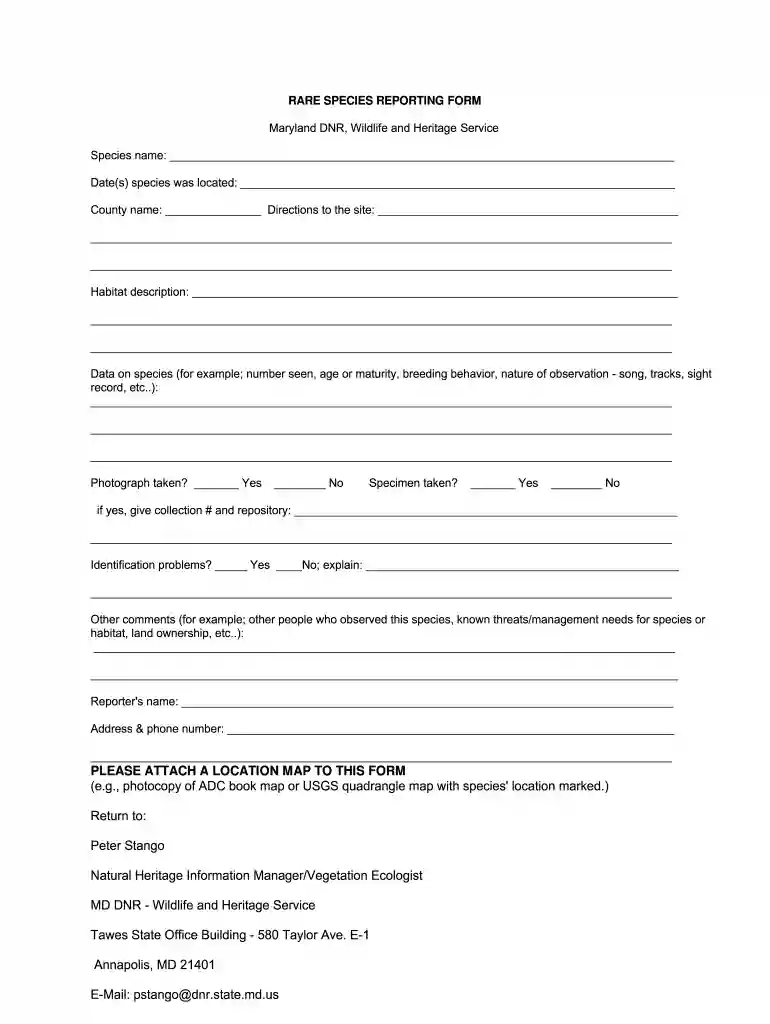
The MD Rare Species Reporting Form is a document developed by the Maryland Department of Natural Resources for reporting sightings of rare species within the state. Its primary purpose is to aid in the documentation and protection of Maryland's rare and endangered flora and fauna. The form serves as a critical tool for conservation efforts, offering a standardized method for individuals to submit detailed information about their observations. By using this form, the state can maintain an accurate database of rare species' locations and habitats, informing conservation strategies and policy decisions.
Using the MD Rare Species Reporting Form involves several key steps to ensure that all relevant data about the sighting is accurately captured. Start by obtaining the form from the Maryland Department of Natural Resources' website, where it is available for download. Once acquired, fill out the form with precise details about the sighting. This includes:
Finally, attach a map highlighting the location and submit the completed form according to the department's instructions, either electronically or via mail.
To acquire the MD Rare Species Reporting Form, visit the official website of the Maryland Department of Natural Resources. The form is typically available in a downloadable format, such as PDF. For those without internet access, the form may also be requested by contacting the department directly via phone or email. Ensuring easy access to the form is crucial to encourage widespread reporting and participation in conservation activities across Maryland.
Completing the MD Rare Species Reporting Form requires attention to detail to ensure comprehensive data collection. Here is a step-by-step guide:
Reporting rare species sightings using this form is vital for several reasons. It helps maintain an up-to-date database, essential for tracking population changes and threats to species. Regular submissions contribute to research efforts and aid in identifying critical habitats that need protection. Ultimately, the form plays a crucial role in Maryland's biodiversity conservation by providing scientists and policymakers with reliable data to make informed decisions.
The MD Rare Species Reporting Form is generally used by a diverse group of individuals committed to wildlife conservation and research. This includes:
This wide range of users underscores the form's importance in community-driven conservation efforts.
Utilizing the MD Rare Species Reporting Form involves adhering to certain legal guidelines to ensure that all data is collected ethically and used appropriately. Reporters must ensure that the observations are made without causing harm or disturbance to the species or its habitat. All provided information must be accurate and honestly reflect the details of the sighting. The data collected is used under the regulations of privacy and environmental protection laws, ensuring the ethical management of sensitive information about endangered species.
The form is composed of several critical sections, each designed to collect specific information that supports conservation efforts. Some of these include:
These components are carefully structured to ensure the relevant data assists in the effective monitoring and protection of rare species within Maryland.
Maryland has specific regulations regarding the reporting of rare species sightings that users of the form must adhere to. These rules might include certain cryptic species that require additional verification before a sighting is recorded officially. Additionally, Maryland law prohibits harassment or disturbance of wildlife, which applies to the observation and reporting process facilitated by the form. Understanding state-specific requirements ensures that users contribute valuable data while respecting regional conservation laws.
At DocHub, your data security is our priority. We follow HIPAA, SOC2, GDPR, and other standards, so you can work on your documents with confidence.