01. Edit your form online
Type text, add images, blackout confidential details, add comments, highlights and more.

Type text, add images, blackout confidential details, add comments, highlights and more.

Draw your signature, type it, upload its image, or use your mobile device as a signature pad.

Send it via email, link, or fax. You can also download it, export it or print it out.
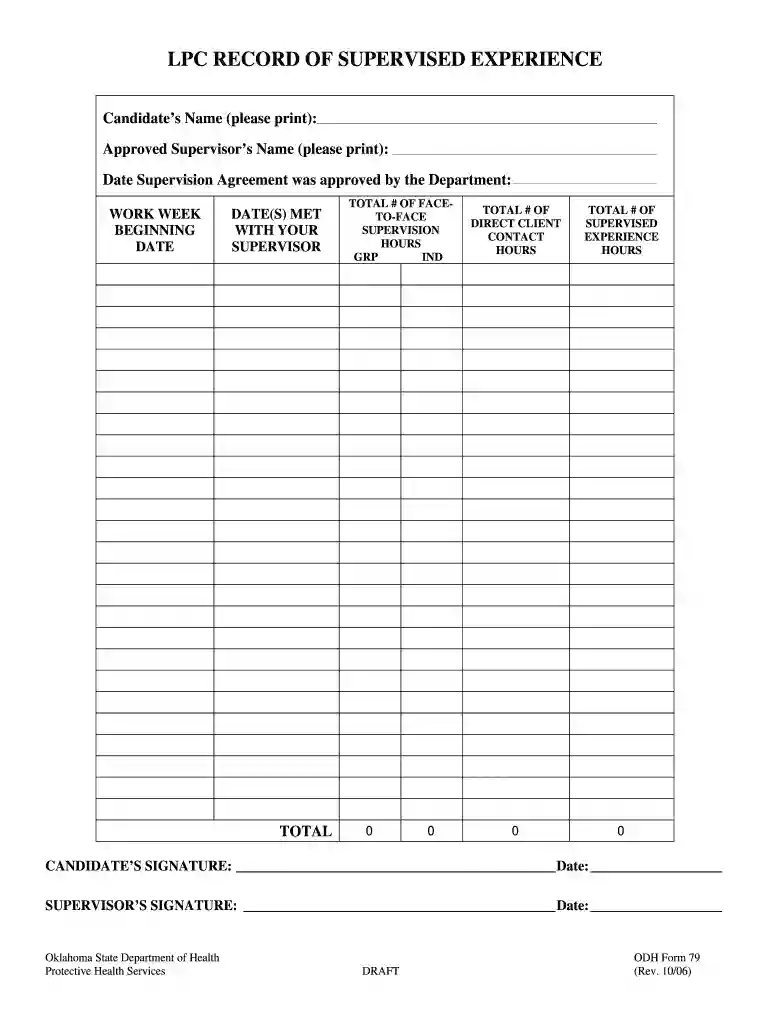
The "Evaluation of Supervised Experience - LPC Draft Document" serves as a formal record to track the supervised experience required for candidates pursuing professional credentials, such as Licensed Professional Counselor (LPC) certification. This document plays a crucial role in ensuring that candidates meet the necessary standards through recorded hours of supervision, direct client interaction, and total hands-on experience. By capturing extensive details like candidate and supervisor information, approval dates, and specific hour logs, it helps maintain transparency and accountability in professional development.
To effectively use the Evaluation of Supervised Experience document, candidates should begin by accurately filling out their personal details and those of their supervisor. This involves providing the supervision agreement's approval date, listing all workweek dates, and detailing the total hours dedicated to direct client contacts and supervision. It's important to ensure that all entries are consistent with the requirements set forth by the professional board overseeing the certification process.
Completing the document involves several methodical steps to ensure accuracy and compliance with professional standards.
Several essential elements are crucial for comprehensive and successful documentation, ensuring all requirements for supervised practice are met.
The legal implications of the Evaluation of Supervised Experience document are significant, as it serves as proof that candidates fulfill licensure requirements. Legal standards dictate precise documentation of supervisory hours to issue and renew a professional license.
This document is primarily utilized by individuals aspiring to be Licensed Professional Counselors (LPC) or other professionals requiring structured supervision as part of their credentials. It is a critical tool for:


Understanding relevant terminology is essential for the effective use and completion of this document.
Case studies can highlight how various candidates have successfully utilized the document in different professional scenarios.
State regulations can significantly impact the structure and requirements of the evaluation document.
Understanding state-specific differences ensures candidates can tailor the document to their jurisdiction's requirements, thus optimizing their licensure application process.
We've got more versions of the EVALUATION OF SUPERVISED EXPERIENCE - LPC Draft doc - ok form. Select the right EVALUATION OF SUPERVISED EXPERIENCE - LPC Draft doc - ok version from the list and start editing it straight away!
| Versions | Form popularity | Fillable & printable |
|---|---|---|
| 2006 | 4.8 Satisfied (145 Votes) |
At DocHub, your data security is our priority. We follow HIPAA, SOC2, GDPR, and other standards, so you can work on your documents with confidence.