




01. Edit your nihss online
Type text, add images, blackout confidential details, add comments, highlights and more.

Type text, add images, blackout confidential details, add comments, highlights and more.

Draw your signature, type it, upload its image, or use your mobile device as a signature pad.

Send nih stroke scale pdf via email, link, or fax. You can also download it, export it or print it out.
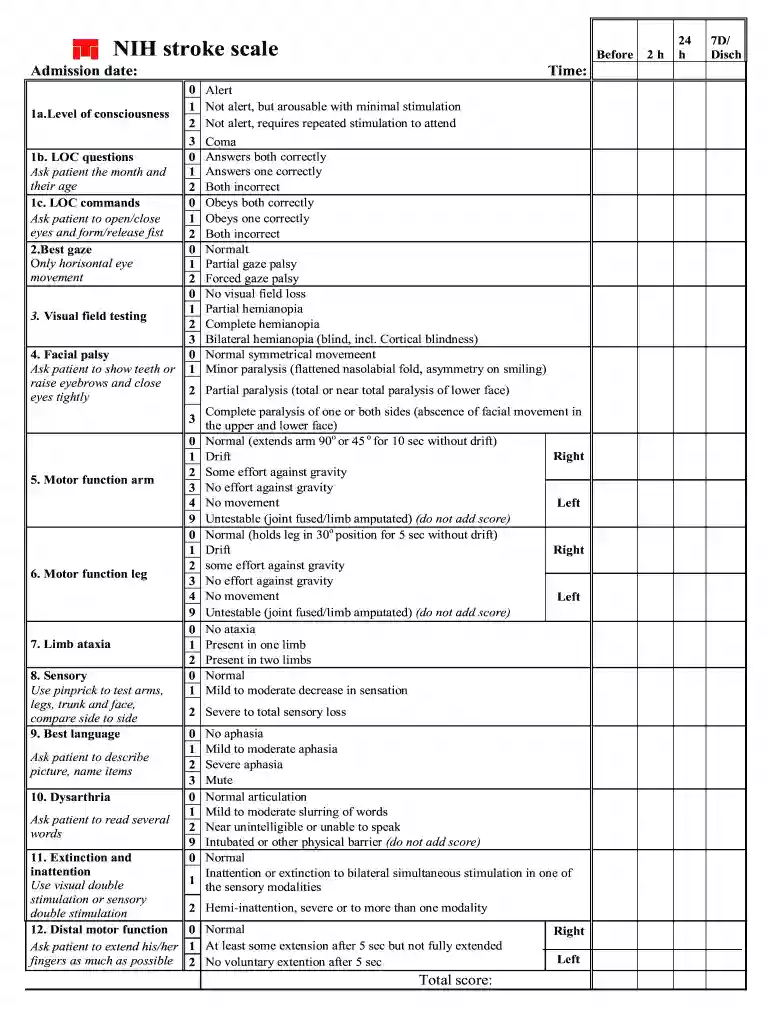
The NIH Stroke Scale (NIHSS) PDF is a standardized assessment tool used to evaluate the severity of stroke symptoms in patients. This scale includes a variety of assessments related to consciousness, eye movement, visual fields, facial movement, motor function, sensory response, language abilities, and attention. Each assessment is meticulously structured, allowing healthcare professionals to score and interpret neurological function accurately.
To effectively utilize the NIHSS PDF, follow these steps:
Healthcare professionals can acquire the NIHSS PDF through several methods:
Familiarity with key terms enhances understanding of the NIHSS PDF:
The NIHSS PDF is primarily utilized by:


The NIHSS PDF is legally recognized as a clinical assessment tool, particularly in acute stroke protocols. The use of this scale is governed by regulatory standards that ensure accurate documentation and patient safety during treatment. Incorrect use or misdocumentation of NIHSS scores may lead to complications in patient care protocols, reimbursement claims, and legal liability in clinical settings.
Real-world application of the NIHSS PDF can vary:
These examples illustrate the NIHSS PDF's practical significance in assessing and managing stroke patients.
While the NIHSS is the most widely recognized tool, several variants exist:
Understanding both the NIHSS PDF and these variants assists healthcare professionals in selecting the most appropriate tool for stroke assessment and management.
We've got more versions of the nihss form. Select the right nihss version from the list and start editing it straight away!
| Versions | Form popularity | Fillable & printable |
|---|---|---|
| 2003 | 4 Satisfied (31 Votes) |
With DocHub, it’s quite simple. The service offers users an add-on called DocHub for Gmail, which you can locate in the Google Workspace Marketplace free of charge. Install it and give it access to your Google account. Open your email with your nihss score pdf attached and click on the add-on button in the right-side panel. Log in to your DocHub account, and import the file to our editor, where you can fill it out and sign.
If you are looking for a state-specific nihss form sample, you can find it in our DocHub Forms & Templates catalog. Use the search field, enter your form’s name, and search through the results for your state. You may also filter out irrelevant results while searching our catalog by categories.
At DocHub, your data security is our priority. We follow HIPAA, SOC2, GDPR, and other standards, so you can work on your documents with confidence.


