01. Edit your form online
Type text, add images, blackout confidential details, add comments, highlights and more.

Type text, add images, blackout confidential details, add comments, highlights and more.

Draw your signature, type it, upload its image, or use your mobile device as a signature pad.

Send it via email, link, or fax. You can also download it, export it or print it out.
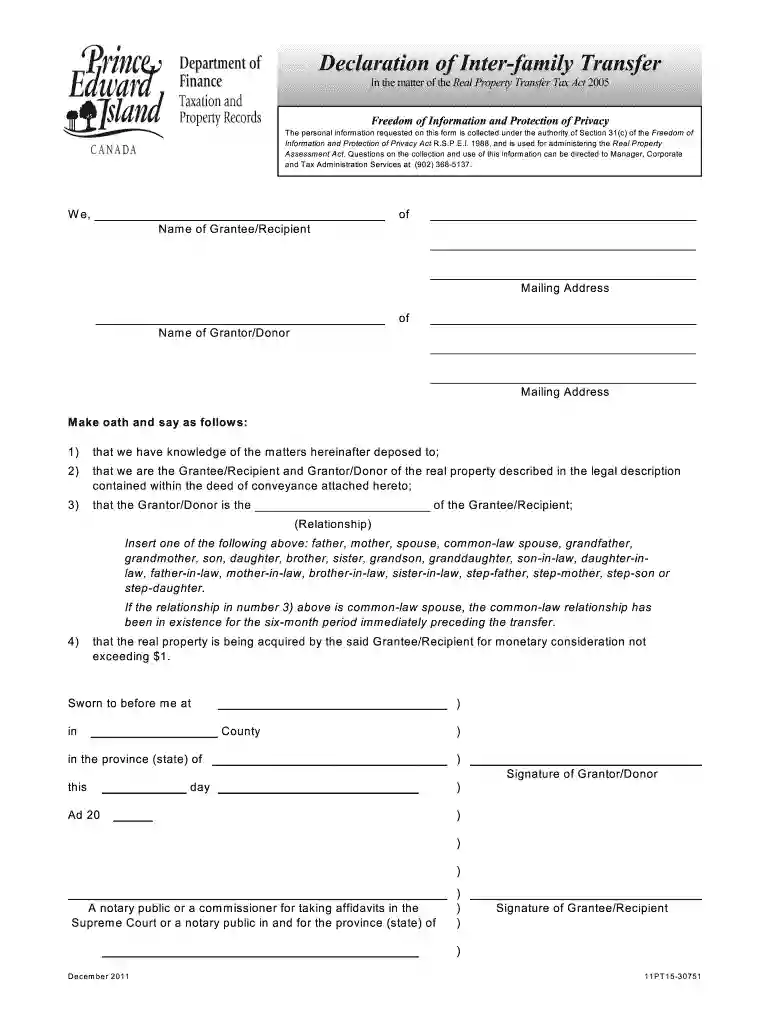
The Declaration of Inter-family Transfer - Government of Prince is a legal document essential for facilitating the transfer of real property between family members, typically under the guidelines established by the Real Property Transfer Tax Act 2005. This declaration is crucial for acknowledging the specifics of the relationship between the grantor and the grantee and ensuring that the transaction complies with relevant regulations. The form also encompasses declarations made under oath before a notary public, making it a critical element in formalizing property ownership transfers within families.
Gather Necessary Information: Begin by collecting all required personal details for both the grantor and grantee, including full names, addresses, and relationship specifics. Ensure all information accurately reflects each party's current status.
Understand the Relationship and Nature of the Transfer: Declare the familial relationship and clarify the intent and nature of the property transfer. This includes whether the transfer is a gift, sale without monetary exchange, or fulfilling a previous agreement within the family.
Notarization: Schedule an appointment with a notary public to witness and notarize the declaration. This step is vital in ensuring the document's legal authenticity.
Submission: Once notarized, submit the form as required by the local government or relevant agency. This can often be done by mail, in-person, or online, depending on the jurisdiction's specific rules.
For the accurate completion of the Declaration of Inter-family Transfer, certain documents are necessary:
Having these documents ready expedites the process and ensures no delays in the submission.
The declaration legally facilitates property transfers without standard market transactions. It accommodates changes of ownership while complying with property transfer taxation laws. By doing so, it mitigates potential tax implications that standard property transfers could incur. Legal compliance is assured by observing all notarization requirements and accurately completing the form based on truthful declarations.
While the overarching purpose of this form is consistent nationwide, there are nuanced differences in state-specific rules that dictate its application. These variations often involve the specifics of tax exemptions or requirements based on familial relations. For example, some states might offer complete tax exemptions for transfers between siblings, while others might impose certain minimal taxes or fees. Always check the relevant state legislation or consult with a legal advisor for your specific state’s rules.
The declaration consists of several critical elements which must be thoroughly addressed:
Declaration Statement: This section stipulates the intent and how the familial relationship influences the transfer.
Notary Section: Details regarding the notary public's credentials, signature, and seal.
Affirmation of Intent: Explicit confirmation from both parties that the transfer is intentional and agreed upon without external coercion.
Each of these components ensures that the process is legally binding and correctly recorded.
This form is applicable primarily to direct family members, which generally include siblings, parents, children, and sometimes extended family under certain circumstances. Both the grantor and grantee need to be of legal age and sound mind to participate in the property transfer. Eligibility often extends to those looking to streamline property ownership without formal exchanges of funds, primarily when other tax obligations are accounted for.


Each state may impose its deadlines for filing this form, casting light on the importance of timely submission. Missing a filing deadline could lead to a denial of any tax benefits or exemptions that the form affords. Property transfer documents are generally required to be filed within a specific timeframe after notarization, usually between 30 and 60 days. Checking with the local property office can provide precise deadlines and avoid complications.
Failure to correctly file the Declaration of Inter-family Transfer can lead to several consequences. These may include fines, the imposition of back taxes, and even the invalidation of the property transfer. It may also result in legal scrutiny to ensure that the intent of the parties involved aligns with state regulations. Therefore, adherence to all processes is critical to avoid unnecessary penalties.
We've got more versions of the Declaration of Inter-family Transfer - Government of Prince form. Select the right Declaration of Inter-family Transfer - Government of Prince version from the list and start editing it straight away!
| Versions | Form popularity | Fillable & printable |
|---|---|---|
| 2011 | 4.8 Satisfied (186 Votes) |
At DocHub, your data security is our priority. We follow HIPAA, SOC2, GDPR, and other standards, so you can work on your documents with confidence.