01. Edit your form online
Type text, add images, blackout confidential details, add comments, highlights and more.

Type text, add images, blackout confidential details, add comments, highlights and more.

Draw your signature, type it, upload its image, or use your mobile device as a signature pad.

Send it via email, link, or fax. You can also download it, export it or print it out.
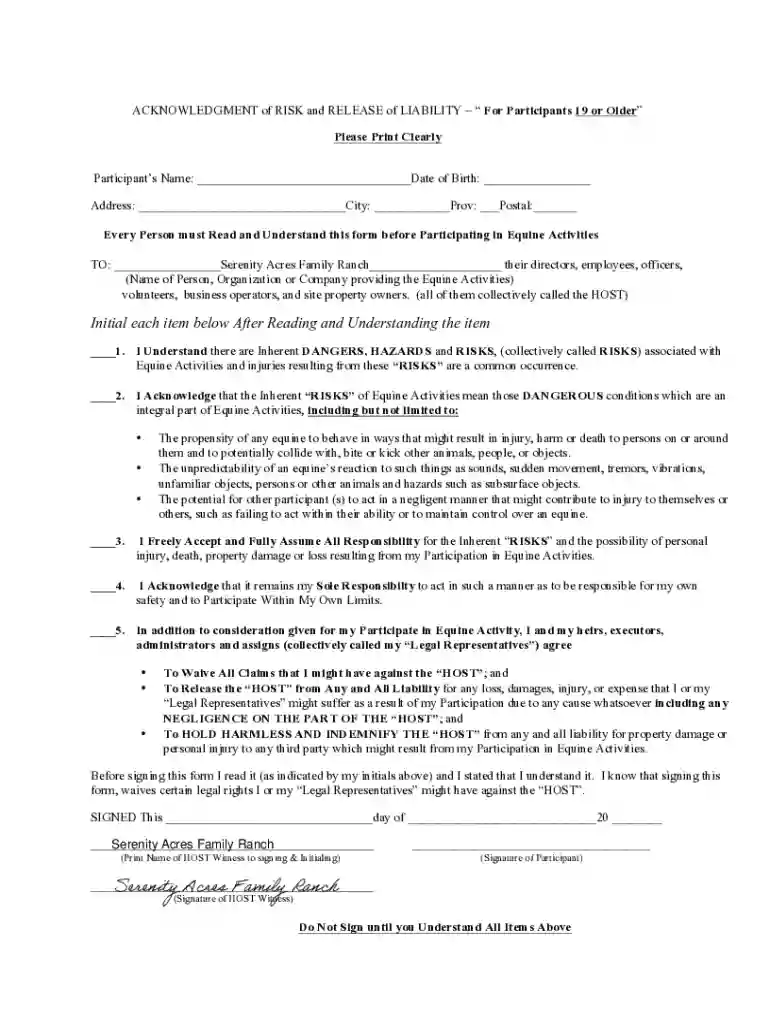
The "Acknowledgment of Risk and Release of Liability" form serves as a legally binding document that outlines the potential risks associated with a specific activity or event. By signing this document, participants acknowledge their awareness of these risks and agree not to hold the organizing party responsible for any potential injuries or damages incurred. It is commonly used in activities that inherently involve physical risks, such as equine events, sports, and adventure tourism. The specificity of the form ensures that participants clearly understand the nature of the risks they are accepting, thereby reducing the liability of the host or organizer.
This form should be utilized before participants engage in an activity known to involve potential hazards. Organizers must ensure that the form is presented in a clear and understandable manner, allowing participants adequate time to review it comprehensively. It's crucial that each participant signs the form prior to participation. Depending on the age and legal requirements, signatures may also be required from guardians for younger participants. This documentation can be employed not only to provide legal coverage but also as part of a broader set of safety protocols to ensure all parties are informed and prepared for the risks involved.
Read the Document Fully: Ensure you comprehend all aspects of the form, paying particular attention to the listed risks and the waiver of liability.
Provide Personal Information: Fill in your name, contact details, and any other required personal information.
Acknowledge Understanding: Initial or sign sections indicating that you understand the risks and agree to the terms.
Submit Required Signatures: Complete all necessary signature fields. If applicable, ensure a guardian's signature is provided for underage participants.
Return the Document: Submit the completed form to the event organizer or as directed, before the specified deadline.
In the United States, this form is a legal tool used to minimize liability for organizations hosting potentially hazardous activities. It functions under the premise that participants cannot claim ignorance of risks when they have signed a document explicitly detailing those risks. This form can help protect organizations from lawsuits by providing clear evidence that participants were both informed and accepting of the potential hazards involved.
This form is widely utilized across various industries that engage in activities with inherent risks. Common users include:


Consider the case of "Serenity Acres Family Ranch," where participants engage in equine activities. Each participant must sign an acknowledgment that highlights the dangers of horseback riding, such as falls or being kicked by a horse. Potential users of this form also include rock climbing instructors who need to protect themselves legally when offering climbing lessons. These examples demonstrate the form’s utility in both user education and organizational risk management.
We've got more versions of the Acknowledgment of Risk and Release of Liability form. Select the right Acknowledgment of Risk and Release of Liability version from the list and start editing it straight away!
| Versions | Form popularity | Fillable & printable |
|---|---|---|
| 2025 | 4 Satisfied (34 Votes) | |
| 2025 | 4.8 Satisfied (31 Votes) | |
| 2025 | 4.3 Satisfied (34 Votes) | |
| 2025 | 4.2 Satisfied (34 Votes) | |
| 2025 | 4.6 Satisfied (55 Votes) | |
| 2025 | 4.5 Satisfied (44 Votes) | |
| 2025 | 4.2 Satisfied (37 Votes) | |
| 2025 | 4.7 Satisfied (34 Votes) | |
| 2024 | 4.3 Satisfied (21 Votes) | |
| 2024 | 4.6 Satisfied (51 Votes) | |
| 2024 | 4.5 Satisfied (23 Votes) | |
| 2024 | 4.8 Satisfied (29 Votes) | |
| 2024 | 4.1 Satisfied (28 Votes) | |
| 2024 | 4.9 Satisfied (51 Votes) | |
| 2024 | 4.4 Satisfied (31 Votes) |
At DocHub, your data security is our priority. We follow HIPAA, SOC2, GDPR, and other standards, so you can work on your documents with confidence.