01. Edit your form online
Type text, add images, blackout confidential details, add comments, highlights and more.

Type text, add images, blackout confidential details, add comments, highlights and more.

Draw your signature, type it, upload its image, or use your mobile device as a signature pad.

Send it via email, link, or fax. You can also download it, export it or print it out.
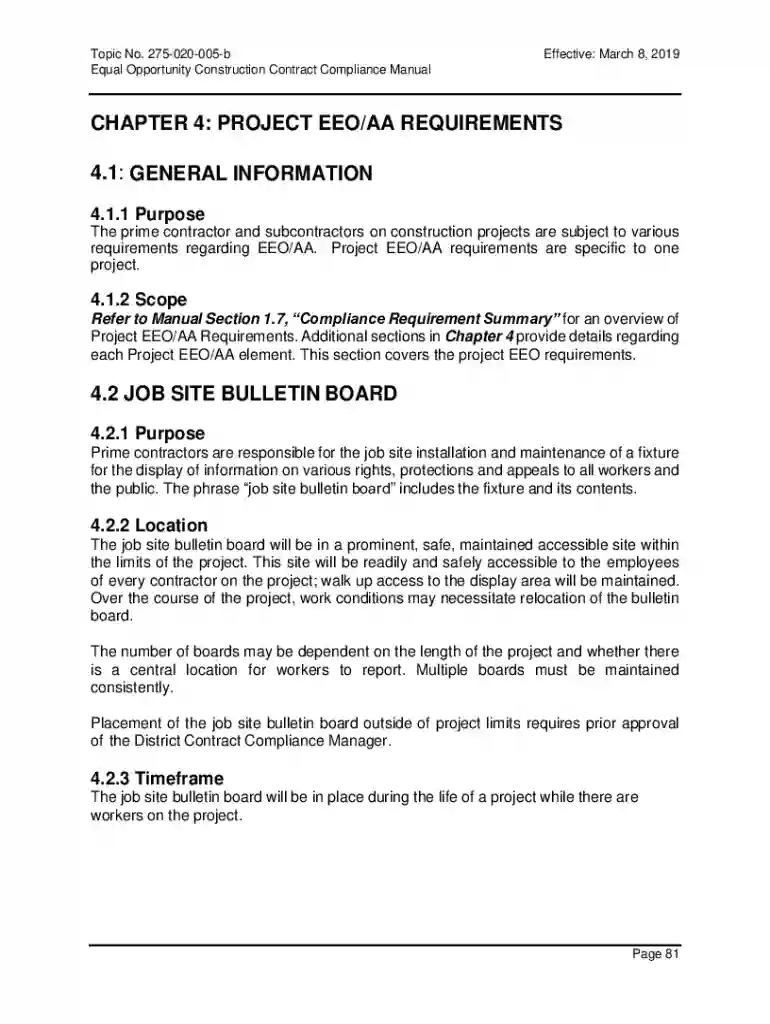
The "FL DOT Chapter 4: Project EEO AA Requirements" is an essential component of construction projects to ensure compliance with Equal Employment Opportunity (EEO) and Affirmative Action (AA) standards. This manual includes specific obligations for both prime contractors and subcontractors. Key elements involve the installation of job site bulletin boards to display necessary information for workers, communication protocols to inform project personnel about their rights, and annual reporting requirements to the Federal Highway Administration (FHWA). It also describes training assessments for compliance staff and procedures for conducting compliance reviews to ensure adherence to EEO standards.
The requirements are applicable across various real-world scenarios within construction projects. For example, a prime contractor working on a state highway project might implement these guidelines by conducting regular training sessions for their compliance officers to better understand EEO mandates. Additionally, subcontractors must ensure that job site bulletin boards are updated with the latest EEO information to educate workers about their rights.
The manual is mandated by federal law to be part of construction contracts involving federal funding. It assists in maintaining a non-discriminatory work environment. Adherence to the manual's guidelines is not just a contractual obligation but a federal requirement. Non-compliance can result in legal repercussions, including loss of federal funding for projects.
The manual can be accessed through the Florida Department of Transportation's official website. Additionally, contractors involved in federally funded projects often receive this as part of the contractual documentation package from the project owner.
While the fundamental requirements are federally mandated, minor adjustments may exist based on Florida's state regulations. Contractors should stay updated on both federal and state provisions to ensure full compliance.
The manual is primarily utilized by project managers, compliance officers, and legal teams within construction firms handling federally funded projects. It ensures that all parties involved are aware of their responsibilities in promoting EEO and AA initiatives.


Failing to adhere to these guidelines can result in significant penalties, including fines, legal action, and the potential loss of federal funding for projects. Continuous failures to comply can also lead to the disqualification of contractors from future bids on projects requiring federal funding.
Users should incorporate the manual into their project management documentation and compliance procedures. Regular updates and training sessions are vital to ensuring every staff member understands their role in compliance. Proper documentation and adherence to outlined procedures will help minimize risks associated with non-compliance.
Regular compliance reviews should be conducted to ensure that all procedures meet the set standards. Contractors are required to submit comprehensive annual reports detailing compliance activities to the FHWA, ensuring transparency and accountability.
These elements provide the basis for a thorough understanding and implementation of the FL DOT Chapter 4 requirements, crucial for maintaining compliance and promoting an equitable workplace environment within construction projects.
We've got more versions of the FL DOT Chapter 4: Project EEO AA Requirements form. Select the right FL DOT Chapter 4: Project EEO AA Requirements version from the list and start editing it straight away!
At DocHub, your data security is our priority. We follow HIPAA, SOC2, GDPR, and other standards, so you can work on your documents with confidence.