01. Edit your form online
Type text, add images, blackout confidential details, add comments, highlights and more.

Type text, add images, blackout confidential details, add comments, highlights and more.

Draw your signature, type it, upload its image, or use your mobile device as a signature pad.

Send it via email, link, or fax. You can also download it, export it or print it out.
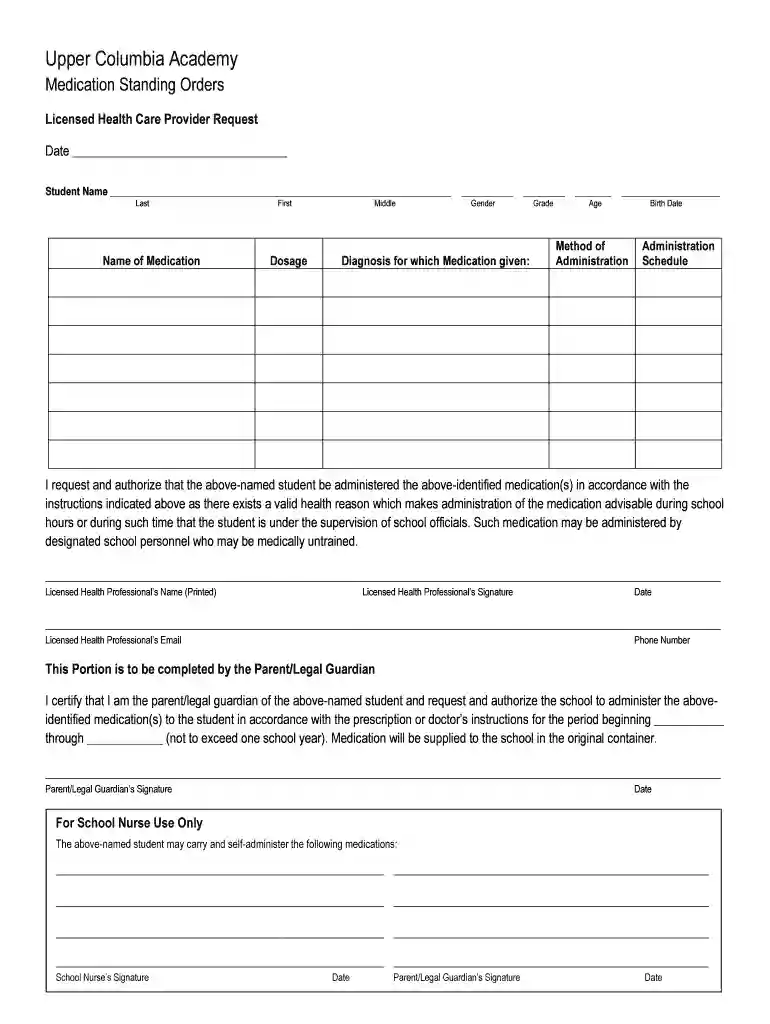
Medication Standing Orders, particularly at Upper Columbia Academy (UCAA), are standardized protocols that allow licensed healthcare providers to prescribe certain medications that can be administered by non-physician staff members in specific settings. These orders ensure that students receive necessary treatments during school hours efficiently and safely. By establishing clear guidelines, these orders simplify the process of providing medications, especially in routine or emergency situations, ensuring consistent care quality across the institution.
Medication Standing Orders play a vital role in a school setting by streamlining the medication administration process. They provide a comprehensive framework that aligns with medical and educational policies, ensuring both compliance and safety. Understanding this structure is crucial for both healthcare practitioners and school staff who engage in medication administration.
To effectively use the Medication Standing Orders at UCAA, it's important to follow the detailed steps provided within the order. These steps typically involve assessing the student's health condition, confirming parental consent, and ensuring the medication prescription fits within the established standing orders.
Regular training sessions are recommended for staff members to stay updated on the procedures and any changes to the standing orders.
The Medication Standing Orders can typically be requested from the UCAA health administration. They are usually distributed to parents, guardians, and authorized school personnel to ensure everyone involved understands the procedures and responsibilities.
Understanding how to obtain these orders ensures that parents and school staff are well-informed about the processes and can access this critical information when needed.
Completing the Medication Standing Orders involves filling out several sections, which usually include details about the student, the medication, and consent for administration. Here's a detailed guide:
Completion of these orders accurately is vital to maintain student safety and ensure compliance with school and health regulations.
Each Medication Standing Order contains several critical elements that provide structure and clarity for medication administration:
Understanding these elements is crucial for the safe and effective implementation of the standing orders, as it helps prevent errors and ensures adherence to medical best practices.
The legal framework surrounding the Medication Standing Orders ensures compliance with state and federal regulations regarding medication administration in educational settings. These orders provide legal protection for school staff administering medications, as long as they adhere to the documented procedures.
Legal use ensures that all participants, from healthcare providers to school staff, operate within a framework that protects students' health and complies with regulatory standards.
Consider the scenario of a student experiencing an asthma attack during school hours. The Medication Standing Orders may include:
Such real-world examples emphasize the practical utility of standing orders and illustrate their application in daily school lives, ensuring student health is continuously monitored and managed effectively.
Each state may impose different rules for the administration of medication in schools, affecting how UCAA implements its standing orders. It's vital for parents and school personnel to understand these regulations:
Awareness and understanding of these state-specific rules help ensure that the standing orders at UCAA are executed legally and efficiently, minimizing the risk of regulatory breaches.
At DocHub, your data security is our priority. We follow HIPAA, SOC2, GDPR, and other standards, so you can work on your documents with confidence.