01. Edit your form online
Type text, add images, blackout confidential details, add comments, highlights and more.

Type text, add images, blackout confidential details, add comments, highlights and more.

Draw your signature, type it, upload its image, or use your mobile device as a signature pad.

Send it via email, link, or fax. You can also download it, export it or print it out.
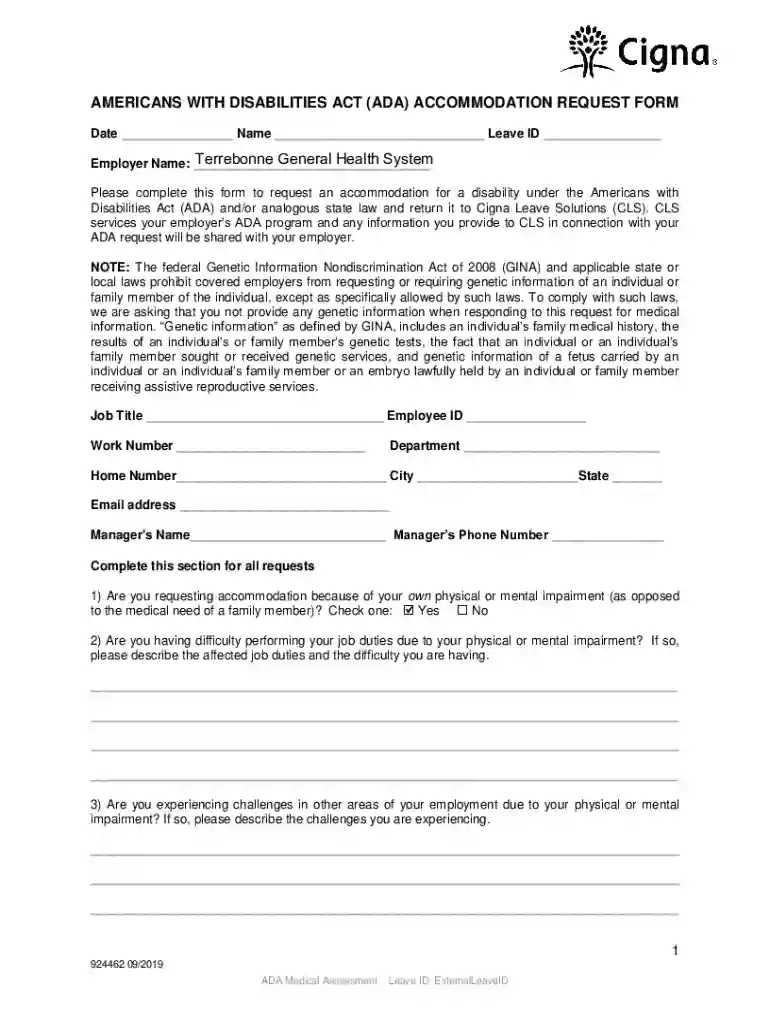
The Americans with Disabilities Act (ADA) Accommodation Request Form is an essential document designed for employees in the United States who require adjustments in their workplace due to a disability. This form allows employees to formally request modifications, ranging from equipment changes to altered work schedules, that facilitate their performing job functions effectively. Enacted as part of the broader ADA legislation, the form underscores an employer's legal obligation to provide reasonable accommodations unless doing so would cause undue hardship.
When utilizing the ADA Accommodation Request Form, it is critical to adhere to a structured approach to facilitate smooth processing. Employees should begin by clearly detailing their personal information, followed by a comprehensive description of their disability and how it impacts their work. It is essential to articulate specific accommodations being requested, ensuring clarity to avoid potential misunderstandings. If required, employees may need to provide additional documentation, such as medical records or a healthcare provider questionnaire, to validate their requests.
The form is structured to cover critical elements necessary for an effective accommodation request. This includes sections for:
Several key terms are crucial in understanding and completing this form:
The ADA Accommodation Request Form serves a dual purpose: providing employees with a mechanism to formally request necessary workplace adjustments and ensuring employers comply with the ADA legislation. Completing and processing this form protects both parties. Employers are advised to maintain confidentiality, respecting the sensitive nature of disclosed information in accordance with federal privacy laws. Failure to adequately address accommodation requests can lead to legal disputes, potentially resulting in litigation or penalties against the employer.
Consider an employee with a visual impairment requiring screen reader software to complete computer-based tasks. By using the form, this employee can request the installation of assistive technology, ensuring effective job performance. Another example could involve an employee with a chronic condition requesting flexible work hours to manage medical appointments. In both cases, the form provides a documented channel for requests, facilitating a legally compliant and supportive work environment.
Generally, this form is utilized by employees who experience physical or mental challenges affecting their job performance. It is also employed by human resources departments, managers, or supervisors tasked with assessing and fulfilling accommodation requests. Organizations use it as part of their compliance framework, ensuring they follow the ADA's mandate to provide equitable employment opportunities.


While the ADA is a federal law, some states have specific regulations that may influence how accommodations are processed. For instance, states like California have more stringent disability laws, expanding the definition of what constitutes a disability and providing broader protections for employees. It is imperative that both employees and employers are aware of any state-specific mandates that may affect the accommodation request process, ensuring that all legal obligations are met comprehensively.
Employees eligible to use the form must meet certain criteria. They need to have a qualifying disability as defined by the ADA and must be capable of performing the essential functions of the job, with or without accommodation. The disability must have a substantial effect on one or more major life activities or employment duties. To solidify their request, employees might need to provide medical evidence or documentation confirming their condition.

The ADA Accommodation Request Form may require supporting documents to verify the need for accommodations. These often include medical documentation from a healthcare provider, which outlines the nature of the disability and its impact on job performance. In some cases, employers might request a job description to better understand the essential functions that may be affected. All submitted documents should be up-to-date and relevant to the accommodation request, ensuring they adequately support the claim for modifications.
At DocHub, your data security is our priority. We follow HIPAA, SOC2, GDPR, and other standards, so you can work on your documents with confidence.