






Definition and Meaning
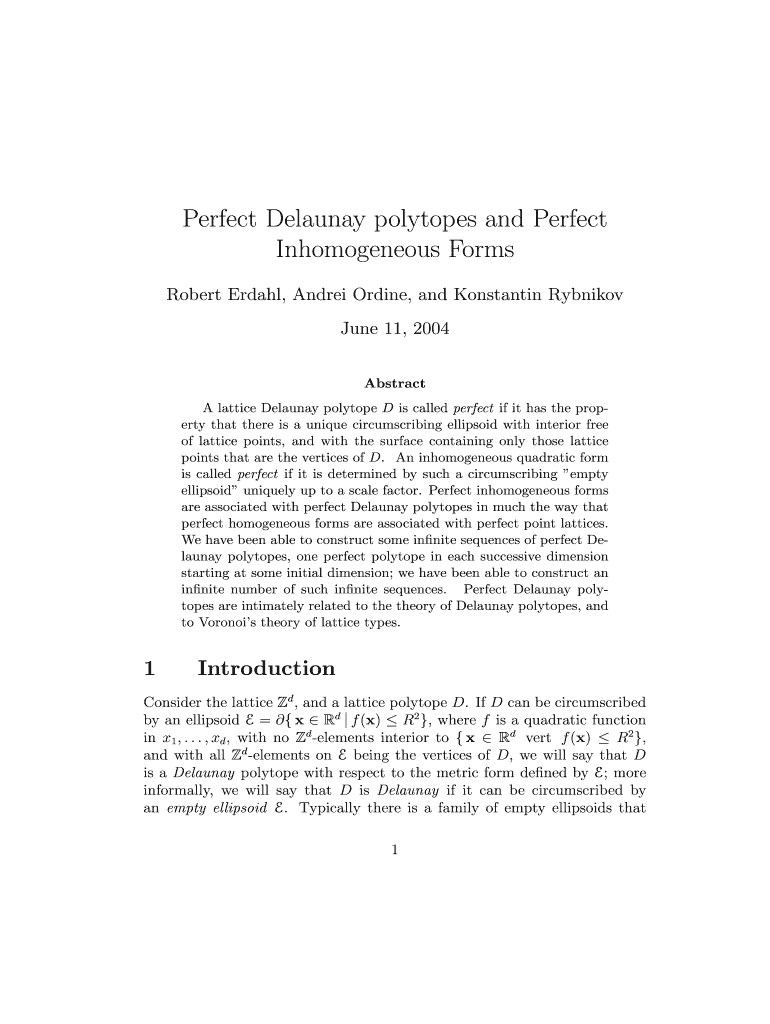
Perfect Delaunay polytopes are a specific class of lattice polytopes that are uniquely circumscribed by an empty ellipsoid with certain properties regarding lattice points. These structures are deeply connected to inhomogeneous quadratic forms, allowing for the exploration of mathematical relationships in geometry, particularly in Voronoi and Delaunay tilings. The concept is significant for understanding the classification and properties of these geometric formations across various dimensions.
How to Use the Perfect Delaunay Polytopes and Perfect Inhomogeneous Forms
To effectively use the concepts of Perfect Delaunay polytopes and Perfect Inhomogeneous Forms, it is essential to:
- Identify the Lattice Structure: Understand the lattice's configuration to recognize perfect Delaunay polytopes and their relation to empty ellipsoids.
- Analyze Quadratic Forms: Examine related inhomogeneous quadratic forms that can help in constructing these polytopes.
- Application in Geometry: Utilize them to explore geometric relationships in Voronoi and Delaunay tilings, which are crucial for applications in crystallography and computer graphics.
Steps to Complete the Perfect Delaunay Polytopes and Perfect Inhomogeneous Forms
Completing forms involving perfect Delaunay polytopes entails several steps:
- Assemble Required Information: Gather data about the lattice configuration and properties.
- Follow Proper Classification Techniques: Use classification criteria to differentiate between various polytopes.
- Validation through Software Tools: Apply computational tools to verify the properties and uniqueness of the polytope construction.
Importance of Perfect Delaunay Polytopes and Perfect Inhomogeneous Forms
Perfect Delaunay polytopes hold substantial importance due to their roles in:
- Mathematical Research: Providing insights into high-dimensional geometric structures.
- Practical Applications: Used in areas such as optimization, data science, and physics for simulations and modeling.
- Enhancing Geometric Understanding: Aid in the study of the arrangement and organization of complex structures.
Who Typically Uses the Perfect Delaunay Polytopes and Perfect Inhomogeneous Forms
These concepts are predominantly used by:
- Mathematicians: For solving advanced problems in lattice theory and geometry.
- Physicists: To model crystalline structures and material science phenomena.
- Computer Scientists: Particularly in fields like computational geometry and CAD software development.


Examples of Using the Perfect Delaunay Polytopes and Perfect Inhomogeneous Forms
Several scenarios showcase the application of these polytopes:
- Crystallography: Analyzing crystal lattice structures to predict material properties.
- Optimization Problems: Solving complex problems involving multidimensional data sets for efficient resource allocation.
- 3D Modeling: In graphics and visualization, enhancing the realism and accuracy of virtual environments.
Key Elements of Perfect Delaunay Polytopes and Perfect Inhomogeneous Forms
Understanding key elements is critical:
- Lattice Points: Integral part of defining the structure of Delaunay polytopes.
- Circumscribing Ellipsoid: Unique geometric feature that helps in their identification.
- Quadratic Forms: Provide the mathematical framework to construct and classify these polytopes effectively.
Legal Use of Perfect Delaunay Polytopes and Perfect Inhomogeneous Forms
Legal considerations for using these forms may include:
- Compliance: Ensuring that any application or publication adheres to scientific standards and ethical considerations.
- Intellectual Property: Managing the rights associated with discoveries or software based on these mathematical forms, particularly in commercial applications.
Software Compatibility for Perfect Delaunay Polytopes and Perfect Inhomogeneous Forms
Certain software tools are compatible to assist with these forms:
- Mathematica and MATLAB: Commonly used for performing the necessary calculations and visualizations.
- CAD Software: For creating and testing 3D models based on Delaunay polytopes.
- Data Analysis Platforms: Use computational geometry algorithms to process and analyze complex datasets involving these structures.