






Definition & Meaning
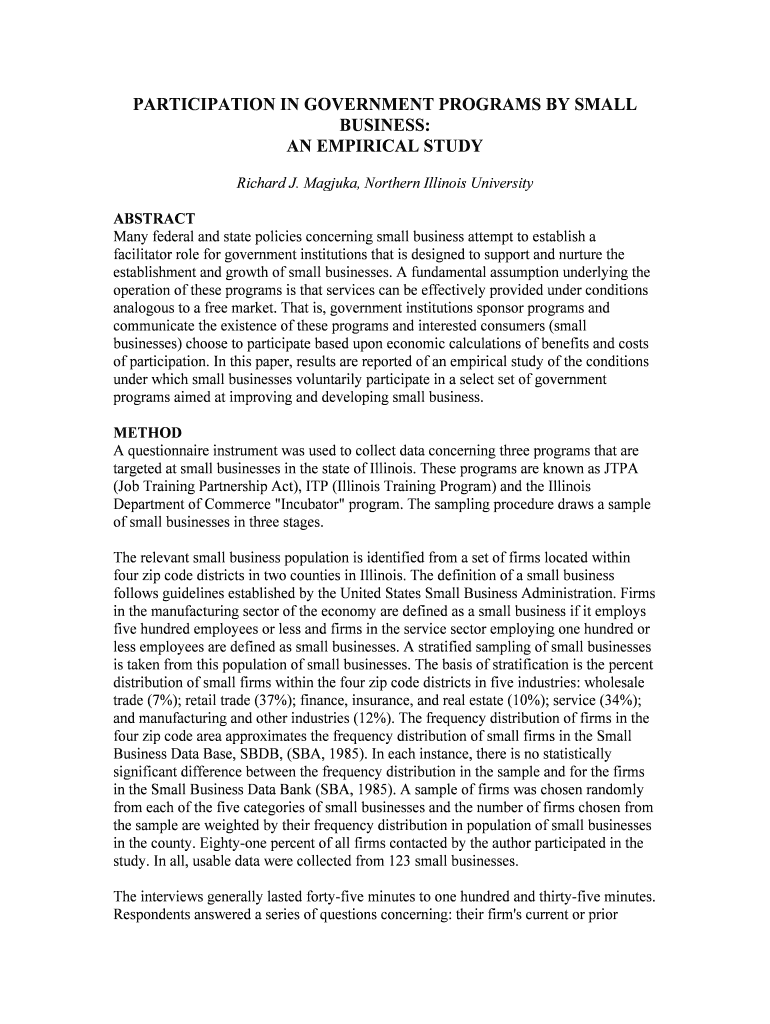
The form "An empirical study - Small Business Advancement National Center" (SBANC) is a comprehensive document that delves into the participation of small businesses in government programs aimed at fostering their growth. The study places specific emphasis on the Job Training Partnership Act (JTPA), Industrial Technology Program (ITP), and Incubator programs in Illinois. It provides insights into how these programs are perceived and utilized by small businesses, emphasizing the vital role of informal communication networks over purely economic factors in driving program participation.
How to Use the An Empirical Study - Small Business Advancement National Center
Utilizing the SBANC study involves understanding the data contained within regarding small business awareness and participation in government programs. The document serves as an informational guide for analyzing factors influencing small business engagement with various government initiatives. By reviewing this empirical study, businesses can gain insights into how connections with larger firms might increase awareness and involvement in these programs. Moreover, policymakers and researchers can use the study to tailor initiatives that bridge the gap between small businesses and available resources.
Steps to Complete the An Empirical Study - Small Business Advancement National Center
- Review Program Data: Start by examining the data related to JTPA, ITP, and Incubator programs. Pay close attention to participation rates and factors influencing engagement.
- Analyze Informal Networks: Assess the effectiveness of informal communication networks in increasing program awareness among small businesses.
- Evaluate Business Connections: Consider the influence of a small business's connections to larger firms on their likelihood to participate in government programs.
- Identify Key Findings: Highlight significant conclusions, such as the low awareness rate (28%) of these programs among small businesses.
- Strategize Implementation: Based on the study's insights, develop strategies for increasing program awareness and participation within the small business community.
Key Elements of the An Empirical Study - Small Business Advancement National Center
- Program Participation Data: Detailed statistics on how many small businesses are aware of and participate in the JTPA, ITP, and Incubator programs.
- Influence of Business Networks: Analysis of how connections with larger firms can affect small business engagement with government initiatives.
- Role of Informal Networks: Exploration of the significance of non-economic communication pathways in promoting program awareness.
- Challenge of Economic Assumptions: The study challenges the notion that economic factors are the sole drivers of small business program participation.
Who Typically Uses the An Empirical Study - Small Business Advancement National Center
The study is predominantly utilized by researchers, policymakers, and small business advisors. Researchers use it to analyze trends and factors affecting small business participation in government programs. Policymakers refer to it for crafting policies that enhance program accessibility and effectiveness. Small business advisors leverage the insights to guide their clients in exploring and taking advantage of available governmental support programs.


Important Terms Related to An Empirical Study - Small Business Advancement National Center
- JTPA (Job Training Partnership Act): A federal program aimed at improving employment through training programs.
- ITP (Industrial Technology Program): A government initiative focusing on the development of advanced technologies within industries.
- Incubator Program: Provides support services and resources to early-stage companies to accelerate their growth.
Examples of Using the An Empirical Study - Small Business Advancement National Center
- Case Study: A small tech startup in Illinois using the study to understand how their peers are engaging with the ITP for technological advancement support.
- Research Project: A policy researcher examining how informal networks impact program participation to propose new communication strategies.
- Workshop Material: Small business development centers using insights from the study to educate entrepreneurs about available government programs and effective networking.
Digital vs. Paper Version
In the context of the SBANC study, digital versions offer greater accessibility and ease of analysis compared to paper formats. The digital format allows researchers and policymakers to quickly identify trends, compare data points, and share findings with broader audiences. Organizations often opt for digital versions to allow easy updates and distribution among stakeholders, enhancing collaborative efforts to increase small business program participation.
Eligibility Criteria
For small businesses looking to participate in the government programs discussed in the SBANC study, eligibility often includes being registered and operating within specific sectors like technology or manufacturing, among others. Additional criteria might involve size constraints, revenue limits, or specific operational years. Understanding these eligibility requirements is crucial for small businesses to determine their qualification for these growth-oriented government initiatives.

Application Process & Approval Time
The application process for participating in the JTPA, ITP, or Incubator programs typically involves submitting business information, demonstrating eligibility, and outlining specific needs or goals that align with program objectives. Approval times vary based on program type, application completeness, and the volume of applications received. Generally, businesses should prepare for a multi-week to multi-month timeline from submission to approval.
Business Types That Benefit Most From An Empirical Study - Small Business Advancement National Center
Businesses in technology, manufacturing, and early-stage startups stand to benefit significantly from the insights provided in the SBANC study. These entities can leverage the data to refine their strategies for engaging with government programs aimed at technological adoption, workforce development, and early-stage growth support.