01. Edit your form online
Type text, add images, blackout confidential details, add comments, highlights and more.

Type text, add images, blackout confidential details, add comments, highlights and more.

Draw your signature, type it, upload its image, or use your mobile device as a signature pad.

Send it via email, link, or fax. You can also download it, export it or print it out.
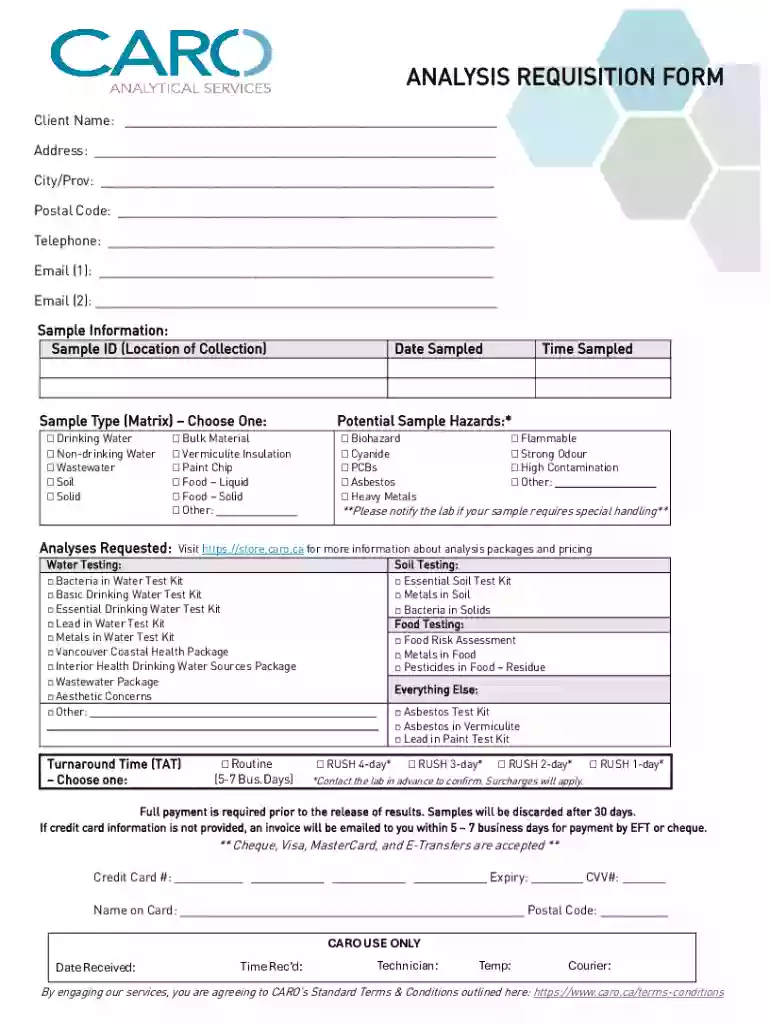
The Analysis Requisition Form is a critical document used primarily in laboratory settings, specifically for requesting analyses of samples, such as water quality testing. It serves as a structured method for clients to communicate their testing needs to a laboratory like CARO Analytical Services. The form captures essential information that enables accurate processing and timely results. A well-completed Analysis Requisition Form includes client details, sample specifics, and desired analyses, ensuring clear instructions for laboratory personnel. This document is fundamental in achieving precise evaluation outcomes and maintaining a seamless workflow within analytical testing environments.
To use the Analysis Requisition Form effectively, follow a sequential approach to ensure all necessary information is captured. Begin by completing the client section with personal or organizational details, such as name, contact information, and billing address. Next, elaborate on the sample information, which includes the type, quantity, and origin of the samples being submitted. This helps the laboratory understand the context and any specific handling requirements. The section on requested analyses must be detailed, specifying which tests need to be conducted and any particular methods to be employed. Finally, review the form for completeness, ensuring that all fields are filled accurately to facilitate efficient sample processing.
The Analysis Requisition Form contains several crucial elements that facilitate the sample analysis process. It starts with client identification fields that gather basic contact and billing information. Subsequently, the form includes a section for sample details, capturing critical data such as sample type, volume, collection date, and any known hazards associated with the sample. A field dedicated to requested analyses allows the client to specify the exact tests and preferred processing methods. Additionally, there are sections for turnaround time preferences and payment method selection, both significant in aligning laboratory services with client expectations. Understanding and accurately filling each element is essential for a streamlined laboratory testing process.
Completing an Analysis Requisition Form is a structured process that ensures all required information is provided. Begin by assembling all necessary documentation, including client details and sample data. Fill out the client information section thoroughly, ensuring names, addresses, and contact numbers are accurate. Next, provide comprehensive details about the samples, listing each type, quantity, and any handling notes. Specify the analyses you wish to conduct, using clear language and referencing any applicable standards or methods. Check the appropriate options for turnaround time and payment method. Before submission, double-check each entry for accuracy and completeness, as errors can delay the analysis process.
Familiarity with specific terms associated with an Analysis Requisition Form improves clarity and communication. Key terms include "client details," referring to the section that collects billing and contact information, and "sample information," which encompasses the type, source, and condition of the samples. Another vital term is "requested analyses," which outlines the tests and methods to be executed. "Turnaround time" denotes the preferred duration within which the client expects results, while "payment methods" refer to the options available for settling service fees. Understanding these terms ensures that the form is completed accurately and aligns client expectations with laboratory capabilities.
The users of the Analysis Requisition Form primarily include entities that require specialized laboratory testing, such as environmental agencies, manufacturing companies, agricultural businesses, and water treatment facilities. These organizations rely on accurate sample analysis to inform decision-making, ensure regulatory compliance, and maintain quality control. Additionally, researchers and academic institutions frequently use this form when submitting samples for scientific studies. Each user group benefits from the detailed layout and structured nature of the form, which facilitates a mutual understanding between clients and laboratories, ensuring precise and reliable test results.


The Analysis Requisition Form plays a crucial role in maintaining regulatory compliance within testing operations. It ensures that sample submissions adhere to applicable environmental and safety regulations by capturing comprehensive data on potential hazards and required analyses. The form acts as a formal record of client instructions and laboratory commitments, which can prove essential in legal contexts or audits. Its design supports compliance with legal standards for sample handling and analysis, reaffirming the validity and reliability of results. Organizations must ensure the form is completed accurately to uphold its function as a legally binding document representing ordered laboratory services.
Real-world scenarios can illustrate the practical application and importance of an Analysis Requisition Form. For instance, a water treatment facility may use the form to request testing on water samples to ensure they meet safety standards before distribution to consumers. Agricultural businesses often submit soil samples through this form to identify nutrient levels and optimize crop production. Environmental agencies submit air or water samples for pollutant analysis to enforce environmental regulations. Each example underscores the utility of the form in providing comprehensive instructions that guide laboratories in delivering precise, tailored analyses aligned with specific industry needs.
We've got more versions of the Analysis Requisition Form form. Select the right Analysis Requisition Form version from the list and start editing it straight away!
At DocHub, your data security is our priority. We follow HIPAA, SOC2, GDPR, and other standards, so you can work on your documents with confidence.