01. Edit your form online
Type text, add images, blackout confidential details, add comments, highlights and more.

Type text, add images, blackout confidential details, add comments, highlights and more.

Draw your signature, type it, upload its image, or use your mobile device as a signature pad.

Send it via email, link, or fax. You can also download it, export it or print it out.
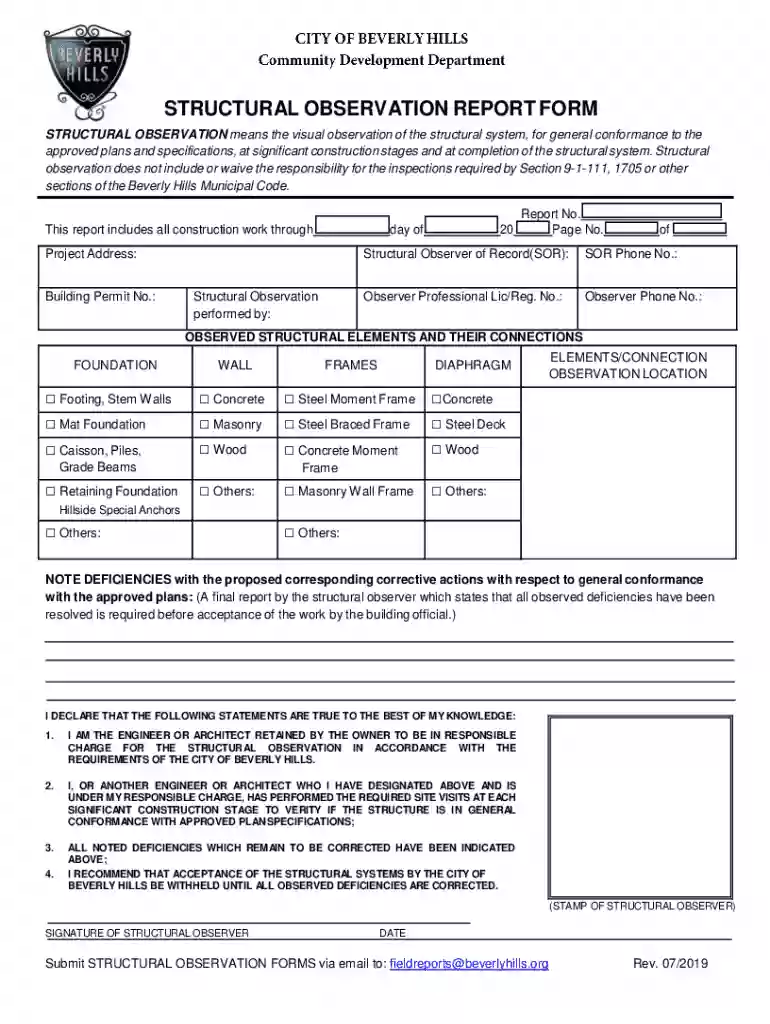
A Structural Observation Report Form in Los Angeles is a critical document used in the construction industry to record and assess the structural components of a building project. This form serves as a detailed record, ensuring that the structural system of a construction project aligns with the approved plans and specifications. It requires input from a qualified Structural Observer of Record (SOR), who documents observed elements and notes any structural deficiencies. This comprehensive process aids in verifying that the construction integrity meets regulatory standards before project completion.
The form is primarily used by licensed structural engineers and architects who serve as the SOR for construction projects. It is also utilized by construction managers and contractors who seek to ensure compliance with structural integrity standards. Additionally, city building inspectors might reference this report during site evaluations to confirm compliance with local regulations.


In Los Angeles, proper completion of this form is not just regulatory but a legal obligation for all licensed professionals involved in construction. It acts as a safeguard, ensuring structures adhere to safety standards and diminishing the risk of future liability claims. Failing to complete this form accurately or timely could result in legal repercussions, such as fines or revocation of professional licenses.
California's building codes require that the report adheres to specific guidelines that vary slightly from other states, emphasizing stricter seismic considerations given the region's propensity for earthquakes. SORs must ensure that all recording, documentation, and observation meet these enhanced seismic and structural standards.
While traditional completion of the Structural Observation Report Form can be manual, platforms like DocHub integrate digital solutions, allowing for easier documentation, editing, and real-time collaboration. Professionals frequently use specialized software like AutoCAD or Revit alongside DocHub for a seamless transfer and integration of digital diagrams and observations, streamlining the overall workflow.
Consider a new commercial building project in downtown Los Angeles. The SOR will utilize the form to document key structural phases, ensuring support beams are correctly positioned as per seismic requirements. If deficiencies are identified, such as an incorrectly positioned beam, the form would guide contractors on necessary adjustments, efficiently handled through digital updates in real-time using document management solutions like DocHub.
We've got more versions of the Structural Observation Report Form - Los Angeles form. Select the right Structural Observation Report Form - Los Angeles version from the list and start editing it straight away!
At DocHub, your data security is our priority. We follow HIPAA, SOC2, GDPR, and other standards, so you can work on your documents with confidence.