CR-112 JV-792 S Judicial Council Form 2026

Get Form
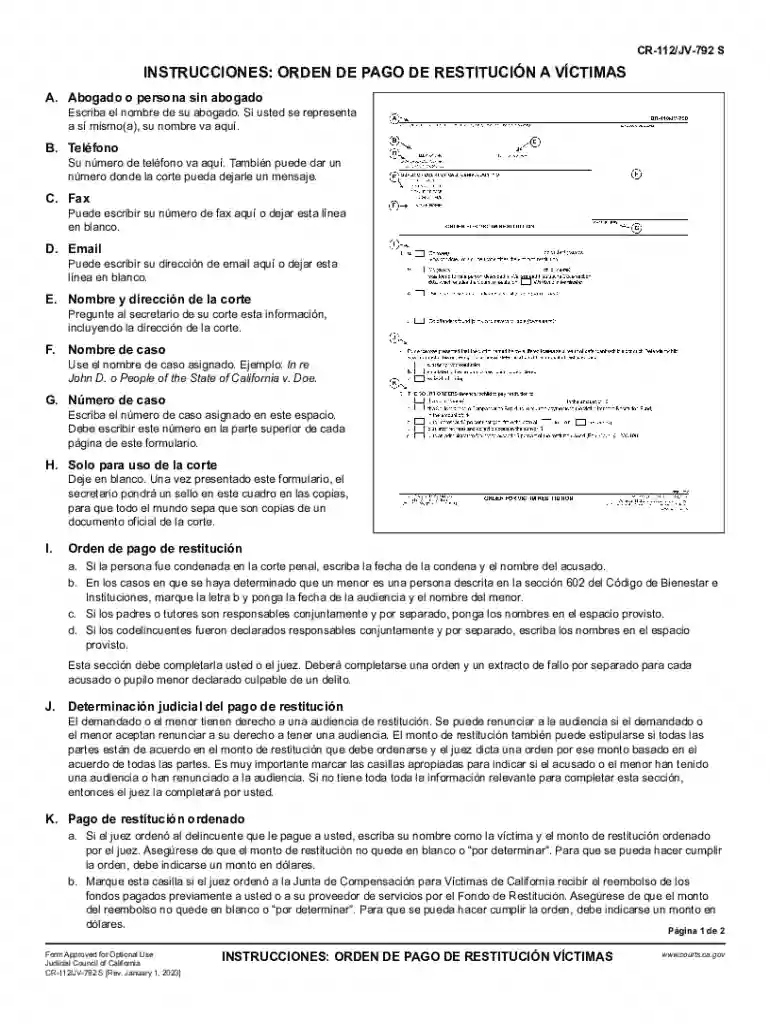
CR-112 JV-792 S Judicial Council Form Preview on Page 1

Here's how it works

01. Edit your form online
Type text, add images, blackout confidential details, add comments, highlights and more.

02. Sign it in a few clicks
Draw your signature, type it, upload its image, or use your mobile device as a signature pad.

03. Share your form with others
Send it via email, link, or fax. You can also download it, export it or print it out.

Definition and Meaning

The CR-112/JV-792 S Judicial Council Form is a legal document utilized within the California court system to address issues related to restitution payments for victims. This form specifically instructs how to complete a court order for restitution, ensuring that all victims receive the financial compensation ordered by the court. This document is necessary in situations where the victim or their attorney must provide detailed information regarding the victim’s losses and the corresponding restitution amount to be ordered by the court.

How to Use the CR-112/JV-792 S Judicial Council Form

Using the CR-112/JV-792 S form requires a clear understanding of its purpose and the requirements it involves. Users should ensure that all sections are completed accurately, detailing the victim’s information, the nature of the loss or damage, and the amount sought for restitution. The form will typically involve:

  1. Identifying information about the victim and the offender.
  2. Detailed description of the crime or incident leading to financial loss.
  3. Documentation to support claims, including billing statements, invoices, or repair estimates.
  4. Information on previous restitution received, if applicable.

Each section must be filled out in accordance with the instructions provided to ensure the victim receives fair consideration by the court.

Steps to Complete the CR-112/JV-792 S Judicial Council Form

Completing this form involves several key steps to ensure accuracy and compliance with California court requirements:

  1. Gather Information: Collect all necessary documents and details about the victim, the incident, and the financial impact.
  2. Record Victim Details: Fill in the personal and contact information of the victim or their representative.
  3. Document Financial Losses: Provide a comprehensive list of damages, expenses, or losses resulting from the incident.
  4. Attach Supporting Evidence: Include relevant receipts, bills, or repair estimates that substantiate the claimed amount.
  5. Verify and Sign: Double-check all entries for accuracy and sign the form to affirm the veracity of the provided information.
  6. Submit to Court: Meet required filing deadlines and submit to the appropriate court handling the restitution case.

Who Typically Uses the CR-112/JV-792 S Judicial Council Form

Generally, individuals or entities directly affected by crime, leading to a financial or material loss, utilize this form. This might include:

  • Victims of personal or property crime.
  • Attorneys representing victims in seeking restitution.
  • Legal representatives acting on behalf of victims or affected parties.

The form serves as a formal mechanism to claim restitution, ensuring victims can outline their losses and justify the requested compensation.


decoration image ratings of Dochub

Important Terms Related to the CR-112/JV-792 S Judicial Council Form

Understanding the terminology used in the CR-112/JV-792 S form is essential for accurate completion:

  • Restitution: Monetary compensation ordered by the court for the victim.
  • Victim: The individual or entity suffering loss or damage due to another's actions.
  • Restitution Order: A court mandate detailing the exact amount to be paid to the victim.
  • Supporting Documentation: Evidence required to justify the restitution amount claimed.

Each term has specific legal implications and must be appropriately addressed in the form to ensure effective restitution.

Legal Use of the CR-112/JV-792 S Judicial Council Form

The legal framework supporting the CR-112/JV-792 S form is rooted in ensuring fair and just compensation within the California courts. The form:

  • Must be used in compliance with California Judicial Council guidelines.
  • Is only valid within the context of legal proceedings concerning restitution.
  • Relies on truthful and accurate information, as falsifying details may lead to legal repercussions.

This form is designed to protect victim rights, streamline restitution processes, and enforce court orders effectively.

Key Elements of the CR-112/JV-792 S Judicial Council Form

The form contains several crucial elements that must be carefully addressed:

  • Claimant Information: Details of the person or entity seeking restitution.
  • Incident Description: Overview of the events leading to the claim.
  • Restitution Calculation: Detailed accounting of losses with corresponding amounts.
  • Certification and Signature: Declaration verifying the honesty and accuracy of provided information.

Each section of the form must be completed comprehensively to meet legal standards and facilitate the restitution process.

Examples of Using the CR-112/JV-792 S Judicial Council Form

Practical examples highlight how the CR-112/JV-792 S form is used:

  • Personal Injury: A victim of a hit-and-run accident seeks restitution for medical bills and loss of income, utilizing the form to document expenses tied to the injury.
  • Property Damage: A homeowner whose property was vandalized fills out the form to claim repair costs, attaching invoices and repair estimates as verification.

In each scenario, the form acts as a formal request for restitution, guiding victims in detailing their financial losses for assessed compensation.

State-Specific Rules for the CR-112/JV-792 S Judicial Council Form

Understanding state-specific guidelines is crucial for the effective use of this form within California:

  • Filing Procedures: Must comply with regional court requirements regarding submission and deadlines.
  • Supportive Documentation: Follow specific rules on acceptable evidence, depending on local jurisdiction standards.
  • Court Contact Points: References listed for queries or guidance relating to form completion.

Adhering to these state-directed rules ensures that the process of restitution is transparent, fair, and legally sound within California's jurisdiction.

be ready to get more

Complete this form in 5 minutes or less

Get form

Got questions?

We have answers to the most popular questions from our customers. If you can't find an answer to your question, please contact us.
Contact us
Restitution attempts to address both victims tangible needs, by reimbursing them for crime- related costs, and their emotional needs, by acknowledging that they were harmed and deserving of reparation.
The victim compiles a list of economic losses and documentation and provides a restitution request to the prosecuting agency. The victim advocate notifies opted-in victims of their rights and assists the victim with referrals to agencies and services that can assist with victims needs.
This reimbursement is called restitution, and it may be ordered for lost income, property damage, counseling, medical expenses, funeral costs or other financial costs directly related to the crime.
Be specific as possible when listing the damages you suffered and/or the items you lost. You must enclose copies of bills, receipts, estimates, employer statement verifying missed work days, and any other documents that will assist the court. Attach additional sheets if necessary.
Restitution is a court-ordered payment by offenders to their victims to cover the victims economic losses resulting from the crime.

Security and compliance

At DocHub, your data security is our priority. We follow HIPAA, SOC2, GDPR, and other standards, so you can work on your documents with confidence.

Learn more
ccpa2
pci-dss
gdpr-compliance
hipaa
soc-compliance
be ready to get more

Complete this form in 5 minutes or less

Get form

People also ask

Reparations can docHubly improve the victims everyday life, allowing them to resume their existence: getting a new house when their old one has been burnt down, or accessing healthcare to cure the sequels of torture or sexual violence.

Related links