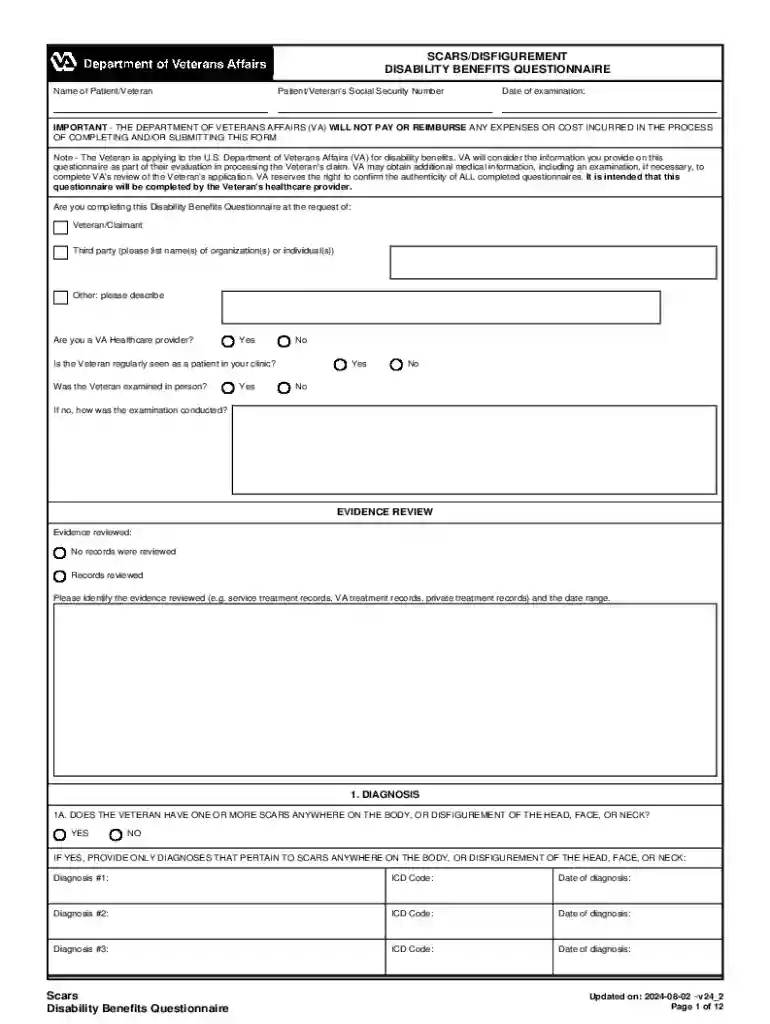
SCARS DISFIGUREMENTDISABILITY BENEFITS QUESTIONNAIRE 2026

Get Form
SCARS DISFIGUREMENTDISABILITY BENEFITS QUESTIONNAIRE Preview on Page 1

Here's how it works

01. Edit your form online
Type text, add images, blackout confidential details, add comments, highlights and more.

02. Sign it in a few clicks
Draw your signature, type it, upload its image, or use your mobile device as a signature pad.

03. Share your form with others
Send it via email, link, or fax. You can also download it, export it or print it out.

Definition and Purpose of the Scars Disfigurement Disability Benefits Questionnaire

The Scars Disfigurement Disability Benefits Questionnaire is designed for Veterans applying for disability benefits related to scars or disfigurement. It serves to provide a structured format for collecting comprehensive and detailed information about the physical condition. This form is crucial because it standardizes the information required by Veterans Affairs (VA) evaluators, ensuring consistency and clarity when assessing eligibility for benefits related to cosmetic injury or disfigurement. The form is typically utilized by medical professionals examining the Veteran, capturing details about how scars or disfigurations impact functionality or cause discomfort.

Key Elements of the Questionnaire

The form is composed of distinct sections that gather various types of information essential for evaluating the severity and impact of scars or disfigurement:

  • Patient Information: Collects basic details about the veteran, including full name, Social Security Number, and service details.
  • Evidence Review: A designated space for medical professionals to record prior medical evidence and documentation reviewed before the examination.
  • Diagnosis of Scars: Allows the physician to specify the type and extent of scars or disfigurements present.
  • Medical History: Captures the patient's past medical history relevant to the condition, which can include prior surgeries or trauma that led to the current disfigurement.
  • Physical Examination Details: Provides space for objective findings from the physical examination, such as the location of scars, texture, color, and any noted functional limitations.

Steps to Complete the Scars Disfigurement Disability Benefits Questionnaire

Completing the questionnaire requires a collaborative effort between the veteran and a qualified medical professional:

  1. Patient Information Section: The veteran fills out personal details and service information.
  2. Medical Evidence Review: The healthcare provider examines prior medical records before the patient examination.
  3. Conducting the Physical Examination: The physician assesses the affected areas, noting attributes like size, texture, and impact on daily functioning.
  4. Recording the Findings: All examination details, including subjective reports from the veteran and objective observations, are documented.
  5. Submitting the Form: Upon completion, the form is submitted to VA for evaluation, meeting necessary deadlines and supplementing with additional documentation if required.

Who Typically Uses the Scars Disfigurement Disability Benefits Questionnaire

The form is predominantly used by Veterans seeking disability benefits for service-connected scars or disfigurements. It is completed by healthcare professionals — typically VA-appointed doctors or Veterans' private doctors who are familiar with VA requirements. The process is a crucial step for veterans needing to highlight how disfigurements adversely impact their quality of life and ability to perform daily activities.


decoration image ratings of Dochub

Eligibility Criteria for Completing the Questionnaire

Eligibility to submit the Scars Disfigurement Disability Benefits Questionnaire typically involves:

  • Veteran Status: Applicants must be military veterans or personnel whose scars or disfigurements are believed to be service-connected.
  • Medical Assessment: A valid medical diagnosis concerning the scars or disfigurement, often supported by medical evidence or history.
  • Functional Impact: The condition must affect functionality or qualify as disfiguring under VA criteria to be eligible for benefits.
decoration image

Legal Use and Compliance

The questionnaire is not only a clinical assessment tool but also a legal document used to substantiate claims for disability benefits. Compliance with VA guidelines during its completion ensures the accurate representation of the veteran's condition and the legal standing of the claim. Failure to complete it properly or to submit necessary supporting documents could delay benefits or result in denial of the claim.

Required Documents and Form Submission Methods

To accompany the questionnaire and ensure comprehensive evaluation and decision:

  • Medical Records: Prior surgical records or documents detailing the injury/incident that caused the disfigurement.
  • Supporting Evidence: Photographs or imaging studies that clearly show the extent of the scars or disfigurement.
  • Submission Options:
    • Mail: Hard copies can be sent directly to the VA office.
    • Online: Digital submissions, if supported by DocHub or other VA platforms.
    • In-Person: Physically submitting the form at VA facilities, ensuring receipt confirmation.

Examples and Practical Scenarios

Veterans who have undergone significant surgical procedures resulting in disfigurement or those with prominent scars from service-related incidents often utilize the questionnaire to formalize claims. For example, a veteran with burn scars affecting facial movements would go through a medical assessment to document the degree of functional impairment using this form, which then serves as direct evidence supporting the benefits claim.

be ready to get more

Complete this form in 5 minutes or less

Get form

Got questions?

We have answers to the most popular questions from our customers. If you can't find an answer to your question, please contact us.
Contact us
If you suffer tissue loss and gross distortion or asymmetry of one of the aforementioned features, or if you have two or three characteristics of disfigurement, then your disability rating is 30%. If you experience one characteristic of disfigurement, this has a disability rating of 10%.
Yes, a scar can be considered a form of disfigurement, especially if it docHubly alters a persons appearance.
Yes, scars can qualify as a VA disability if they result from service-related injuries or medical treatment. The VA evaluates scars based on their severity, symptoms, and impact on function to determine the appropriate disability rating.
Disfigurements are not automatically considered disabilities, but they can have disabling effects that qualify them as such. Amputations are an example of this, and so is facial damage that negatively affects speech.
Disfigurement is when a person has a scar, burn, skin texture, a missing body limb or a differently shaped body part that affects that persons appearance. Disfigurement may also lead to emotional or psychological distress over the concern of looking different from others.

Security and compliance

At DocHub, your data security is our priority. We follow HIPAA, SOC2, GDPR, and other standards, so you can work on your documents with confidence.

Learn more
ccpa2
pci-dss
gdpr-compliance
hipaa
soc-compliance
be ready to get more

Complete this form in 5 minutes or less

Get form

People also ask

2025 Pay Rates for 30% 60% Disability Rating Dependent Status30% Disability Rating60% Disability Rating Veteran (No Dependents) $537.42 $1,395.93 Veteran with Spouse (No Dependents) $601.42 $1,523.93 Veteran with Spouse and 1 Child $648.42 $1,617.93 Veteran with 1 Child $579.42 $1,480.9311 more rows
A rating of 80% means that the veterans impairments are considered substantial, docHubly impacting their overall functional capacity. To docHub an 80% disability rating, veterans typically have multiple service-connected conditions, each rated at varying levels of severity.
The VA evaluates scars based on characteristics like length, width, color, texture, and underlying tissue damage, assigning disability ratings from 10% to 80%. Severe scars on the head, face, or neck with substantial disfigurement or tissue loss can receive higher ratings, up to 80%.

Related links