01. Edit your form online
Type text, add images, blackout confidential details, add comments, highlights and more.

Type text, add images, blackout confidential details, add comments, highlights and more.

Draw your signature, type it, upload its image, or use your mobile device as a signature pad.

Send it via email, link, or fax. You can also download it, export it or print it out.
The term "form online" refers to digital versions of traditional paper forms that are accessible through the internet. These forms are generally used for various purposes such as applications, data collection, legal documentation, and surveys. By allowing users to fill out, submit, and often sign the forms digitally, online forms streamline processes by reducing the need for physical paperwork and facilitating quicker data processing.
Using an online form is generally straightforward, but it involves certain steps to ensure accuracy and completeness. Here’s a systematic approach to using them effectively:
Completing an online form involves distinct phases, each crucial for successful submission. Here's a detailed guide:
Preparation and Planning: Gather necessary documents and information before starting, especially for complex forms such as tax applications.
Step-by-Step Completion:
Verification and Submission:
Choosing to use online forms offers numerous advantages that make them an appealing option for many users:
Efficiency and Speed: Online forms are processed more quickly than paper forms, reducing waiting times.
Cost-Effective: Using digital forms eliminates printing and mailing costs.
Accessibility: Accessible from any internet-enabled device, enhancing convenience and flexibility.
Error Reduction: Automated form checks often reduce manual errors, enhancing data accuracy and reliability.
Security Benefits: Advanced encryption methods protect user data during transfer and storage.
Understanding specific terminology related to online forms is vital for effective use:
Fillable Fields: Sections of the form where user inputs are required, including text boxes, dropdowns, and radio buttons.
Digital Signature: An electronic form of a handwritten signature used to authenticate the document.
Encryption: The process of encoding data to protect it from unauthorized access.
Authentication: Security measure to verify identity, often through passwords or two-factor authentication.
Submission Acknowledgment: Confirmation received post-submission, which might include a tracking number or a copy of submitted details.
Online forms comprise several components designed to facilitate user interaction and data collection:
User Interface: The design and layout, including form fields, navigation buttons, and instructional text.
Validation Rules: Operational scripts that ensure only correct and relevant data are captured in fields.
Responsive Design: Compatibility across devices, including mobile, tablet, and desktops.
Backend Processing: Systems that manage data storage and retrieval once forms are submitted.
User Support Services: Help systems and FAQs designed to aid users experiencing issues with form submission.
Online forms are employed in a wide array of scenarios, each tailored to specific needs:
Ensuring legal compliance when using online forms is crucial, especially for documents requiring personal information:
Compliance Standards: Forms should adhere to relevant laws such as the ESIGN Act, which provides legal recognition of electronic signatures.
Privacy Regulations: Compliance with privacy laws, like HIPAA for healthcare forms, ensures sensitive data protection.
Audit Trails: Many systems maintain detailed logs showing form access and modification history.
Disclosure Requirements: Online forms must often include details about data usage and consent.
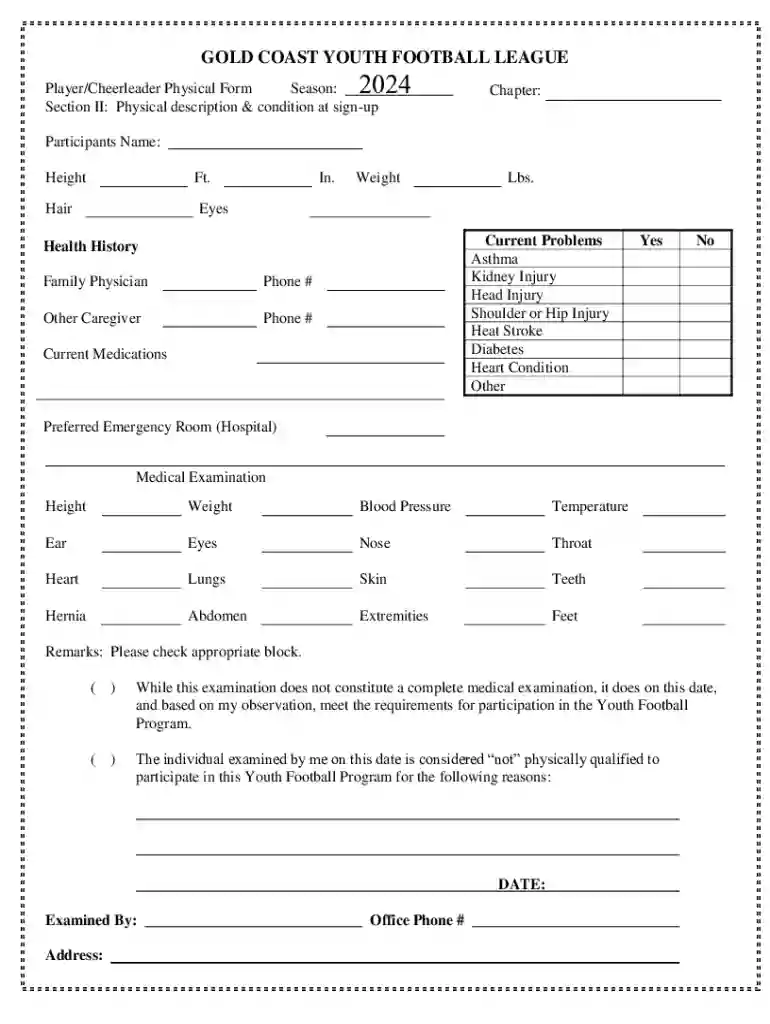
We've got more versions of the Player Cheerleader Physical Form form. Select the right Player Cheerleader Physical Form version from the list and start editing it straight away!
At DocHub, your data security is our priority. We follow HIPAA, SOC2, GDPR, and other standards, so you can work on your documents with confidence.