01. Edit your form online
Type text, add images, blackout confidential details, add comments, highlights and more.

Type text, add images, blackout confidential details, add comments, highlights and more.

Draw your signature, type it, upload its image, or use your mobile device as a signature pad.

Send it via email, link, or fax. You can also download it, export it or print it out.
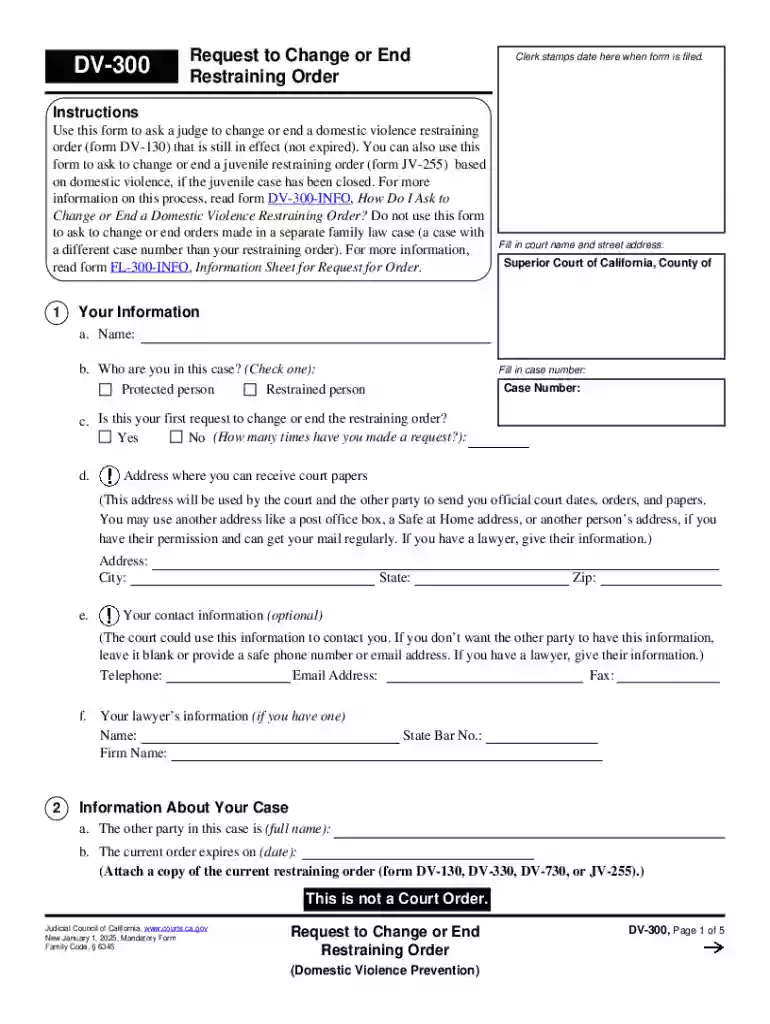
The DV-300 form is a legal document used in California to request a judge to change or terminate an existing domestic violence restraining order. It serves a critical role in allowing individuals to formally petition for modifications to the terms of protection orders. Understanding the purpose of the DV-300 is essential, as it directly affects the legal obligations and protections of both the petitioner and the respondent. Typically, individuals who have obtained a domestic violence restraining order but wish to revise its terms, either due to changed circumstances or resolved conflicts, utilize this form.
Obtaining the DV-300 form is a straightforward process. Interested individuals can access the form through several channels, including:
Completing the DV-300 requires careful attention to detail and adherence to specified instructions. The following steps outline the completion process:
Section for Personal Information: Begin by providing your full legal name, address, and any relevant contact information. Ensure accuracy to avoid processing delays.
Case Details: Include the original case number, date, and any prior documents associated with the restraining order.
Specific Requests: Clearly state your request to change or end the restraining order and provide detailed reasons supporting this request.
Reasons for the Request: Explain why the modification or termination is necessary, perhaps due to reconciled relationships or no longer perceived threats.
Signature and Date: Ensure the form is signed and dated appropriately, a step vital for the form's validity.
The legal use of the DV-300 is governed by specific California statutes. Filing this form mandates compliance with local legal protocols and includes serving the other party involved in the restraining order.
Serving the Opposing Party: After submission, the petitioner must ensure that the respondent is formally notified of the filing through appropriate legal channels.
Filing Protocols: Consists of submitting the filled form to the appropriate court handling the original restraining order.
There are several critical terms and concepts associated with the DV-300 form that users should familiarize themselves with:
Restraining Order: A legal order issued by a court to protect an individual from harassment, stalking, or physical violence.
Petitioner: The person submitting the request for the modification or termination of the existing order.
Respondent: The individual whom the restraining order was originally filed against.
Not everyone qualifies to file a DV-300. The prevailing eligibility requirements typically include:
Current Valid Restraining Order: Must have an existing restraining order actively in place.
Change in Circumstances: There should be a valid change in circumstances warranting a request to alter the terms.
No Pending Appeals: Ensures that the case isn’t subject to review or appeals that could influence the decision.


Understanding the key elements of the DV-300 ensures comprehensive and correct completion. These include:
Statement of Changes: Clearly enumerates the proposed changes to the order.
Supporting Evidence: Any documentation supporting the need for changes should be attached.
Verification: Most sections require explicit confirmation of truthfulness by the petitioner.
There are multiple methods for submitting the DV-300, which include:
In-Person: Submit the form directly to the clerk’s office at the courthouse.
Mail: Mailing the completed form to the relevant court can also be a valid filing method.
Online Submission: Some jurisdictions may offer electronic submission options for ease of filing.
Each submission method requires checking specific court rules and guidelines to ensure proper filing and acceptance of the form. Knowing the relevant details and procedures ensures the effective and timely processing of the request.
We've got more versions of the Dv-300 form. Select the right Dv-300 version from the list and start editing it straight away!
| Versions | Form popularity | Fillable & printable |
|---|---|---|
| 2025 | 4.1 Satisfied (37 Votes) |
At DocHub, your data security is our priority. We follow HIPAA, SOC2, GDPR, and other standards, so you can work on your documents with confidence.