01. Edit your form online
Type text, add images, blackout confidential details, add comments, highlights and more.

Type text, add images, blackout confidential details, add comments, highlights and more.

Draw your signature, type it, upload its image, or use your mobile device as a signature pad.

Send it via email, link, or fax. You can also download it, export it or print it out.
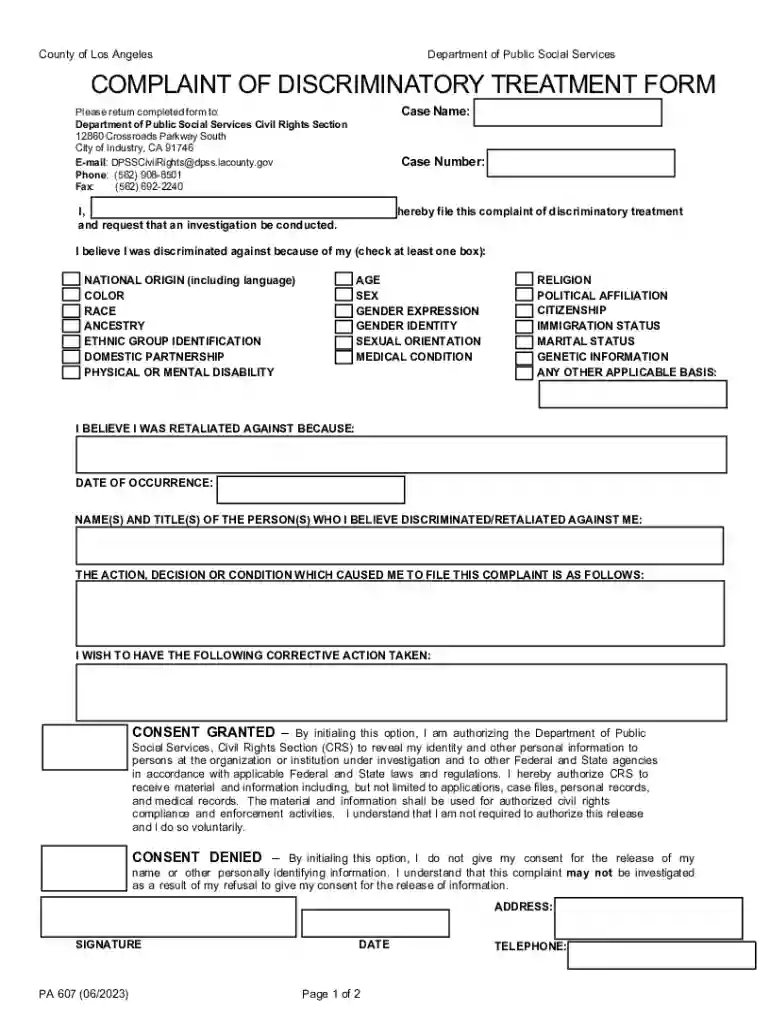
The Complaint of Discriminatory Treatment Form is a structured document used to formally report incidents of discrimination within various contexts. This form allows individuals to detail specific instances where they believe they have experienced unfair treatment based on protected characteristics such as race, gender, age, disability, or religion. It serves as a crucial tool for documenting grievances and initiating an official examination or investigation into the reported conduct. By using this form, individuals can ensure their complaints are formally acknowledged and processed by appropriate authorities, such as the County of Los Angeles Department of Public Social Services.
Personal Information: Begin by entering personal details such as your name, address, and contact information. Accurate contact information is vital for follow-up and resolution.
Description of Incident: Provide a comprehensive account of the discriminatory event, including dates, location, and names of those involved. Be as detailed as possible to facilitate proper evaluation.
Type of Discrimination: Clearly specify the type or basis of discrimination—such as race, gender, or disability. This categorization aids in the appropriate handling and routing of the complaint to the correct department or personnel.
Supporting Evidence: Attach any supporting documents or evidence like emails, witnesses, or prior complaints that may strengthen the validity of your claim.
Signature and Date: Conclude by signing and dating the form to affirm that the information provided is true and accurate to the best of your knowledge.
Individuals who believe they have faced discriminatory treatment are the primary users of this form. This includes employees in various organizations, students, consumers, and other participants in environments where anti-discrimination policies are enforced. The form is vital for those who seek to initiate a formal investigation into claims of workplace discrimination, denial of public services, or biased treatment in educational settings. Ensuring access to the form plays a pivotal role in both protecting rights and promoting accountability within institutions.


Each component of the form is tailored to gather pertinent information systematically, which aids institutions in conducting thorough investigations and determining the next steps in addressing the complaint.
The Complaint of Discriminatory Treatment Form is an instrument protected under various state and federal laws, including Civil Rights Act provisions. Filing this form triggers legal obligations for an investigation and response from the entity receiving it. Importantly, users of the form are shielded from retaliation, ensuring that reporting discrimination does not lead to further victimization. The legal framework surrounding this form underscores its role in safeguarding individual rights and promoting fair treatment.
Availability of multiple submission methods enhances accessibility, ensuring that all individuals can report discrimination without technological or logistical barriers.
To effectively support the complaint, document submission is essential. Common documents include:
These documents substantiate claims and facilitate a more effective review process, increasing the potential for a satisfactory resolution.
Understanding key terms is essential for those completing the form:
Grasping these concepts ensures that complainants accurately capture and communicate the nature of their complaint within the form.
We've got more versions of the Complaint of Discriminatory Treatment Form form. Select the right Complaint of Discriminatory Treatment Form version from the list and start editing it straight away!
At DocHub, your data security is our priority. We follow HIPAA, SOC2, GDPR, and other standards, so you can work on your documents with confidence.