




01. Edit your a 0546 gf english online
Type text, add images, blackout confidential details, add comments, highlights and more.

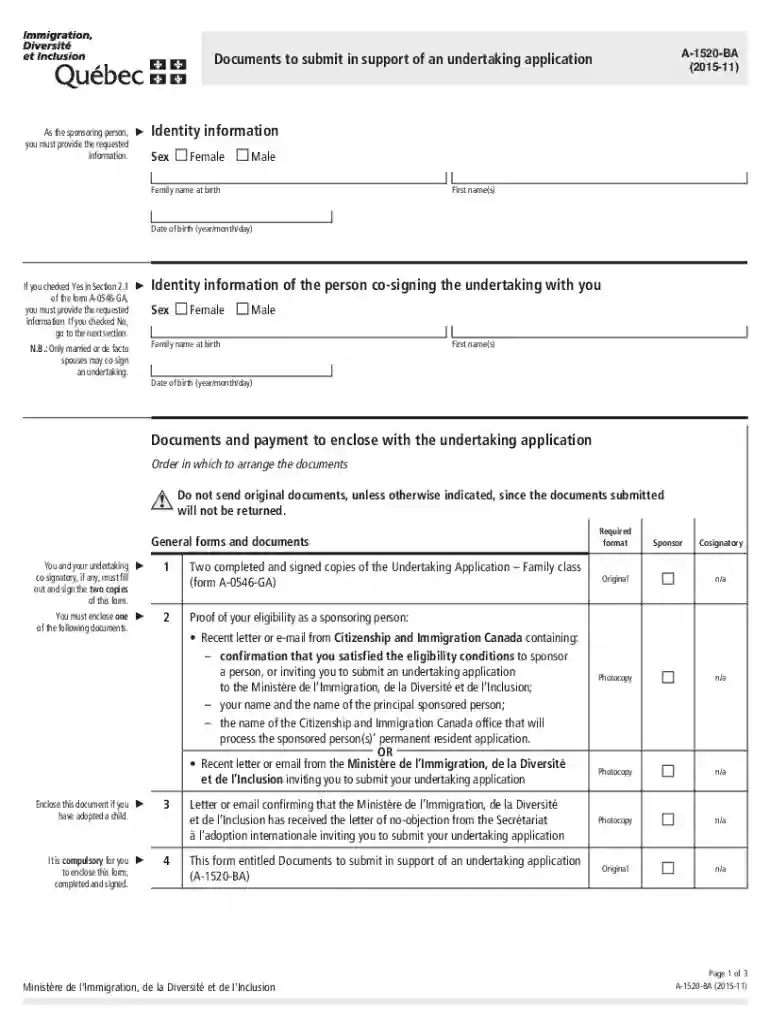
Type text, add images, blackout confidential details, add comments, highlights and more.

Draw your signature, type it, upload its image, or use your mobile device as a signature pad.

Send a 1520 via email, link, or fax. You can also download it, export it or print it out.
The term "English BF" lacks a direct association with a specific legal or tax document. However, if we were to infer, it might relate to forms that involve bilingual English-French documentation, commonly used in regions with bilingual policies, such as Canada. These documents typically require completion in both English and French to comply with linguistic mandates.
Organizations or individuals often use these types of forms to ensure compliance with local language laws, provide accessible information to speakers of both languages, and maintain transparency in documentation processes. If "English BF" is a placeholder or shorthand for another term, the broader context will define its exact meaning.
Utilizing a dual-language form, potentially like "English BF," requires attention to specific language sections. Here are essential steps for effectively completing and submitting such forms:
Bilingual Completion: Ensure that all sections of the form are filled out in both English and French. This might involve translating responses to ensure consistency across both language entries.
Language Accuracy: Use professional translation services if necessary to maintain the accuracy of terms and phrases, as minor errors in translation can result in compliance issues or misinterpretation.
Consistent Responses: Check for consistency between the two language sections to avoid discrepancies that may raise questions or cause processing delays.
Acquiring the "English BF" form, if referring to a bilingual document, may involve the following steps:
Online Platforms: Government or official websites in bilingual regions often offer downloadable versions of these forms. Check national or provincial portals for access.
Local Government Offices: Forms can typically be obtained directly from relevant local offices or service centers that handle bilingual documentation.
Request by Mail: For those unable to access online platforms, a written request to the issuing authority may facilitate receiving a paper version by mail.
Completion of a form labeled as "English BF" likely entails these steps:
Read Instructions Thoroughly: Before starting, ensure you understand all instructions provided in both languages to avoid mistakes.
Gather Required Documentation: Have all necessary supporting documents accessible for reference and attachment as needed.
Fill Out Bi-Lingual Sections: Carefully enter all required data in both the English and French portions of the form.
Review for Errors: Verify that both language sections are completely filled and accurate to prevent rejection or delays.
Submit According to Instructions: Follow the specific submission guidelines provided, which may vary depending on whether submission is online, by mail, or in person.
The usage of "English BF" forms is common among:
Residents of Bilingual Regions: Citizens or permanent residents in areas like Quebec in Canada, where government forms are required in both languages.
Businesses: Companies operating in bilingual regions must often use these forms for regulatory compliance in local business operations and communications.
Immigrants and Sponsors: Individuals engaging in immigration processes that touch bilingual territories may need to use such formats in their applications.


When dealing with "English BF" or similar documentation, understanding particular terminology is crucial:
Translation Equivalents: Ensure terms like "social insurance number" and its French equivalent "numéro d'assurance sociale" are used correctly.
Bi-linguistic Mandates: Awareness of legal requirements for language use in forms enhances compliance and accuracy.
Certification: If applicable, certification of translations by official bodies might be required for submission acceptance.
Legal contexts for using "English BF" forms may involve:
Compliance with Language Policies: Ensuring adherence to mandated bilingual documentation practices in multilingual regions.
Official Proceedings: Using the form correctly for government submissions, contract agreements, or legal documentation that necessitates dual-language use.
Court Acceptance: Preparing documents for use in legal proceedings where bilingual submission is mandated.
There can be regional variations in bilingual form requirements:
Quebec's Language Laws: These laws require documentation in both languages, featuring specific guidelines regarding structure and content.
Federal vs Provincial: Differences may exist between federal requirements for bilingual forms and those required at provincial levels.
Formatting Standards: Regional or state-specific standards may dictate the layout and presentation of bilingual documents, requiring adherence to prescribed templates and formatting rules.
Through comprehending and applying the outlined details of the "English BF" form usage and structure, individuals and entities can ensure effective completion and submission, aligning with necessary regional demands and facilitating smooth processing and acceptance.
We've got more versions of the a 0546 gf english form. Select the right a 0546 gf english version from the list and start editing it straight away!
At DocHub, your data security is our priority. We follow HIPAA, SOC2, GDPR, and other standards, so you can work on your documents with confidence.





This poem is compelling, and I kept rereading it, in part because the poem seems simplistic when it is actually complex and rich in its emotion and structure.Read more
Released 11/25/2023. I decided to make a relaxed song about how the world kind of mistreated Mei and Boyfriend, mainly inspired by the panel of a younger


