







Definition and Meaning
The "E-# and form-ox-st - hss caltech" is a specialized document utilized primarily within academic and research environments, specifically linked to the California Institute of Technology (Caltech). This form is typically related to research methodologies and preferences in economic models, particularly focusing on consumer preferences and demand analysis. It encapsulates various theoretical frameworks and mathematical formulations that help in understanding and analyzing consumer behavior and economic dynamics.
Key Elements of the E-# and Form-Ox-St - HSS Caltech
In the form, several elements are crucial for its application in economic models:
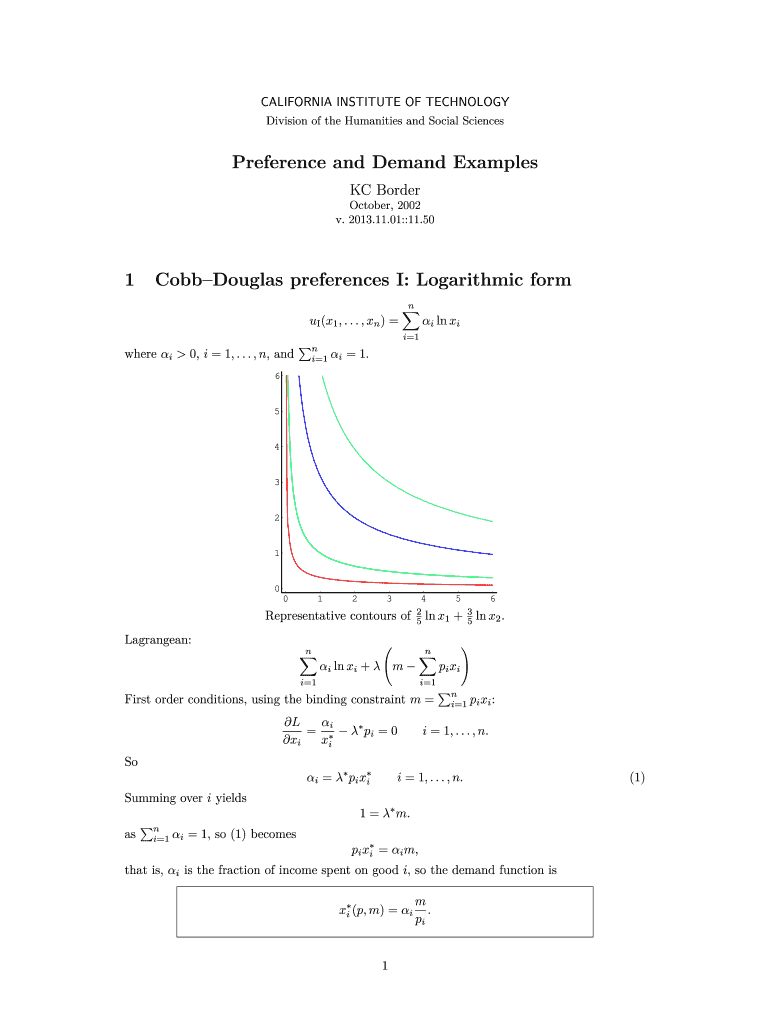
- Cobb-Douglas Preferences: This section highlights both logarithmic and multiplicative forms, providing insights into how resource allocation impacts consumer behavior.
- Quasi-linear Preferences: This element assesses preferences where utility functions include linear and non-linear components, useful for partial separability in preferences.
- Linear Preferences: This provides a straightforward approach to visualize how linear trade-offs impact consumer choice.
- Leontief Fixed-Proportion Preferences: These preferences consider fixed ratios of resource allocation and are essential for fixed input-output analysis.
Each section integrates utility functions, Lagrange formulations, and first-order conditions to create a comprehensive picture of consumer preference modeling.
How to Obtain the E-# and Form-Ox-St - HSS Caltech
Securing this form generally necessitates direct engagement with Caltech's Humanities and Social Sciences (HSS) department. Interested parties often need to be involved in related research or academic pursuits to gain access.
- Institutional Affiliation: Align with Caltech’s research departments or affiliated projects.
- Research Proposal: Submit a detailed proposal outlining your research needs and objectives.
- Formal Request: Complete any necessary formalities through the HSS department communication channels.
Steps to Complete the E-# and Form-Ox-St - HSS Caltech
- Understanding the Structure: Familiarize yourself with the different sections, each of which focuses on specific preference models and economic frameworks.
- Data Preparation: Gather relevant economic data that correlates with the preference models described.
- Mathematical Analysis: Employ the Lagrangean, indirect utility functions, and Roy's identity as described to analyze data.
- Review and Validation: Ensure calculations and formulations align with established equations within the form to maintain accuracy.
- Final Submission: Compile your findings and submit within the stipulated guidelines provided by Caltech.
Practical Examples of Using the E-# and Form-Ox-St - HSS Caltech
- Case Study on Consumer Goods Demand: Utilize the form to assess changes in consumer purchasing patterns under varying economic conditions using Cobb-Douglas preferences.
- Academic Research: Integrate linear and quasi-linear preference models in academic papers to predict changes in market dynamics.
- Policy Analysis: Apply Leontief fixed-proportion models to evaluate how governmental policies affect community economic behavior.
These applications can advance both theoretical understanding and practical policymaking.
Who Typically Uses the E-# and Form-Ox-St - HSS Caltech
This form is predominantly used by:
- Researchers: Engaging in economic research or academic study within institutions such as Caltech.
- Economists: Looking to analyze consumer preferences and demand structures.
- Policy Makers: Assessing economic policies based on consumer behavior predictions.
- Students: Involved in higher degree studies focusing on economic models and theories.


Important Terms Related to E-# and Form-Ox-St - HSS Caltech
- Utility Functions: Representations of consumer satisfaction and choices.
- Lagrangean Formulation: A mathematical approach used to find the maximum or minimum value of functions subject to constraints.
- First-Order Conditions: Conditions derived from setting the first derivative of the utility function to zero for maximizing or minimizing it.
- Indirect Utility Functions: Functions that represent consumer satisfaction based on income and price variations.
- Roy’s Identity: A principle connecting indirect utility functions to demand, crucial for economic analysis.
Each term is foundational for grasping the complex interactions analyzed by the form.
Legal Use of the E-# and Form-Ox-St - HSS Caltech
While largely academic, legal usage includes:
- Compliance with Research Standards: Ensuring that economic analyses conform to specific legal and ethical guidelines set forth by research and academic institutions.
- Intellectual Property Rights: Proper attribution must be given when utilizing the form's methodologies within publications or investigations.
- Data Privacy: When applying this form to real-world datasets, consider privacy laws such as the California Consumer Privacy Act (CCPA) regarding data handling.
Compliance ensures both ethical research practices and legal protection.
Versions or Alternatives to the E-# and Form-Ox-St - HSS Caltech
While the E-# and Form-Ox-St is the primary model, alternatives could include:
- Previous Versions: Older iterations might differ slightly in structure and focus.
- Alternative Economic Models: Different institutions may offer similar tools but with variations in methodology or application focus, like models from MIT or Harvard.
- Supplementary Analytical Tools: Economic software or statistical programs like Stata or R can offer alternative or supportive analytical capabilities.
Exploring these alternatives may provide additional insights or support for complex analyses.




