




01. Edit your form online
Type text, add images, blackout confidential details, add comments, highlights and more.

Type text, add images, blackout confidential details, add comments, highlights and more.

Draw your signature, type it, upload its image, or use your mobile device as a signature pad.

Send it via email, link, or fax. You can also download it, export it or print it out.
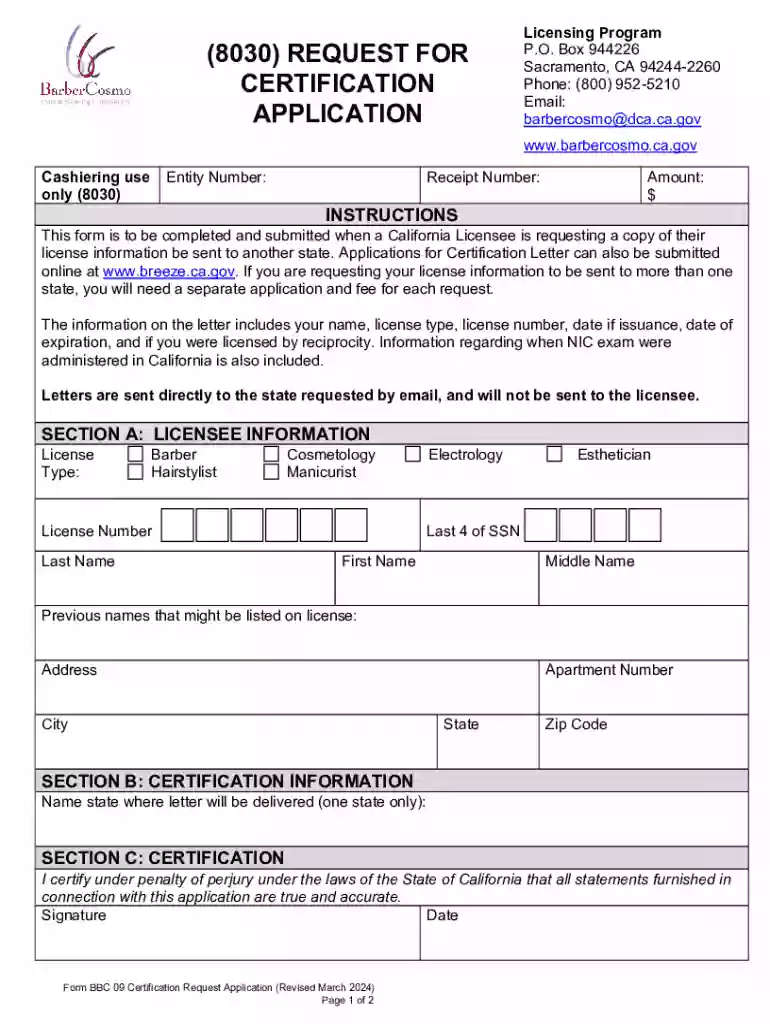
The (8030) Request for Certification Application serves as a formal document for California Licensees who intend to have their license information sent to another state. This application is a crucial step in ensuring that licensees can verify their credentials and qualifications in new jurisdictions. By processing this certification, licensees facilitate the recognition of their professional status when relocating or expanding their practice across state lines. Understanding the purpose of this form is essential for maintaining compliance with state regulations and ensuring smooth cross-state credential transfers.
Licensees using the (8030) Request for Certification Application must follow precise steps to ensure their application is processed efficiently. The form requires detailed personal information, including the applicant's full name, contact details, and professional license number. Once filled out, the application should be reviewed for completeness before submission to avoid delays.
By adhering to these steps, applicants can minimize processing times and ensure their credentials are transmitted accurately to the intended state.
The (8030) Request for Certification Application can be accessed through multiple channels to accommodate user preferences. Typically, the form is available for download from the official website of the California Board of Barbering and Cosmetology. Licensees can choose between downloading a digital copy for print and mail submission or requesting a hard copy through mail services.
Filling out the (8030) Request for Certification Application involves several straightforward steps designed to streamline the process. Missing information or incomplete sections can lead to application rejection, so thoroughness is crucial.
By following these steps meticulously, applicants can ensure that every part of the form is completed correctly, reducing the likelihood of submission errors.
Submitting a (8030) Request for Certification Application is a significant administrative process for professionals seeking to practice in different states. The form not only facilitates legal compliance but also ensures that professionals maintain their credibility and standing in new jurisdictions. Recognizing the importance of this application is vital for career mobility and continuity.
The (8030) Request for Certification Application is typically utilized by a diverse range of professionals within California who are regulated by the Board of Barbering and Cosmetology. These include barbers, cosmetologists, and other personal care professionals who need to verify their credentials in other states.


Understanding the typical user base for this application helps in appreciating its relevance across various professional fields.

The key elements of the (8030) Request for Certification Application focus on specific areas that need accurate information to process the certification request effectively. Understanding these elements is critical for successful form submission.
These elements ensure that the application is not only comprehensive but also precise in addressing the certification needs of the applicant.
The legal use of the (8030) Request for Certification Application involves adherence to state and regulatory guidelines governing professional practice. Licensees must certify that all provided information is truthful and accurate to avoid legal repercussions.
Understanding the legal implications and duties associated with this application ensures applicants meet all regulatory standards and maintain their professional integrity.
We've got more versions of the (8030) REQUEST FOR CERTIFICATION APPLICATION form. Select the right (8030) REQUEST FOR CERTIFICATION APPLICATION version from the list and start editing it straight away!
At DocHub, your data security is our priority. We follow HIPAA, SOC2, GDPR, and other standards, so you can work on your documents with confidence.



Please contact Graduate Admissions at (540) 286-8030 or Email us at graduate@umw.edu, or you can fill out our Request for More Information Form.
This form is to be completed and submitted when a California Licensee is requesting a copy of their license information be sent to another state.
An application group is a collection of reports stored in OnDemand. The reports should have common indexing and storage management requirements. An applicationRead more


