




01. Edit your form online
Type text, add images, blackout confidential details, add comments, highlights and more.

Type text, add images, blackout confidential details, add comments, highlights and more.

Draw your signature, type it, upload its image, or use your mobile device as a signature pad.

Send it via email, link, or fax. You can also download it, export it or print it out.
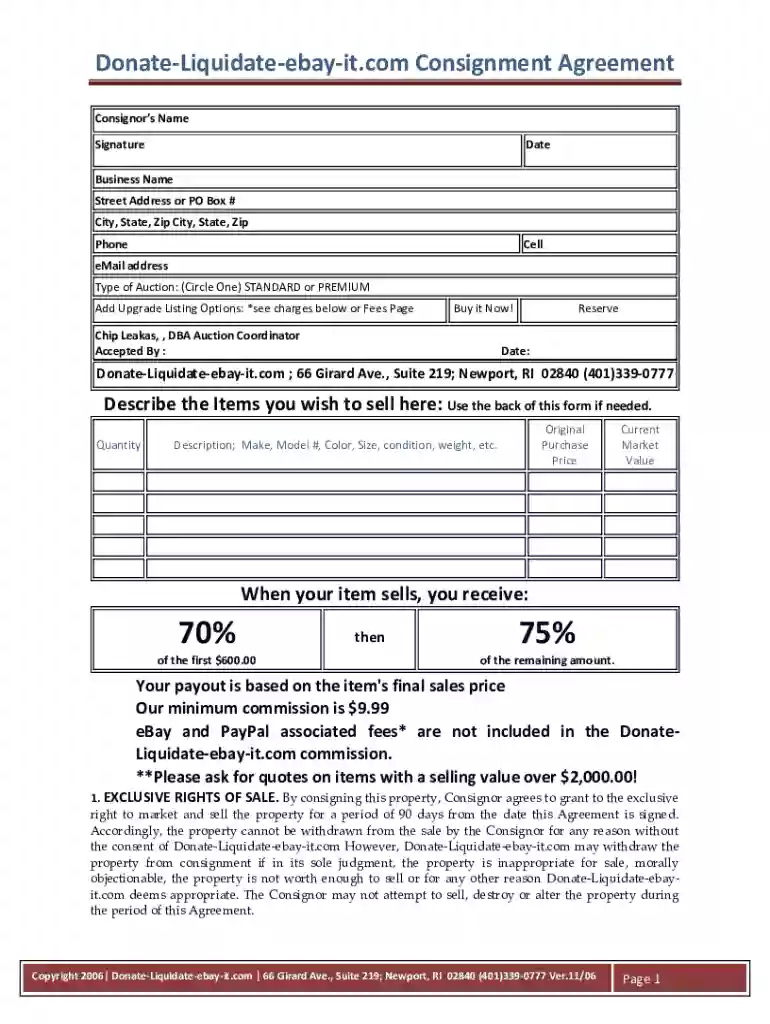
The Donate-Liquidate-ebay-it Consignment Agreement encompasses several critical elements that ensure clarity and mutual understanding between the consignor and the agency. Key elements include:
Commission Structure: Consignors agree to a specified commission rate based on final sale prices through the auction services. This structure ensures that both parties benefit proportionately from successful sales.
Responsibilities: The agreement outlines the duties of both the consignor and the agency, including accurate item documentation, prompt payments, and clear communication channels for any queries or issues that may arise.
Exclusive Rights: By signing the agreement, consignors grant exclusive rights to the company to sell listed items for a period of ninety days. This ensures a focused effort on auctioning items without conflicts from other sales platforms.
Insurance Policies: Details of any insurance coverage provided by the agency for the consigned items during the custody period, safeguarding consignors against unforeseen damages or losses.
Payment and Shipment Process: The procedures for payments, including timing and methods, and the logistics of shipping items post-sale are thoroughly detailed, ensuring a smooth post-sale transition for consignors.
These components work together to create a comprehensive blueprint for consigning items, providing peace of mind and assurance of a professional and organized selling process.
Using the Donate-Liquidate-ebay-it Consignment Agreement effectively involves several steps to ensure all parties understand and comply with the terms:
Review the Agreement: Carefully read through the document to comprehend all stipulated terms. Focus on commission rates, exclusive rights duration, and responsibilities.
Provide Accurate Information: Accurately detail the items being consigned, including condition, value, and any special characteristics. Precise descriptions help in maximizing potential sale prices.
Sign the Agreement: Ensure both parties sign the document, confirming their commitment to adhere to the outlined terms and responsibilities.
Set Up Consignment Timeline: Discuss and agree upon a timeline for when items will be listed and potential auction dates.
Monitor Sales: Actively track the sales process and maintain communication with the agency to ensure transparency and address any questions promptly.
By following these steps, consignors can harness the full potential of the consignment services, maximize sale outcomes, and foster a professional relationship with the platform.
Completing the Donate-Liquidate-ebay-it Consignment Agreement involves a systematic approach to ensure accuracy and compliance:
Initial Consultation: Engage with the agency for an initial consultation to understand the consignment process and assess compatibility.
Prepare Documentation: Gather all necessary documents about the items, including original purchase receipts, appraisals, and photos, to support item descriptions.
Fill Out Agreement Sections: Methodically fill out all sections of the agreement, including consignor details, item information, and any specific terms mutually agreed upon.
Verify Terms: Double-check commission rates, exclusive rights duration, and insurance coverage specified in the agreement to prevent misunderstandings.
Finalize the Agreement: Once verified, sign the document along with the agency representative, solidifying the consignment contract.
These steps aid in an effective agreement completion, ensuring all relevant facets are correctly addressed and acknowledged.
Understanding the legal use of the Donate-Liquidate-ebay-it Consignment Agreement is essential for ensuring that all consignment activities comply with applicable laws:
ESIGN Act Compliance: The agreement may be executed electronically, adhering to the Electronic Signatures in Global and National Commerce Act. This ensures that digital consents are legally binding and reliable.
Conflict Resolution: The agreement typically includes a section on dispute resolution mechanisms, detailing arbitration or mediation processes if conflicts arise.
State Law Adherence: It must comply with the specific state regulations governing consignment sale agreements, ensuring legality across different jurisdictions.
Liability Clauses: Clearly defined liability clauses protect both parties, detailing circumstances under which each would be held accountable for losses or damages.
These legal considerations ensure a robust framework supporting fair and lawful consignment transactions.
This agreement is typically employed by a range of users involved in selling high-value items through consignment services:
Individual Sellers: People looking to sell personal items, such as collectibles, antiques, or luxury goods, often turn to consignment platforms for broader audience reach and professional selling.
Estate Executors: Individuals managing estate sales that require the liquidation of assets through trusted processes benefit from consignment agreements.
Small Business Owners: Retailers or boutique owners seeking to offload inventory efficiently without managing direct sales will find consignment agreements advantageous.
Nonprofit Organizations: Charities looking to sell donated items to fundraise utilize consignment agreements to enhance transparency and reliability in transactions.
These diverse users exemplify the flexibility and value propositions offered by consignment agreements across various selling scenarios.


Key terminology within the Donate-Liquidate-ebay-it Consignment Agreement provides clarity and mutual understanding of consignment proceedings:
Consignor: The individual or entity that owns the items and grants rights to sell them.
Consignee: The company or platform responsible for the sale and management of the consigned items.
Commission: A fee calculated as a percentage of the sale price, rewarded to the consignee for its services.
Appraisal Value: An estimated monetary valuation of an item, based on condition, market demand, and other factors.
Provenance: Documentation or history of an item's origin and ownership, often important for authenticity verification.
Understanding these terms contributes to effective communication and operational coherence in consignment transactions.
Different states may impose distinct regulations impacting the execution of consignment agreements:
Regulatory Oversight: Some states require specific registrations or licenses for businesses offering consignment services, impacting how contracts are executed.
Tax Implications: Varying sales tax enforcement can influence consignment earnings. Understanding state tax requirements helps optimize net profits.
Consumer Protection Laws: States like California implement stringent consumer protection laws, impacting terms related to resale and return policies within consignment agreements.
Contractual Requirements: Legal stipulations regarding the necessary disclosures and agreement formats may vary from state to state.
Being well-versed in these state-specific rules assists in preparing compliant and effective agreements tailored to distinct regional legal frameworks.
Practical examples help illustrate the use of the consignment agreement:
Antique Dealer Scenario: An antique shop utilizes the agreement to consign vintage items. Through clear item descriptions and structured commissions, it facilitates seamless front-end operations, allowing focus on marketing and selling.
Art Collector Case: An art collector consigns a series of paintings. The agreement ensures transparency in sales efforts and provides insurance coverage while the items are listed for auction.
Fashion Retailer Instance: A boutique uses the agreement to shift seasonal inventory. Documenting the exclusive sale rights helps streamline the turnover of collections, aligning with promotional cycles.
These scenarios demonstrate the versatility and operational benefits of employing a well-structured consignment agreement.
We've got more versions of the Donate-Liquidate-ebay-it Consignment Agreement form. Select the right Donate-Liquidate-ebay-it Consignment Agreement version from the list and start editing it straight away!
| Versions | Form popularity | Fillable & printable |
|---|---|---|
| 2006 | 4.9 Satisfied (30 Votes) |
At DocHub, your data security is our priority. We follow HIPAA, SOC2, GDPR, and other standards, so you can work on your documents with confidence.




by M Lovett 2017 The C.A.L.M. Method (Consignment Auction Liquidation Marketing Method) uses auction liquidation as its means of distribution and sale of goods.
Bid and asked quotations are not taken certain information about a donation of any of must be considered. into account. these types of property on Form 8283.Read more


