




01. Edit your application permanent disability online
Type text, add images, blackout confidential details, add comments, highlights and more.

Type text, add images, blackout confidential details, add comments, highlights and more.

Draw your signature, type it, upload its image, or use your mobile device as a signature pad.

Send discharge permanent disability via email, link, or fax. You can also download it, export it or print it out.
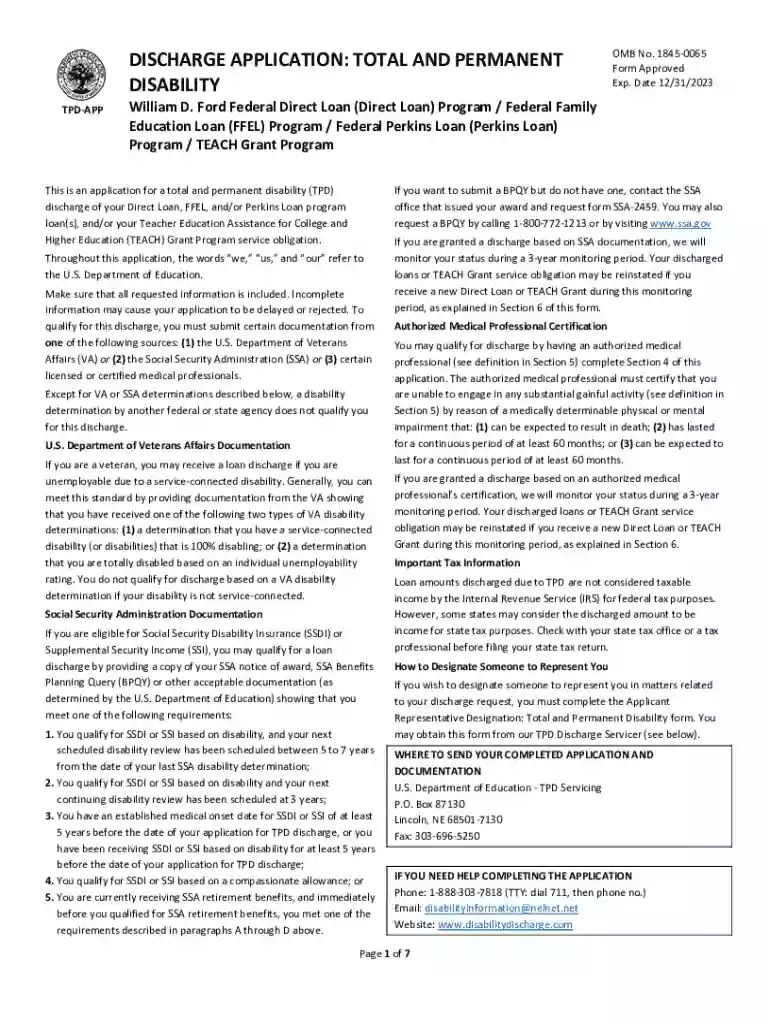
A Discharge Application, in the context of federal student loans and TEACH Grant obligations, is a formal request to cancel debt under specific conditions. It pertains primarily to individuals diagnosed with a Total and Permanent Disability (TPD). This means the applicant is unable to engage in substantial gainful activity due to a physical or mental impairment expected to result in death, last continuously for at least 60 months, or already lasted for 60 months. Understanding its comprehensive usage is crucial for eligible candidates seeking relief from educational debt burdens.
Filling out the Discharge Application involves the following steps:
Obtain the Application: Locate the official form from the appropriate educational or government authority. This may involve downloading it from the U.S. Department of Education's website or obtaining it through related resources.
Understand the Eligibility Criteria: Ensure you meet the TPD criteria. This includes confirmation from the U.S. Department of Veterans Affairs, the Social Security Administration, or a licensed physician.
Collect Required Documents: Gather necessary supporting paperwork, such as medical records, VA documentation, or SSA disability benefits notices (e.g., SSA-1099 for Social Security Disability Insurance).
Complete the Application: Fill in all sections accurately. Provide personal information, contact details, and any information pertinent to your disability status. Double-check for any required fields to avoid processing delays.
Submit the Form: Choose a submission method: mail, online, or in-person. Ensure all sections are complete and that documents are securely attached.
Await Confirmation and Next Steps: Once submitted, tracking the application's status is essential. Be prepared for any follow-up requests for additional information.
The application process requires specific documentation to support claims. These documents include:
These documents play a crucial role in verifying the applicant's eligibility and speeding up the processing time.
Eligible applicants must meet rigorous criteria:
Eligibility must be clearly proven to ensure a successful application and prevent unnecessary delays or rejections.


Understanding the timeline and approval phases is key:
Initial Review: Once submitted, an initial review evaluates completeness and document legitimacy. This stage can take several weeks.
Verification Phase: Authenticity of the provided documents is verified. This phase requires coordination with respective verification bodies.
Decision: Confirmation of eligibility can take months and is followed by either an approval notice or a request for additional information.
Applicants should remain patient and responsive throughout this process to ensure a smooth progression.
Applicants have multiple submission options:
Each method carries its own benefits and drawbacks regarding processing speed and ease of access.
Legally, the Discharge Application provides a method for eligible individuals to seek relief under federal law. Successful completion and approval result in discharge of loan obligations, but applicants must:
Legal compliance is essential for maintaining the integrity and trust within the federal student loan system.
Familiarity with related terminology can aid applicants in navigating this process effectively:
Understanding these terms clarifies the process and reduces potential confusion during application or follow-up communications.
We've got more versions of the application permanent disability form. Select the right application permanent disability version from the list and start editing it straight away!
At DocHub, your data security is our priority. We follow HIPAA, SOC2, GDPR, and other standards, so you can work on your documents with confidence.



Mar 2, 2026 Plasma-based water treatment is a technology that, using only electricity, converts water into a mixture of highly reactive speciesRead more
This is an application for a total and permanent disability (TPD) discharge of your Direct Loan, FFEL, and/or Perkins Loan program loan(s), and/or your Teacher


