01. Edit your form online
Type text, add images, blackout confidential details, add comments, highlights and more.

Type text, add images, blackout confidential details, add comments, highlights and more.

Draw your signature, type it, upload its image, or use your mobile device as a signature pad.

Send it via email, link, or fax. You can also download it, export it or print it out.
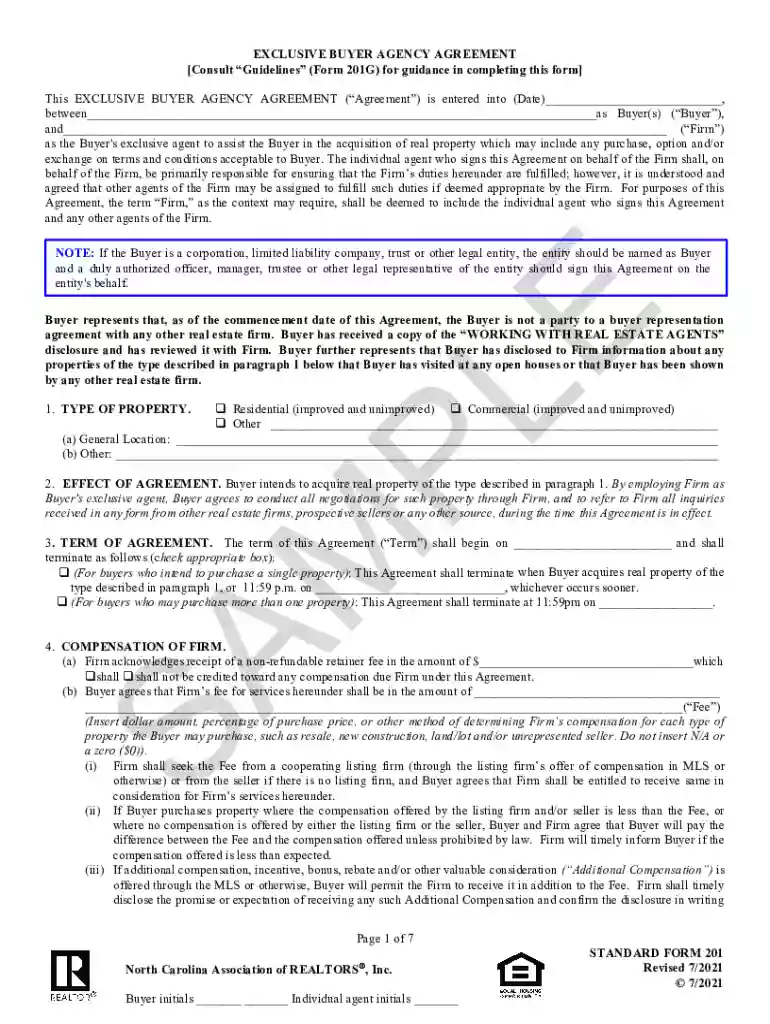
NC Real Estate Forms Contracts are standardized documents used in the state of North Carolina for property transactions. They define the legal terms and responsibilities between parties involved in buying or selling real estate. These forms ensure that transactions comply with state laws and regulations, minimizing the risk of disputes. They commonly cover aspects such as property details, sales price, payment terms, and closing conditions, thereby providing a structured framework for seamless real estate operations.
NC Real Estate Forms Contracts can be accessed through various channels for convenience and compliance. The most direct method is through the North Carolina Association of REALTORS® (NCAR), which offers these documents to its members. Real estate agents often provide these forms to clients involved in a property transaction. Alternatively, they are available through legal or real estate-specific platforms that specialize in state-compliant documentation. Users must ensure that they obtain the latest version to ensure compliance with current legal standards.
Completing the NC Real Estate Forms Contracts involves several critical steps to ensure accuracy and legality.
Each section should be completed with precision to prevent any legal discrepancies or misinterpretations.
These contracts are predominantly used by licensed real estate agents, buyers, and sellers within North Carolina. Real estate attorneys often review these documents to provide legal guidance and ensure that terms comply with state laws. Additionally, real estate investors and developers use these forms to formalize transactions, often involving multiple parties in complex property dealings.


Several components are integral to NC Real Estate Forms Contracts, emphasizing their comprehensive nature:
North Carolina has distinct rules that govern real estate transactions, reflected in these standardized contracts. Adherence to the Residential Property Disclosure Act requires sellers to disclose known defects, while strict enforcement of the due diligence provisions protects both buyers and sellers. Moreover, state-specific brokerage agreements outline the duties and compensation permitted for real estate agents operating within state lines.
For these contracts to be legally binding, they must be completed in accordance with North Carolina real estate law. Real estate professionals must ensure that all sections are filled without omissions and that all parties have access to any addenda or modifications. The contract's execution must be free from fraud, duress, or undue influence, and all involved parties must possess the legal capacity to enter into agreements.
Real-world scenarios showcase the practical application of these contracts:
Each example underscores the contract's role in streamlining transactions while providing clarity and legal protection.
At DocHub, your data security is our priority. We follow HIPAA, SOC2, GDPR, and other standards, so you can work on your documents with confidence.