




01. Edit your form online
Type text, add images, blackout confidential details, add comments, highlights and more.

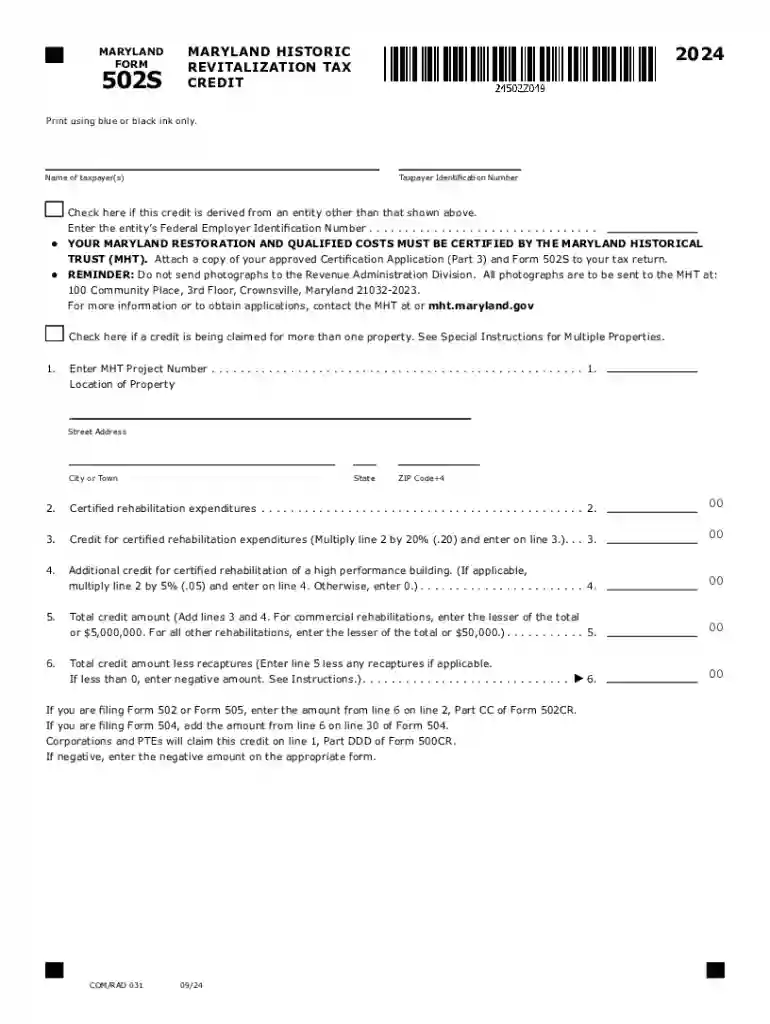
Type text, add images, blackout confidential details, add comments, highlights and more.

Draw your signature, type it, upload its image, or use your mobile device as a signature pad.

Send it via email, link, or fax. You can also download it, export it or print it out.
The 2024 Maryland 502S Maryland Heritage Structure Rehabilitation Tax Credit (MHRTC) is a financial incentive provided by the state of Maryland to support the rehabilitation of certified historic structures. This tax credit is designed to encourage the preservation of Maryland's historical and cultural heritage by offering tax reductions to property owners who invest in renovating historic buildings. The credit benefits taxpayers by reducing the taxable income amount, effectively lowering the overall state tax liability.
Eligibility for the 2024 Maryland 502S MHRTC is contingent upon several factors, including the nature of the property and the type of rehabilitation work undertaken. A property must be deemed historic by the Maryland Historical Trust and meet specific criteria to qualify:


Completing the 2024 Maryland 502S form involves several detailed steps that ensure all requirements are met and that the applicant maximizes the available tax credits.
Understanding the terminology related to the 2024 Maryland 502S MHRTC is crucial for successful application and compliance:
To benefit from the 2024 Maryland 502S, it is essential to adhere to the prescribed filing deadlines and remain aware of key dates throughout the application process:
The process of applying for the 2024 Maryland 502S MHRTC can be facilitated by utilizing compatible tax preparation software, which supports efficiency and accuracy.
Illustrating practical scenarios can provide greater insight into how the 2024 Maryland 502S MHRTC benefits different entities:
Legal compliance is critical when applying for and utilizing the 2024 Maryland 502S MHRTC. Understanding and adhering to regulations ensures legitimacy and avoids penalties.
By providing thorough guidance on using the 2024 Maryland 502S Maryland Heritage Structure Rehabilitation Tax Credit, this document aims to equip property owners and stakeholders with the necessary knowledge and tools to effectively utilize this valuable state resource.
We've got more versions of the 2024 Maryland 502S Maryland Heritage Structure Rehabilitation Tax Credit form. Select the right 2024 Maryland 502S Maryland Heritage Structure Rehabilitation Tax Credit version from the list and start editing it straight away!
At DocHub, your data security is our priority. We follow HIPAA, SOC2, GDPR, and other standards, so you can work on your documents with confidence.






Maryland S/Sgt. Russell G. Doran 3530 N. Ella St., Philadelphia, Penna.
The states largest and most competitive preservation incentive program, with tax credits up to $5 million for substantial rehabilitations.


