




01. Edit your 2008 1120 online
Type text, add images, blackout confidential details, add comments, highlights and more.

Type text, add images, blackout confidential details, add comments, highlights and more.

Draw your signature, type it, upload its image, or use your mobile device as a signature pad.

Send it via email, link, or fax. You can also download it, export it or print it out.
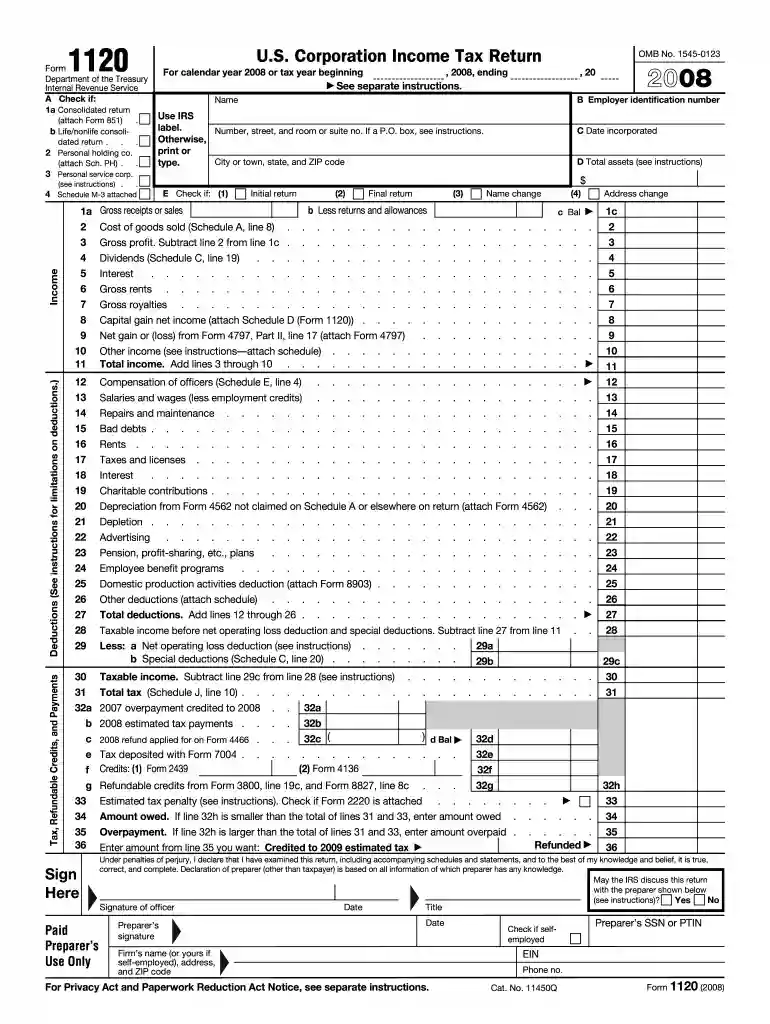
The 2008 Form 1120 is the U.S. Corporation Income Tax Return used by corporations to report their income, deductions, tax liability, and other financial details to the Internal Revenue Service (IRS). This form is essential for determining the tax obligations of a corporation for the given tax year. Corporations are required to complete sections that cover various aspects of their operations, making it a comprehensive document. The form also plays a critical role in compliance, ensuring that corporations disclose necessary financial details as required by federal regulations.
Corporations must follow a specific sequence to correctly use the 2008 Form 1120. Initially, they need detailed income statements and expense reports, which are integral for accurate completion of the form.
Completing the 2008 Form 1120 requires careful attention to detail and a systematic approach:
The 2008 Form 1120 is primarily used by corporations, including domestic entities and those operating within the U.S. It is mandatory for any corporation seeking to report its financial performance and tax liabilities to the IRS.


For the 2008 tax year, the regular deadline for filing Form 1120 was the 15th day of the third month after the end of the corporation’s tax year. For a calendar-year corporation, this typically fell on March 15, 2009. Extensions and any associated paperwork need to be filed beforehand if the corporation required additional time to file.
Understanding the terminology within the 2008 Form 1120 is crucial for accurate completion:
The IRS provides a comprehensive set of guidelines to assist corporations in completing the 2008 Form 1120. Following these instructions helps in ensuring that the form is filled out correctly and submitted according to federal requirements.
Corporations that fail to file Form 1120 in a timely and accurate manner may face several penalties from the IRS:
Corporations must adhere to all IRS rules when preparing and filing Form 1120 to avoid these penalties and ensure compliance with federal tax laws.
We've got more versions of the 2008 1120 form. Select the right 2008 1120 version from the list and start editing it straight away!
| Versions | Form popularity | Fillable & printable |
|---|---|---|
| 2025 | 4.4 Satisfied (37 Votes) | |
| 2024 | 4.6 Satisfied (32 Votes) | |
| 2023 | 4.2 Satisfied (33 Votes) | |
| 2022 | 4.8 Satisfied (59 Votes) | |
| 2021 | 4.8 Satisfied (80 Votes) | |
| 2020 | 4.3 Satisfied (37 Votes) | |
| 2019 | 4.4 Satisfied (228 Votes) | |
| 2018 | 4.3 Satisfied (133 Votes) | |
| 2017 | 4.3 Satisfied (98 Votes) | |
| 2016 | 4.4 Satisfied (267 Votes) | |
| 2015 | 4.3 Satisfied (34 Votes) | |
| 2014 | 4.2 Satisfied (35 Votes) | |
| 2014 | 4 Satisfied (59 Votes) | |
| 2013 | 4 Satisfied (42 Votes) | |
| 2013 | 4.8 Satisfied (25 Votes) |
At DocHub, your data security is our priority. We follow HIPAA, SOC2, GDPR, and other standards, so you can work on your documents with confidence.
The U.S. Environmental Protection Agency through its Office of Research and Development managed portions of the technical work described here under.Read more
For Privacy Act and Paperwork Reduction Act Notice, see separate instructions. Cat. No. 11450Q. Form 1120 (2008). Page 2. Form 1120 (2008). Page 2. Schedule A.Read more
the 3 preceding years: 1120), Capital Gains and Losses. Schedule D, Form 1041 or Form 1120, if. An exempt organization using Form. 1. Gross sales, applicable,Read more


