01. Edit your form online
Type text, add images, blackout confidential details, add comments, highlights and more.

Type text, add images, blackout confidential details, add comments, highlights and more.

Draw your signature, type it, upload its image, or use your mobile device as a signature pad.

Send it via email, link, or fax. You can also download it, export it or print it out.
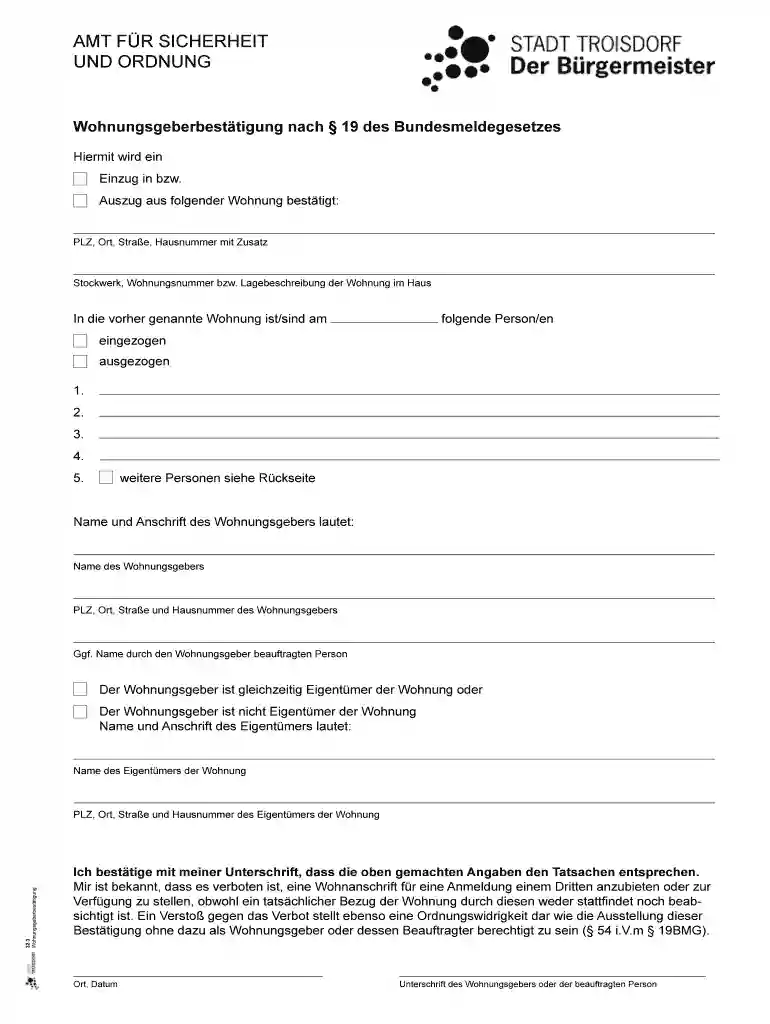
The Wohnungsgeberbestätigung nach § 19 des Bundesmeldegesetzes is a residential confirmation required by German law. It certifies an individual's move-in or move-out at a specific address, providing essential details such as the landlord's information and their ownership status. This document serves as a protective measure against misuse of residential addresses for registration purposes. It must be signed by the landlord or an authorized representative to be valid. This form ensures accurate population records and aids in logistical planning at the municipal level.
To properly use the Wohnungsgeberbestätigung, individuals must present it at their local registration office when registering their new address. This document verifies the change of residence and is a legal requirement in Germany. Upon moving into a new residence, individuals have a specific timeframe—typically two weeks—to register their address using this form. Failure to do so can result in fines. The document streamlines the registration process by providing the local government with necessary, accurate information in a standardized format.
To acquire the form, tenants should directly contact their landlord or property manager, who is responsible for providing it. Landlords typically issue these forms upon signing the rental agreement or upon the tenant's move-in. It is essential for tenants to request the document promptly to comply with registration deadlines. In cases where landlords are uncooperative, tenants may seek assistance from local renters' associations.
The Wohnungsgeberbestätigung is crucial for ensuring accurate governmental records. It plays a vital role in maintaining an efficient and up-to-date population register, which can affect various administrative processes, including voting registration, school placements, and tax assignments. Additionally, it helps prevent housing fraud by requiring a formal confirmation of residence.
The form consists of several critical components that must be accurately filled out to be valid:
This form is legally binding and adheres to the guidelines set forth in the Federal Registration Act. Only authorized individuals such as landlords or delegated representatives can issue it, making fraudulent issuance or tampering a punishable offense. Its primary legal function is to prevent address misuse and ensure accurate administrative records.
Primarily used by individuals relocating within Germany, the form is also critical for landlords, property managers, and governmental authorities responsible for maintaining accurate residential records. Tenants moving into new residences and landlords managing multiple properties often engage with this form regularly.


By offering comprehensive guidance on the Wohnungsgeberbestätigung nach § 19 des Bundesmeldegesetzes, this resource ensures users understand the importance, acquisition process, legal implications, and step-by-step completion of the form.
At DocHub, your data security is our priority. We follow HIPAA, SOC2, GDPR, and other standards, so you can work on your documents with confidence.