01. Edit your form online
Type text, add images, blackout confidential details, add comments, highlights and more.

Type text, add images, blackout confidential details, add comments, highlights and more.

Draw your signature, type it, upload its image, or use your mobile device as a signature pad.

Send it via email, link, or fax. You can also download it, export it or print it out.
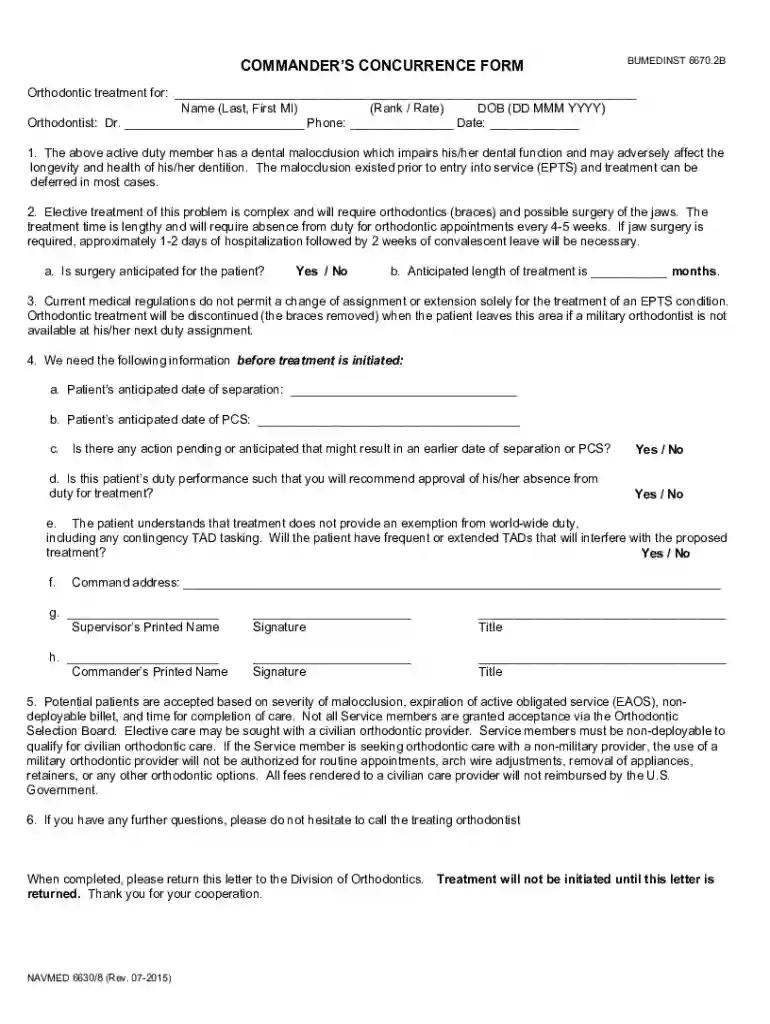
The Commander's Concurrence Form is a crucial document used within the military, particularly concerning the orthodontic treatment of active duty personnel. It serves to provide a comprehensive outline of the treatment plan, including details about the patient's dental malocclusion and the treatment's complexity and duration. This form is essential for evaluating how the proposed medical procedure might affect military duties, requiring the service member's commanding officer's agreement or "concurrence" before proceeding. This ensures that the treatment aligns with operational requirements and doesn't interfere with the service member's responsibilities.
Effectively using the Commander's Concurrence Form involves several key steps. First, accurate personal and service-related information must be filled out by the military personnel requiring orthodontic treatment. This includes anticipated separation or Permanent Change of Station (PCS) dates. The form is then reviewed by the commanding officer, who assesses duty performance recommendations and potential deployment conflicts. The commanding officer's approval indicates that military operations will not be compromised by the ongoing treatment.
The form contains specific elements designed to capture all necessary data to make an informed decision:
In a legal context, the form ensures that all military regulations concerning active duty health management are followed. It serves as documented proof of a mutual agreement between the military service member and their superior. This is particularly important for auditing and compliance purposes, ensuring transparency and accountability in medical treatment while on duty.
Completing this form requires careful attention to detail to ensure all information reflects current military status and treatment needs.
Understanding specific terminology is crucial for anyone dealing with the Commander's Concurrence Form:
Real-life applications of this form include scenarios such as:
To determine eligibility for using the Commander's Concurrence Form, a service member must be in active duty and need orthodontic treatment not covered by standard military health benefits. Eligibility is assessed based on service duration, current duty commitments, and medical necessity.


While the overarching process follows federal military protocols, there might be minor distinctions in executing these procedures based on state regulations. Particularly, state-specific healthcare guidelines could affect available treatments or specialist referrals. Service members are encouraged to consult their base’s legal or medical personnel to understand these differences fully.
With the advancement of technology, the Commander's Concurrence Form can often be filled out digitally, enabling easy corrections and faster submission. However, some instances might still require the physical form, especially for record-keeping and when a signature from a commanding officer is needed directly on the document.
We've got more versions of the COMMANDERS CONCURRENCE FORM form. Select the right COMMANDERS CONCURRENCE FORM version from the list and start editing it straight away!
| Versions | Form popularity | Fillable & printable |
|---|---|---|
| 2015 | 4.5 Satisfied (49 Votes) |
At DocHub, your data security is our priority. We follow HIPAA, SOC2, GDPR, and other standards, so you can work on your documents with confidence.