Assisted living service form 2026

Get Form
assisted living service plan pdf Preview on Page 1

Here's how it works

01. Edit your assisted living service plan pdf online
Type text, add images, blackout confidential details, add comments, highlights and more.

02. Sign it in a few clicks
Draw your signature, type it, upload its image, or use your mobile device as a signature pad.

03. Share your form with others
Send assisted living care plan template via email, link, or fax. You can also download it, export it or print it out.

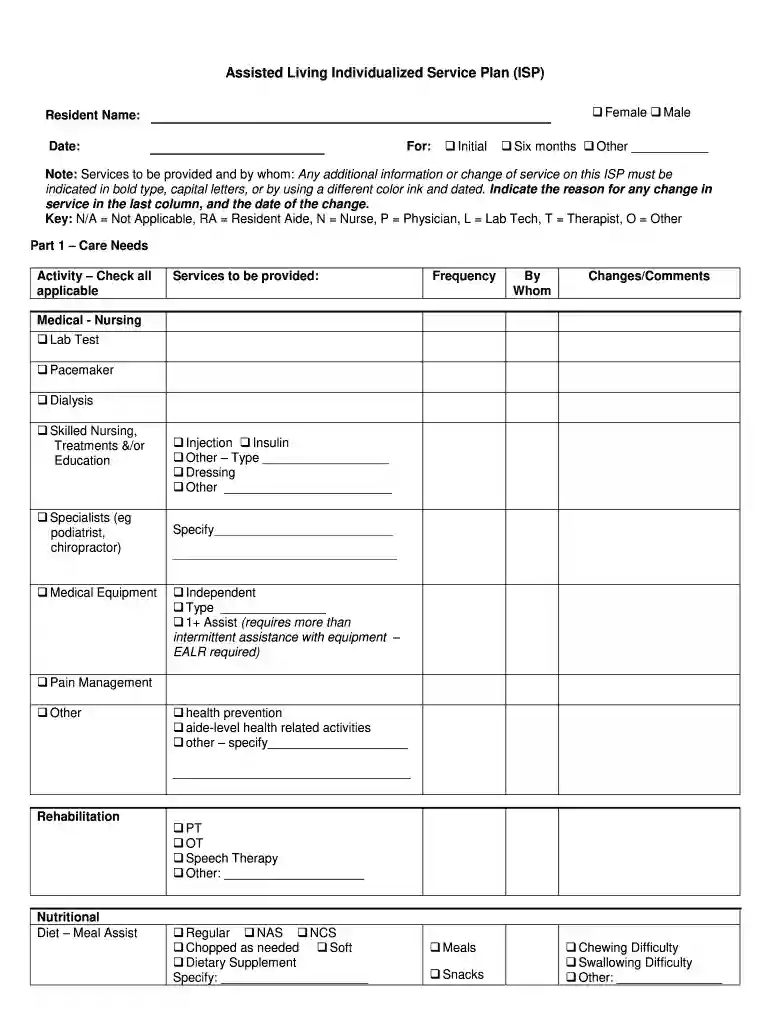
Overview of the Assisted Living Service Form

The Assisted Living Service Form, often referred to as the Individualized Service Plan (ISP), is a crucial document used in assisted living facilities. This form outlines the care needs, preferences, and support services required for each resident. It serves as a personalized guide, ensuring that each individual's health and well-being are prioritized throughout their stay.

Key Elements of an Assisted Living Service Form

The form includes several essential components:

  • Resident Information: This section captures the basic details of the resident, including their name, date of birth, and contact information.
  • Assessment of Needs: A comprehensive assessment of the resident's physical, emotional, and social requirements, which may include medical conditions and mobility assistance.
  • Service Plan Details: Specifies the types of services to be provided. This may include assistance with daily living activities such as bathing, dressing, and medication management.
  • Frequency of Services: Clearly states how often each service will be delivered, whether daily, weekly, or monthly.
  • Responsible Personnel: Identifies the staff members responsible for delivering each service, ensuring accountability and clarity among the care team.

Creating an Individualized Service Plan

Developing an effective ISP involves several steps:

  1. Initial Assessment: Conduct a thorough evaluation of the resident’s physical and cognitive capabilities. This assessment should involve both the resident and, if applicable, their family members.

  2. Setting Goals: Collaboratively establish measurable and achievable goals that address the resident’s needs and preferences.

  3. Documenting the Plan: Record all assessment findings and service details within the Assisted Living Service Form, ensuring that it is clear and comprehensive.

  4. Review and Update: Regularly review the ISP, at least every six months, to accommodate any changes in the resident’s condition or preferences. Document any changes or comments in the form to track the evolution of the care plan.

Examples of an Assisted Living Service Plan

Sample care plans illustrate how to effectively implement the Assisted Living Service Form in various scenarios. For instance, in one case, a resident may require:

  • Daily Assistance with Medication: A staff member is assigned to oversee medication compliance at specific times each day.
  • Weekly Physical Therapy Sessions: A licensed therapist conducts therapy sessions to improve mobility and support recovery from surgery.
  • Nutritional Guidance: A nutritionist collaborates with kitchen staff to tailor meal plans according to the resident's dietary needs.

Legal Considerations for the Assisted Living Service Form

The Assisted Living Service Form must comply with relevant regulations and guidelines, such as:

  • HIPAA Compliance: Protecting the resident's health information is essential. The form must ensure all personal health details are securely managed.
  • Licensing Requirements: Facilities must adhere to state-specific regulations governing assisted living services, ensuring all provided care meets established legal standards.

Benefits of Using the Assisted Living Service Form

Utilizing the Assisted Living Service Form offers numerous advantages, including:

  • Personalization: By tailoring care to individual needs, the form enhances the overall quality of life for residents.
  • Clarity: It streamlines communication among staff, residents, and family members regarding care expectations and responsibilities.
  • Accountability: Designating responsible personnel for each aspect of care fosters reliability and trust within the team.

Challenges in Completing the Assisted Living Service Form

Certain challenges may arise while filling out the Assisted Living Service Form, such as:

  • Incomplete Information: Ensuring that all assessment data is gathered and accurately reflected in the form can be demanding, particularly with complex health conditions.
  • Coordination Among Staff: Effective communication among care teams is essential for the accurate implementation of the ISP.

Best Practices for Maintaining the Assisted Living Service Form

To ensure the effectiveness of the Assisted Living Service Form:

  • Continuous Training for Staff: Regular training and updates on best practices for completing and updating the form can improve compliance and accuracy.
  • Utilization of Technology: Employ electronic records management systems that can automate portions of the ISP process to reduce errors and improve accessibility.

These best practices not only enhance the experience of residents but also contribute to the overall efficiency of the care facility.

be ready to get more

Complete this form in 5 minutes or less

Get form

Got questions?

We have answers to the most popular questions from our customers. If you can't find an answer to your question, please contact us.
Contact us
A typical assessment will examine and rank your family members behaviors, chronic illnesses, communication abilities, dietary requirements, ability to perform activities of daily living (ADLs), ability to manage medications, need for assistive devices and much more.
New Rules for Assisted Living Facilities Staffing Requirements. Resident Care Standards. Enhanced Safety Standards. Transparency and Communication. Resident Rights and Activities. End of the One-Size-Fits-All Policy. Upgraded Facilities. Emergency Preparedness and Response.
In many states, in order to qualify to live in an assisted living facility, you, or your loved one, must need assistance performing at least two of whats known as activities of daily living. Activities of daily living include things like: Bathing. Grooming.
Health Considerations Individuals with severe medical conditions that require round-the-clock medical care might not be suitable candidates for assisted living. For example, a senior with dementia likely wont be a candidate for assisted living, but they may qualify for a more intensive service like memory care.
What qualifies a senior for assisted living The senior requires personal care assistance. They dont need 24/7 medical care. The senior should be medically stable. They meet the age minimum. They can move independently. Seniors have regular health assessments.

People also ask

Original Medicare does not cover assisted living, but it does cover short-term care in a skilled nursing facility. There are various ways to fund assisted living costs, from personal savings to Medicaid waiver programs.
If a senior could jeopardize the safety and health of other residents, the senior may be denied admission to an assisted living facility. Some of the most common conditions for disqualification include seniors who have severe memory impairments, who need extensive medical care, or who are bedridden.

sample care plans for assisted living facilities