






Definition & Meaning
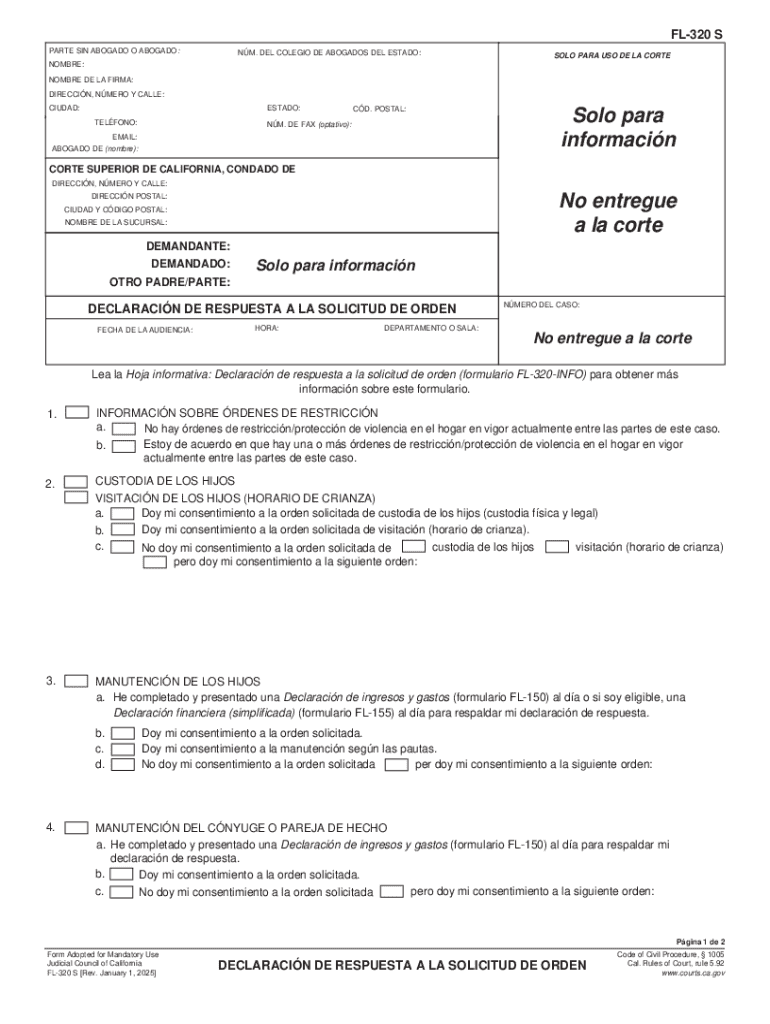
The FL-320 S Declaración de Respuesta a la Solicitud de Orden Judicial Council forms are legal documents used in California specifically for responding to court orders related to family law matters. These forms are essential in cases concerning child custody, visitation, and support, providing a structured method for respondents to present their position officially. Each section of the form allows the respondent to agree or disagree with proposed orders and to provide necessary context about existing restraining orders, ensuring comprehensive coverage of personal and legal details.
Key Elements and Purpose
- Identification Information: The form collects personal details of the involved parties, establishing the identities and roles within the legal proceedings.
- Consent and Objections: Sections are designated for the respondent to express consent or raise objections concerning the specific orders requested.
- Declaration Section: This part includes a declaration under penalty of perjury, affirming the truthfulness of the provided information, which is critical for maintaining integrity in legal processes.
How to Use the FL-320 S Declaración
Understanding how to use the FL-320 S form is crucial for effectively communicating responses in family law cases. This form should be filled out by the responding party after receiving a request for a court order.
Step-by-Step Usage
- Review the Court Order Request: Carefully analyze the initial request to understand the orders being sought.
- Fill in Personal Details: Clearly enter all personal and contact information to ensure accurate identification in legal records.
- Respond to Each Section: Address each proposed order individually, providing consent or outlining objections where appropriate.
- Include Additional Information: Attach any relevant documentation that supports your responses, such as prior child custody agreements or financial statements.
- Sign the Declaration: Sign and date the declaration, asserting the accuracy of the information provided, which serves as a legally binding affirmation.
Steps to Complete the Form
Completing the FL-320 S form involves several careful steps, each designed to capture necessary information accurately and comprehensively.
Detailed Instructions
- Gather Documentation: Have all relevant documents ready, including any previous court orders and personal identification.
- Prepare Personal Information: Enter accurate names, addresses, and contact details for both parties involved in the legal process.
- Assess the Requested Orders: Evaluate each part of the order request, noting areas of agreement or concern.
- Provide Detailed Response: In each response section, include any objections or consent in full detail, offering explanations that support your position.
- Attach Supporting Evidence: Attach documents such as emails, letters, or financial records that substantiate your claims or objections.
- Complete the Declaration: Fill out the declaration section truthfully, ensuring that all statements are made under penalty of perjury.
Legal Use and Compliance
The FL-320 S form must be used correctly to meet legal standards in California, ensuring the process values accuracy and compliance with local laws.
Legal Importance
- Adherence to Legal Standards: The form aligns with California's specific legal guidelines, making it a requisite document in family court cases.
- Penalties for Misrepresentation: Providing false information can lead to penalties, emphasizing the importance of truthfulness in legal documentation.
- Court Acceptance: Proper completion ensures the form's acceptance in court proceedings, facilitating a smooth legal process.
Who Typically Uses the FL-320 S Form
This form is specifically used by individuals involved in family law disputes, particularly in California, who are responding to requests for court orders.


Typical Users
- Parents in Custody Disputes: Often used by parents involved in custody and visitation disagreements to formalize their responses.
- Individuals with Restraining Orders: Those who are responding to modifications or enforcements of restraining orders.
- Parties Involved in Support Cases: Used when addressing child or spousal support issues, especially when modifications are requested.
Important Terms Related to FL-320 S
A comprehensive understanding of key terms associated with the FL-320 S form is crucial for clarity and legal accuracy.
Key Terms Explained
- Respondent: The individual filling out the FL-320 S form, usually the party asked to respond to a request for a court order.
- Petitioner: The party seeking the court's intervention through the initial request for orders.
- Declaration Under Penalty of Perjury: A formal statement affirming the truthfulness of the supplied information, legally binding under penalty of law.
State-Specific Rules for the FL-320 S
Given its legal nature, the FL-320 S form is governed by specific California state laws, ensuring its proper use within the judicial system.
California-Specific Considerations
- Local Court Guidelines: Each county in California may have slight variations in how the form is to be submitted and evaluated, necessitating awareness of local court rules.
- California Family Code: The form adheres to stipulations under California's family law statutes, making compliance imperative to avoid delays or dismissal.