DocHub 218577391-Distance-vsDistance And Displacement Worksheet Answer Key - DocHub 2026

Get Form
DocHub 218577391-Distance-vsDistance And Displacement Worksheet Answer Key - DocHub Preview on Page 1

Here's how it works

01. Edit your form online
Type text, add images, blackout confidential details, add comments, highlights and more.

02. Sign it in a few clicks
Draw your signature, type it, upload its image, or use your mobile device as a signature pad.

03. Share your form with others
Send it via email, link, or fax. You can also download it, export it or print it out.

Understanding the Worksheet: Key Concepts

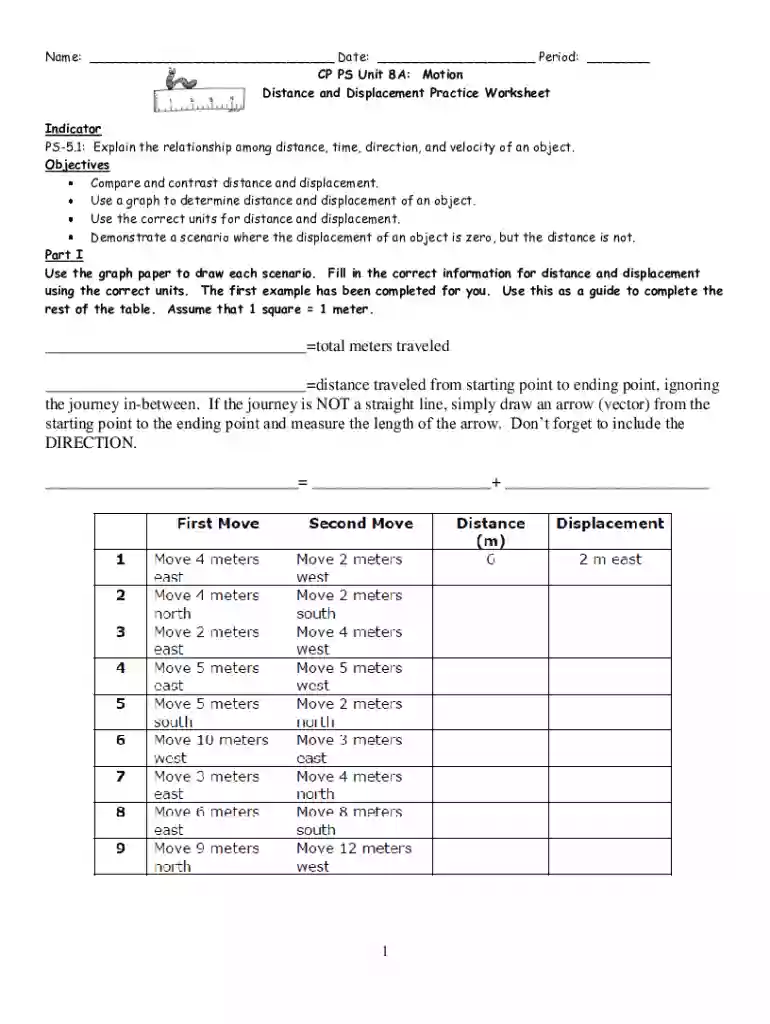
This worksheet, titled "Distance vs. Distance and Displacement Worksheet Answer Key - DocHub," focuses on the essential physics concepts of distance and displacement. It includes exercises designed to help learners differentiate between these two important measurements in motion.

Definition & Meaning of Distance and Displacement

  • Distance: It refers to the total length of the path taken by an object from one point to another. It is a scalar quantity, meaning it has only magnitude and no direction.
  • Displacement: This is the change in position of an object in a specific direction. Unlike distance, displacement is a vector quantity, incorporating both magnitude and direction.

Comparing Distance and Displacement with Examples

  • Distance can be represented as the sum of all intervals traveled, regardless of direction. For example, if a student walks three miles north and then three miles south, the total distance traveled is six miles.
  • Displacement, in the same scenario, would be zero because the student's final position is the same as the starting point.

How to Use the Worksheet Answer Key

The answer key serves as a resource for checking whether the solutions provided in the worksheet are correct. It typically includes detailed answers to each exercise, facilitating a better understanding of the subject matter.

Steps to Complete and Verify the Worksheet

  1. Read Each Problem Carefully: Understand the task at hand and what is being asked.
  2. Calculate Distance and Displacement: Use the given data and apply relevant formulas. Remember, the key difference is that distance is cumulative, while displacement considers only the change in position.
  3. Utilize the Answer Key: Cross-check your calculated answers against the key to ensure accuracy.
  4. Analyze Mistakes: If discrepancies exist, review the problem to identify errors and correct your approach.

Who Typically Uses the Worksheet

This worksheet is primarily designed for students and educators who are focusing on physics topics related to motion. It provides a practical way to understand and apply theoretical concepts.


decoration image ratings of Dochub

Types of Users

  • Students: Particularly those in high school or introductory college-level physics courses.
  • Educators: Teachers and tutors who need resources to instruct and assess students' understanding of motion concepts.

Practical Applications and Scenarios

Real-World Examples Utilizing the Worksheet

  • Athletics: A runner's path using a track is ideal for understanding different concepts. While they may cover a distance of 400 meters around the track, their displacement might be zero if they start and finish at the same point.
  • Navigation: Pilots and sailors use the principles of displacement to determine the shortest path between points, critical for efficient travel.

Important Terms Related to the Worksheet

Understanding key terms is crucial for using the worksheet effectively:

  • Scalar Quantity: Measures only magnitude (e.g., distance).
  • Vector Quantity: Measures both magnitude and direction (e.g., displacement).
  • Reference Point: The starting location used to determine displacement.

Legal and Educational Context

Legality and Academic Integrity

It is important to use the worksheet and answer key within the educational guidelines provided by institutions. This ensures academic integrity and compliance with educational standards.

Supporting United States Educational Standards

This worksheet aligns with core educational standards across the U.S., such as the Next Generation Science Standards (NGSS), which emphasize the importance of understanding basic physics concepts in the context of real-world applications.

State-Specific Considerations

Adapting the Worksheet for Different Regions

While the physical concepts remain universal, educators may need to consider local curricula requirements or state-specific standards when incorporating this worksheet into their lesson plans.

Regional Variations in Educational Focus

Some U.S. states may emphasize different scientific principles or applications, which can influence how a worksheet is utilized in the classroom.

Key Takeaways

The "Distance vs. Distance and Displacement Worksheet" provides a foundational tool for understanding these critical concepts in physics. By practicing with this worksheet, learners can strengthen their analytical skills and improve their ability to apply theoretical knowledge to practical problems. Utilizing resources like the DocHub platform enhances this learning experience by allowing seamless access to worksheets and answer keys online.

Final Thoughts

  • Focus on the differences between scalar and vector quantities.
  • Use the answer key as a learning tool, not just a source for correct answers.
  • Consider real-world applications to reinforce abstract concepts.
be ready to get more

Complete this form in 5 minutes or less

Get form

Got questions?

We have answers to the most popular questions from our customers. If you can't find an answer to your question, please contact us.
Contact us
Distance is the length of the path taken by an object whereas displacement is the simply the distance between where the object started and where it ended up.
Distance is a scalar quantity that refers to how much ground an object has covered during its motion. Displacement is a vector quantity that refers to how far out of place an object is; it is the objects overall change in position.
Distance is the length of the path taken by an object whereas displacement is the simply the distance between where the object started and where it ended up. For example, lets say you drive a car. You drive it 5 miles east and then 3 miles west.
The document discusses the difference between distance and displacement. Distance refers to the total path length traveled by an object, while displacement refers to the change in an objects position.
Displacement = Final position initial position = change in position.

Security and compliance

At DocHub, your data security is our priority. We follow HIPAA, SOC2, GDPR, and other standards, so you can work on your documents with confidence.
Learn more
ccpa2
pci-dss
gdpr-compliance
hipaa
soc-compliance
be ready to get more

Complete this form in 5 minutes or less

Get form

People also ask

If you run a 5K on a circular course, your distance traveled is 5 kilometers, regardless of where you started and finished. Distance is a scalar quantity. Displacement is an objects change in position, only measuring from its starting position to the final position.