
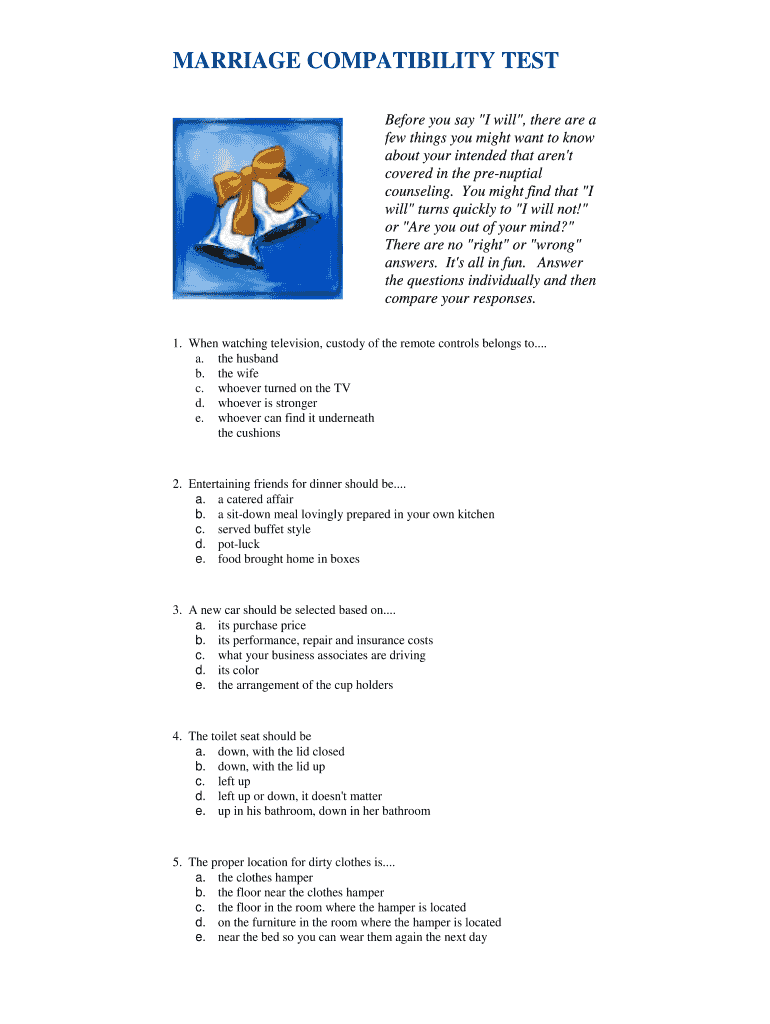







Definition and Purpose of Marriage Compatibility Test
The marriage compatibility test is a tool designed to help couples evaluate their mutual compatibility before marriage. It typically comprises a series of questions that explore various aspects of life, such as values, household responsibilities, and personal preferences. By addressing these elements, couples can gain insights into their relationship dynamics and identify potential areas of alignment or conflict. This self-assessment helps in understanding how each partner views different life's aspects and their approach to mutual decision-making.
How to Use the Marriage Compatibility Test
To effectively use the marriage compatibility test, each partner should answer the questions individually without consulting each other. This ensures that the responses are genuine and based on personal perspectives. After completing the test, partners should compare their answers and discuss any discrepancies or alignments they discover. This discussion can foster clearer communication and understanding, laying the foundation for addressing potential conflicts and reinforcing shared values.
Steps to Complete the Test
- Preparation: Agree on a time when both partners can dedicate uninterrupted attention to the test. Ensure that both have access to the test questions and any necessary materials.
- Individual Completion: Each person should complete the test separately, answering each question honestly and to the best of their ability.
- Comparison: Once both partners have finished, they should come together to compare their answers.
- Discussion: Talk about the areas of agreement and disagreement, focusing on understanding each other's perspectives rather than debating who is right.
- Reflection: Reflect on the insights gained and consider any strategies for improving alignment in disputed areas.
Key Elements of the Marriage Compatibility Test
The test covers multiple key aspects, each crucial to understanding how a couple may function in a marital setting:
- Values and Beliefs: Questions about personal values and cultural or religious beliefs can highlight fundamental views that may affect decision-making.
- Financial Priorities: Queries related to budgeting and financial goals help assess whether partners have similar financial mindsets.
- Household Responsibilities: By tackling how each partner views household chores and roles, couples can anticipate potential conflicts in managing living spaces.
- Lifestyle Preferences: Understanding lifestyle choices, such as travel, leisure activities, or socializing habits, can reveal compatibility in daily life preferences.
Why Take a Marriage Compatibility Test?
Taking the marriage compatibility test is crucial for several reasons:
- Self-Awareness: It promotes self-reflection, allowing partners to better understand their own wants and needs.
- Relationship Perception: The test sheds light on the dynamics of the relationship, revealing areas that are robust and those that may require work.
- Conflict Prevention: By discussing areas of misalignment before marriage, couples can address potential issues proactively and set strategies for resolution.
- Mutual Understanding: Enhanced mutual understanding paves the way for more harmonious interaction and problem-solving in the future.
Who Typically Uses the Marriage Compatibility Test?
Generally, engaged or seriously dating couples who are considering marriage take the marriage compatibility test. It is particularly useful for those who wish to explore and discuss their relationship more deeply before formalizing their commitment. Counselors and relationship therapists may also recommend this test as part of pre-marital counseling to aid couples in identifying and discussing critical relationship facets.


Examples of Using the Marriage Compatibility Test
Consider two scenarios in which the marriage compatibility test proves beneficial:
-
Scenario One: A couple discovers they have differing financial priorities. One partner values saving, while the other prioritizes immediate spending for enjoyment. This insight allows them to develop a financial plan that accommodates both perspectives.
-
Scenario Two: By discussing their views on household responsibilities, another couple realizes they have similar expectations about sharing duties, which reaffirms their commitment to equitable cooperation.
Important Terms Related to Marriage Compatibility Test
Understanding certain terms can enrich your grasp of the test's framework:
- Compatibility: The degree to which partners align in terms of values, goals, and lifestyle preferences.
- Alignment: Agreement or symmetry in partners' views or objectives.
- Dynamics: The forces or properties stimulating growth, development, or change within a relationship.
State-Specific Rules for the Marriage Compatibility Test
While there are no legal mandates requiring couples to take a marriage compatibility test in the United States, certain states may recommend it as part of pre-marital counseling services offered by places of worship or community organizations. This advice aims to prepare couples both practically and emotionally for marriage.




