Claimwire self-insurer-accident-report-sif-2Self-Insurer Accident Report (SIF-2) Forms 2026

Get Form
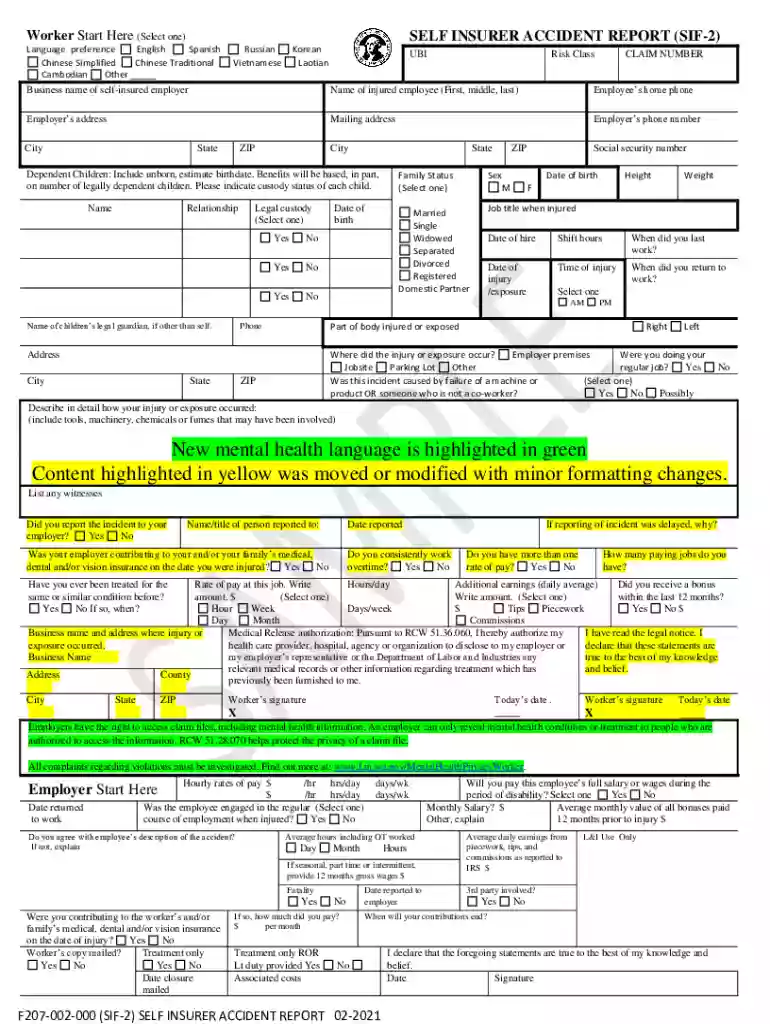
claimwire self-insurer-accident-report-sif-2Self-Insurer Accident Report (SIF-2) Forms Preview on Page 1

Here's how it works

01. Edit your form online
Type text, add images, blackout confidential details, add comments, highlights and more.

02. Sign it in a few clicks
Draw your signature, type it, upload its image, or use your mobile device as a signature pad.

03. Share your form with others
Send it via email, link, or fax. You can also download it, export it or print it out.

Definition & Meaning

The Self-Insurer Accident Report (SIF-2) form is an essential document for employers who operate as self-insurers. This form collects detailed information about workplace accidents involving employees. It includes sections for reporting personal details of the employee and employer, specifics of the injury, authorization for medical information release, and details pertinent to the incident and the insurance coverage. The primary purpose of the form is to ensure a comprehensive and streamlined process for managing claims related to workplace accidents.

Key Elements of the Self-Insurer Accident Report (SIF-2) Forms

The Self-Insurer Accident Report (SIF-2) comprises several critical elements aimed at capturing the necessary data to facilitate claims processing:

  • Employee Information: Full name, address, contact details, and work designation are gathered to identify the involved party.
  • Employer Details: Company name, address, contact information, and the insurer identification number provide the framework for the employer’s self-insurance setup.
  • Injury Specifics: Date, time, and location of the accident, alongside descriptions of the incident and injuries, are included to support the accident’s context.
  • Medical Release Authorization: This section gives permission for medical records related to the incident to be shared with relevant parties.
  • Insurance Coverage details: Information regarding the insurance policy in place for the work environment and status of the claim.

How to Use the Self-Insurer Accident Report (SIF-2) Forms

Utilizing the SIF-2 effectively requires understanding each section’s significance:

  1. Gather Comprehensive Information: Ensure all details related to the employee, employer, and accident specifics are complete and accurate.
  2. Secure Necessary Authorizations: Consent must be obtained for releasing medical records, which supports seamless claims management.
  3. Validate Entries: Double-check that every entry aligns with official records to minimize discrepancies.
  4. Record Submission: Submit the completed form through the designated channel—either digitally or via mail—to expedite processing.

Steps to Complete the Self-Insurer Accident Report (SIF-2) Forms

Filling out the SIF-2 requires attention to detail:

  1. Initiate with Employee Identification: Begin by completing the employee information section.
  2. Detail Employer Data: Proceed with employer details, ensuring the accuracy of the self-insurer number.
  3. Document Injury Specifics: Succinctly describe the incident, including dates, injury descriptions, and environmental conditions.
  4. Authorize Medical Record Release: Ensure that proper consent is documented for any medical records shared.
  5. Complete Insurance Details: Provide comprehensive insurance information to correlate with the accident report.
  6. Review and Submit: Carefully review the filled form for any errors before submission.

Why You Should Use the Self-Insurer Accident Report (SIF-2) Forms

Employing the SIF-2 offers several advantages for managing workplace injury claims:

  • Streamlines Data Capture: By consolidating all necessary details into one document, the form simplifies information gathering.
  • Supports Legal Compliance: Proper use of the SIF-2 ensures compliance with workplace injury reporting requirements.
  • Facilitates Efficient Claims Processing: Comprehensive entries lead to faster resolution and reduced administrative workload.
  • Ensures Medical Data Transparency: With explicit authorization, stakeholders can access necessary medical records openly and legally.

Legal Use of the Self-Insurer Accident Report (SIF-2) Forms

Adherence to legal stipulations in using the SIF-2 form is critical:

  • Regulatory Compliance: Completing and submitting the form is mandatory under certain state and federal regulations governing workplace injuries.
  • Evidence of Due Process: Properly filled forms can serve as crucial documents in legal proceedings regarding workplace accidents.
  • Authorization Signatures: Legal validity hinges on obtaining all required signatures, particularly for the medical release section.

Who Typically Uses the Self-Insurer Accident Report (SIF-2) Forms

The primary users of the SIF-2 include:

  • Self-Insured Employers: Companies that self-manage their insurance employ this form to ensure accurate reporting and claims processing.
  • Human Resource Departments: HR professionals often oversee the completion and submission of these forms as part of compliance and claims management.
  • Insurance and Legal Professionals: Experts in these fields may use the form for assessing and verifying claim details during investigations or legal reviews.
decoration image ratings of Dochub

Examples of Using the Self-Insurer Accident Report (SIF-2) Forms

Consider the following scenarios where the SIF-2 might be applied:

  • Manufacturing Incident: An employee suffers an injury due to a machinery malfunction; the SIF-2 aids in documenting the accident specifics effectively.
  • Construction Site Accident: When a worker is injured on a construction site, using the SIF-2 ensures all regulatory information is gathered and submitted promptly.
  • Office Environment Injury: For incidents such as slips or falls in an office setting, the form offers a template to collate employee and incident details systematically.

State-Specific Rules for the Self-Insurer Accident Report (SIF-2) Forms

Different states may have additional requirements:

  • State-specific Modifications: Some states may require supplementary information or documentation to accompany the SIF-2.
  • Time Frames for Submission: Regulations around the time required for submission post-incident can vary between states.
  • Additional Compliance Requirements: Certain jurisdictions may impose extra compliance mandates for utilizing this form in workplace injury scenarios.

Required Documents for the Self-Insurer Accident Report (SIF-2) Forms

When completing the form, the following documents are frequently required:

  • Employee Reports and Witness Statements: Written accounts of the incident and situation from those involved.
  • Medical Reports and Invoices: Documentation from healthcare providers detailing the injury and treatment costs.
  • Previous Safety Records: Any past records related to safety audits or previous incidents that could impact current claims.
be ready to get more

Complete this form in 5 minutes or less

Get form

Got questions?

We have answers to the most popular questions from our customers. If you can't find an answer to your question, please contact us.
Contact us
Workers compensation insurance provides relief to workers from injuries or illness sustained in the course of their employment and is required of virtually all employers in Washington State. Employers in Washington must obtain coverage either through the state industrial insurance fund or by qualifying to self-insure.
Silicon Difluoride (SiF2) is a compound consisting of one silicon atom bonded to two fluorine atoms. It is a colorless solid with the CAS number 13966-66-0.
Self-Insurance Accident Report (SIF-2)
Your employer will provide you with a Self Insured Accident Report (SIF-2). You must complete this form and file it with your employer if you seek medical treatment. Get medical care. The first time you see a doctor, you may choose any health-care provider who is qualified to treat your injury.
The Special Fund (also known as the Second Injury Fund) pays certain types of claims and expenses authorized by the LHWCA. Claims are paid by the Special Fund only upon application by an authorized insurance carrier or self-insured employer or by Order of the District Director or Administrative Law Judge.

Security and compliance

At DocHub, your data security is our priority. We follow HIPAA, SOC2, GDPR, and other standards, so you can work on your documents with confidence.
Learn more
ccpa2
pci-dss
gdpr-compliance
hipaa
soc-compliance