01. Edit your form online
Type text, add images, blackout confidential details, add comments, highlights and more.

Type text, add images, blackout confidential details, add comments, highlights and more.

Draw your signature, type it, upload its image, or use your mobile device as a signature pad.

Send it via email, link, or fax. You can also download it, export it or print it out.
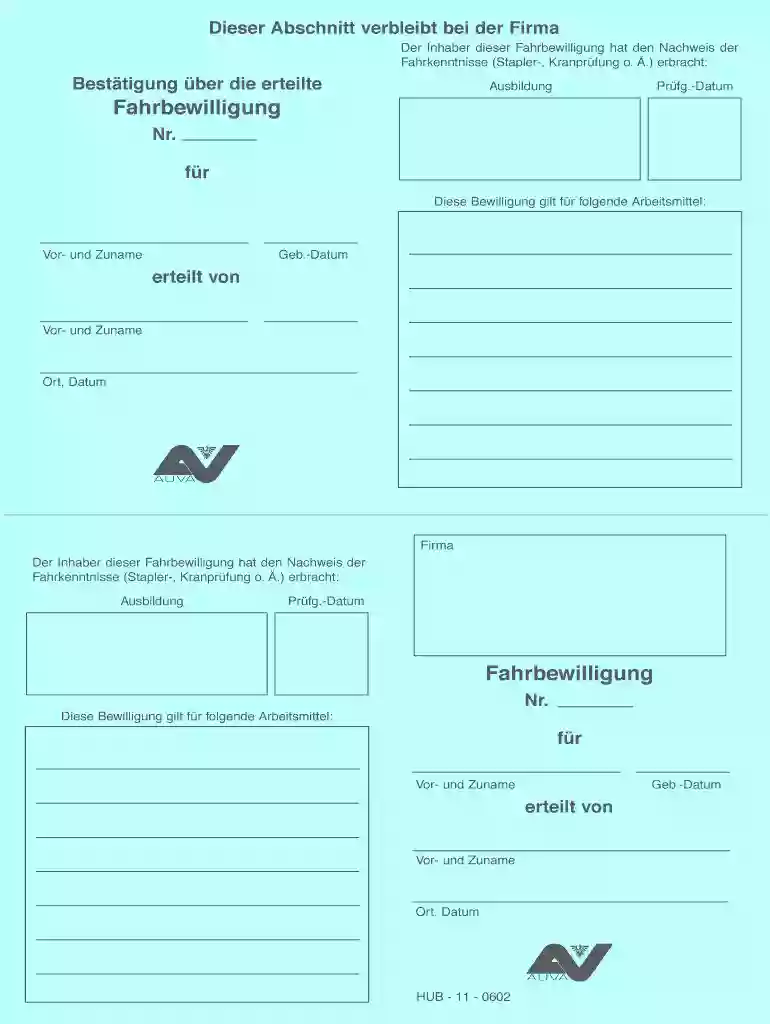
The term "Fahrbewilligung - aushang at" refers to a specific authorization or permit required for the operation of certain machinery, such as cranes and forklifts, within a company setting. This permit serves as proof that the individual has the necessary skills and qualifications to safely operate the equipment, thereby ensuring compliance with safety regulations and minimizing risk in the workplace. The requirement highlights the emphasis placed on workplace safety and regulatory compliance across industries, particularly those involving heavy machinery.
Using the Fahrbewilligung correctly involves adhering to established protocols and ensuring all operations are conducted within the boundaries of the permit. It's essential for the permit holder to be familiar with the machinery's operational guidelines and safety requirements. For instance, the permit must be displayed or made accessible whenever operating the machinery, allowing for ease of verification by supervisors or safety inspectors. Users are often required to complete training programs and present their permits upon request during audits or inspections to confirm compliance with safety standards.
Obtaining the Fahrbewilligung involves several steps and requirements. Initially, applicants must demonstrate a fundamental understanding of the machinery they intend to operate, typically via a training or certification program. These programs often cover both theoretical knowledge and practical skills, ensuring competency in machine operation and emergency procedures. Upon completing the training, individuals must pass a certification exam. Successful candidates receive their Fahrbewilligung, permitting them to operate specified machinery legally. The process may include continuous education to maintain the permit's validity.
A few key terms are associated with the Fahrbewilligung. "Certification" refers to the official acknowledgment that an individual has met the necessary training standards. "Safety regulations" pertain to the rules governing safe machinery operation. "Employer responsibilities" include ensuring all operators are certified and that permits are up to date. "Operations manual" is a document outlining machine-specific operational guidelines. Finally, "renewal" refers to the process of maintaining the permit's validity through periodic updates or additional training modules.
The legal framework surrounding the Fahrbewilligung ensures that machinery is operated safely and efficiently within the workplace. Permission is only granted to those who demonstrate a thorough understanding of both machine operation and safety protocols. Companies bear legal responsibility for verifying that all equipment operators possess valid Fahrbewilligung. Failure to comply with these regulations can result in legal penalties for both the operator and the employer. Additionally, should an accident occur due to operator error, the absence of a valid Fahrbewilligung could influence liability determinations.
Several key elements constitute the Fahrbewilligung. These include the operator's details, such as name and identification number, a list of machinery types covered by the permit, the issue and expiration dates of the permit, and any specific conditions or restrictions on the permit's use. Often, these permits will also feature a section for endorsements, which signify additional qualifications or authorizations the holder has acquired. These elements collectively ensure that the operator's qualifications, authorized equipment, and compliance with training requirements are clearly documented and accessible for verification.
Completing the Fahrbewilligung involves a structured sequence. First, individuals must enroll in an accredited training program tailored to the machinery they aim to operate. After finishing the course, participants undergo a competency test. Upon passing, they submit their test results, personal identification, and other relevant documents to the certifying authority. Once applications are reviewed and approved, permits are issued. Finally, operators should undergo regular reevaluations to maintain their permits, ensuring up-to-date knowledge of machinery and safety regulations.
Consider a manufacturing company that employs numerous forklift operators. Each operator must display a valid Fahrbewilligung, signifying their ability to handle forklifts safely and effectively. Another example could be a construction site utilizing cranes; operators are required to possess the Fahrbewilligung, demonstrating proficiency in crane operation. These examples illustrate the permit's role in maintaining safety standards and ensuring regulatory compliance across various industries. It acts as both a protective measure for workers and an assurance to employers that their operations are conducted responsibly.
The legal framework surrounding the Fahrbewilligung ensures that machinery is operated safely and efficiently within the workplace. Permission is only granted to those who demonstrate a thorough understanding of both machine operation and safety protocols. Companies bear legal responsibility for verifying that all equipment operators possess valid Fahrbewilligung. Failure to comply with these regulations can result in legal penalties for both the operator and the employer. Additionally, should an accident occur due to operator error, the absence of a valid Fahrbewilligung could influence liability determinations.
Several key elements constitute the Fahrbewilligung. These include the operator’s details, such as name and identification number, a list of machinery types covered by the permit, the issue and expiration dates of the permit, and any specific conditions or restrictions on the permit’s use. Often, these permits will also feature a section for endorsements, which signify additional qualifications or authorizations the holder has acquired. These elements collectively ensure that the operator’s qualifications, authorized equipment, and compliance with training requirements are clearly documented and accessible for verification.
At DocHub, your data security is our priority. We follow HIPAA, SOC2, GDPR, and other standards, so you can work on your documents with confidence.