Application for accreditation permit 2026

Get Form
application for accreditation permit Preview on Page 1

Here's how it works

01. Edit your form online
Type text, add images, blackout confidential details, add comments, highlights and more.

02. Sign it in a few clicks
Draw your signature, type it, upload its image, or use your mobile device as a signature pad.

03. Share your form with others
Send it via email, link, or fax. You can also download it, export it or print it out.

Definition and Meaning of the Accreditation Permit

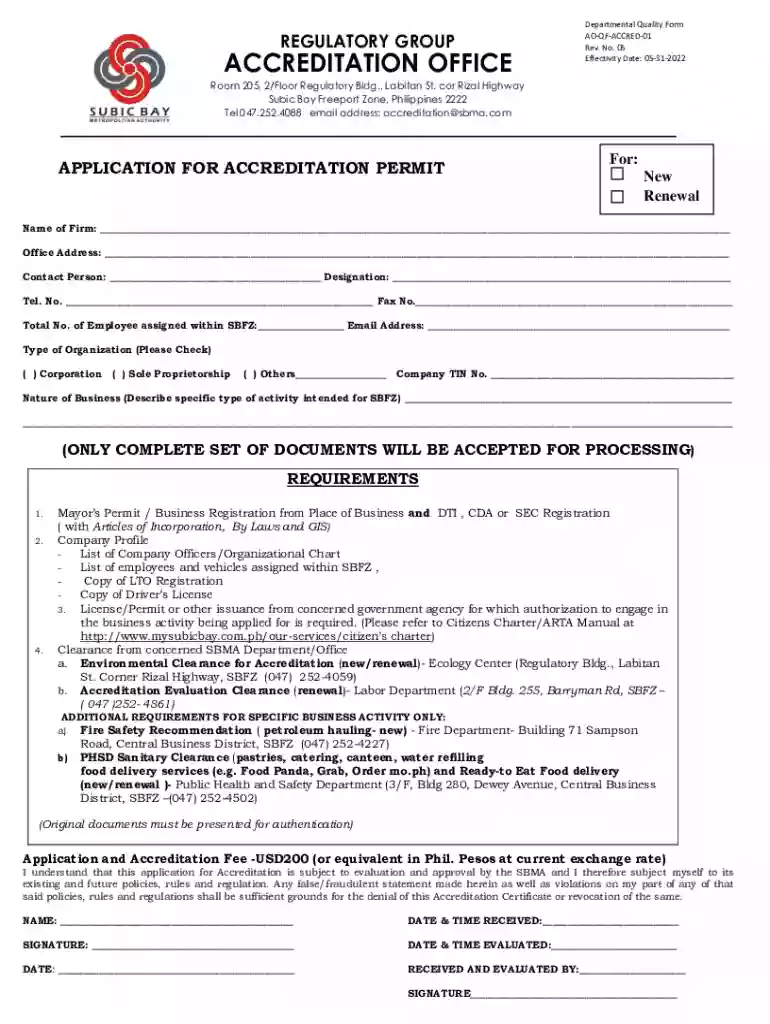
An "accreditation permit" is a formal authorization that certifies an entity's status to conduct specific activities within a regulated framework. In the context of the Subic Bay Freeport Zone's Accreditation Office, this permit verifies an applicant's compliance with local requirements to operate legally within the zone. It initiates the process for businesses seeking legitimacy, offering a structured mechanism to ensure adherence to relevant standards. The permit typically includes essential information such as business identification details and categorizations specific to business operations.

How to Use the Application for Accreditation Permit

The "application for accreditation permit" serves as a comprehensive tool for businesses that aim to formalize their presence within a specific regulatory area, such as the Subic Bay Freeport Zone. Key elements include sections to capture applicant information, detailed business operations, and a checklist of supporting documentation. Importantly, the application guides users through compliance requirements and acts as a formal request evaluated by the Subic Bay Metropolitan Authority (SBMA). Understanding this process assists applicants in aligning business strategies with regional governance standards.

Steps to Complete the Application for Accreditation Permit

  1. Gather Required Documentation

    • Collect all necessary documents, including business permits, profiles, and clearances. Ensure these documents are current and valid.
  2. Fill Out Applicant Information

    • Provide accurate details about the business, including its name, address, and contact information. Ensure consistency across all data presented.
  3. Detail Business Operations

    • Specify the nature of your business operations within the Freeport Zone, outlining services offered and target markets.
  4. Attach Required Documents

    • Verify that all the required documents are attached. Use a checklist to ensure none is missing before submission.
  5. Submit the Application

    • Choose the preferred submission method. Submit either online, by mail, or in-person as specified by the Subic Bay Metropolitan Authority guidelines.
  6. Pay the Application Fee

    • Include payment of the $200 application fee, which can typically be processed online or via traditional banking methods as directed.
  7. Await Evaluation

    • The SBMA evaluates your submission, assessing all information and documents to perform necessary verifications.

Important Terms Related to the Accreditation Permit

  • Applicant Information: Includes the entity's name, addresses, and contact information.
  • Business Details: Outlines the nature and scope of activities of the applying business.
  • Required Documents: Consistent with compliance expectations, includes certifications, permits, and financial statements.
  • Accreditation Office: Designated body responsible for processing applications and issuing permits.

Legal Use of the Accreditation Permit

Holders of the accreditation permit must comply with all legal requirements specified by the regional authority, in this case, the Subic Bay Metropolitan Authority. The permit legitimizes business operations within defined geographical and operational bounds, ensuring adherence to local business laws and regulations. Moreover, non-compliance can lead to penalties such as fines or revocation of business permissions. Consequently, it is vital for applicants to understand legal obligations associated with holding and maintaining an accreditation permit in good standing.

State-Specific Rules for the Accreditation Permit

While the "application for accreditation permit" may be broadly similar across regions within the United States, specific rules can vary according to local governance. In the context of Subic Bay, these rules may include additional environmental considerations, community development commitments, or labor regulations aligned with the Freeport Zone's operational ethos. Applicants must be diligent in understanding these region-specific requirements to ensure comprehensive compliance.

Key Elements of the Accreditation Permit Process

  • Evaluation by SBMA: This involves an initial review of the application and supporting documents followed by a compliance check and potential clarification requests.
  • Fee Payment: A non-refundable USD 200 fee is required for processing the application, pivotal in the accreditation timeline.
  • Documentation Checklist: Substantiates the completeness of the application with permits, clearances, and verifications.
  • Approval Timeline: Estimated processing time varies; however, applicants should be prepared for potential wait periods and follow-up inquiries.

Business Types that Benefit Most from the Accreditation Permit

Businesses that commonly engage in activities within specialized zones benefit significantly from obtaining the accreditation permit. This includes:

  • Manufacturing Firms: Frequently utilize resources in special economic zones like Subic Bay for production advantages.
  • Logistics and Shipping Enterprises: Operate within harbors and ports for strategic distribution purposes.
  • Tourism Operators: Utilize accredited status for credibility and compliance with local tourism policies.
  • Import-Export Businesses: Leverage permits for facilitating global trade efficiently within prescribed regulatory frameworks.
be ready to get more

Complete this form in 5 minutes or less

Get form

Got questions?

We have answers to the most popular questions from our customers. If you can't find an answer to your question, please contact us.
Contact us
Accreditation involves periodic full audits to assess compliance with the Quality Standards. In addition, the Commission monitors the quality of care and services and manages any non-compliance with the Quality Standards.
The accreditation application itself is a guide on all the standards that must be met and the annexes that are required in each case. Filling out the application for accreditation (Self-Assessment Report) requires time, effort and the possible participation of several people.
Enrollment, Self-assessment, Assessment, Commission Review and Decision, and.
There are typically three stages to accreditation: (1) Eligibility, (2) Preaccreditation (Candidacy), and (3) Initial Accreditation. Each stage has specific criteria, processes, and timeframes.
The accreditation review and decision- making process typically involves six stages. Establishment of Institutional or Program Eligibility. Institutional or Program Self-Study. On-Site Team Visit. Written Team Report. Final Decisions/Appeals. Monitoring.

Security and compliance

At DocHub, your data security is our priority. We follow HIPAA, SOC2, GDPR, and other standards, so you can work on your documents with confidence.
Learn more
ccpa2
pci-dss
gdpr-compliance
hipaa
soc-compliance
be ready to get more

Complete this form in 5 minutes or less

Get form

People also ask

Accreditation is a formal, independent verification that a program or institution meets established quality standards and is competent to carry out specific conformity assessment tasks. Conformity assessment tasks may include, but are not limited to, testing, inspection, or certification.
To begin the accreditation process, the institution or program must accomplish the following: Set or re-articulate the programs goals and standards. Investigate existing accrediting bodies to determine the most appropriate accrediting body for the program.

Related links