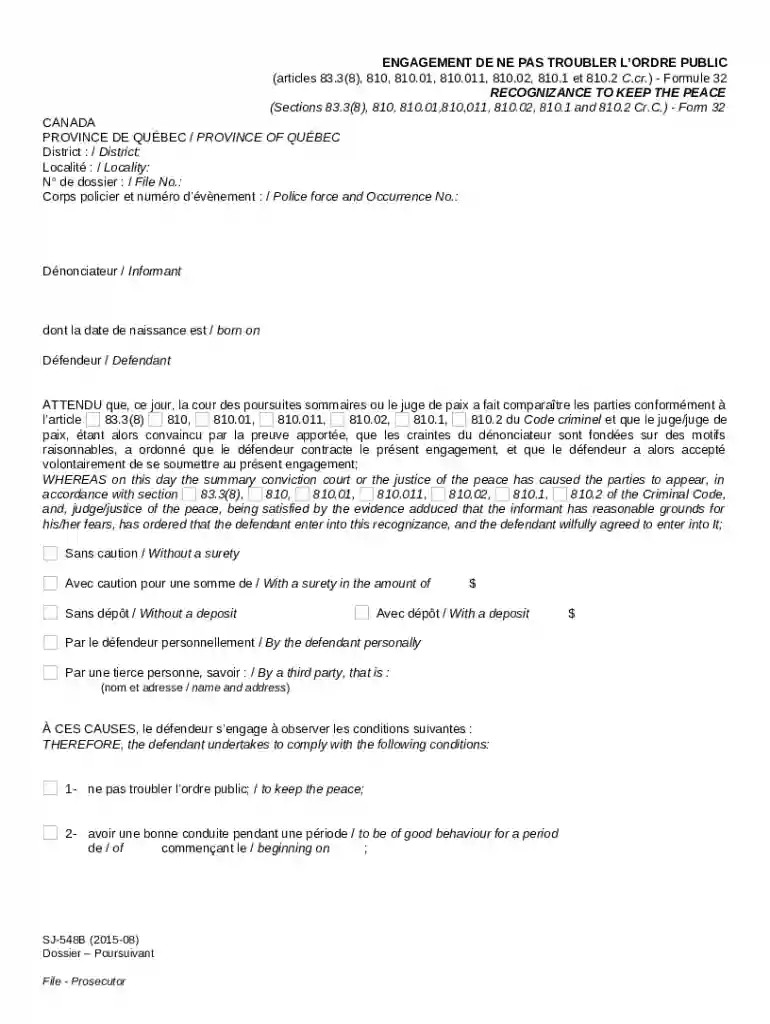
ENGAGEMENT DE NE PAS TROUBLER LORDRE PUBLIC (Articles 810, 810 2026

Get Form
ENGAGEMENT DE NE PAS TROUBLER LORDRE PUBLIC (Articles 810, 810 Preview on Page 1

Here's how it works

01. Edit your form online
Type text, add images, blackout confidential details, add comments, highlights and more.

02. Sign it in a few clicks
Draw your signature, type it, upload its image, or use your mobile device as a signature pad.

03. Share your form with others
Send it via email, link, or fax. You can also download it, export it or print it out.

Definition and Meaning

The "Engagement de ne pas troubler l'ordre public" is a legal commitment mandated by Canadian law. It requires an individual, typically a defendant in a legal matter, to agree not to disturb public order as part of a conditional release or bond. This engagement is grounded in Articles 810 and 810.2 of the Canadian Criminal Code, which aim to prevent disturbances and maintain peace by imposing specific conditions on individuals deemed necessary by the court. These conditions often include restrictions on behavior and association to ensure public safety.

How to Use the Form

Using the "Engagement de ne pas troubler l'ordre public" form involves several key steps. An individual must review the document thoroughly with legal counsel to understand all obligations. The person involved is required to sign the form, agreeing to abide by all the stipulated conditions. Signing this form is a legal acknowledgment of the commitment to maintain public peace, and it often includes stipulations like refraining from unlawful conduct or contact with certain individuals. Noncompliance with these conditions can lead to legal consequences, such as fines or imprisonment.

Steps to Complete the Form

  1. Review the Terms: Begin by reading the form carefully. Ensure you understand each condition.
  2. Legal Consultation: Consult a legal professional to clarify any doubts regarding your obligations.
  3. Provide Personal Information: Fill in your personal details, such as name, address, and contact information.
  4. Acknowledge Conditions: Explicitly acknowledge each condition stated in the form. This may include behavioral restrictions or contact limitations.
  5. Legal Signatures: Sign the form in the presence of a legal authority to validate your commitment.
  6. Submit the Form: Follow submission instructions, which may vary by jurisdiction, to complete this legal process.

Who Typically Uses the Form

This form is primarily used by defendants who have been ordered by the court to undertake a recognizance to keep public peace. It is applicable in cases where the court perceives potential threats to public safety and is often used for individuals with a history of offenses. Apart from defendants, law enforcement officials, legal professionals, and court authorities frequently engage with this form to enforce and regulate the terms stipulated within.


decoration image ratings of Dochub

Legal Use and Considerations

The legal use of the "Engagement de ne pas troubler l'ordre public" is explicitly for maintaining public order. This formality ensures individuals comply with laws and regulations designed to prevent any breach of peace. Legal consequences for breaching this agreement can include revocation of bond, additional penalties, and potential re-arrest. Particular attention is given to the legal jurisdiction, as local laws and regulatory requirements influence how this form is enforced and interpreted.

Key Elements of the Form

  • Conditions: Defines specific behaviors prohibited to ensure public peace, such as avoiding specific locations or individuals.
  • Duration: Stipulates the period during which the individual must comply with the conditions.
  • Consequences: Outlines penalties for non-compliance, including potential arrest or increased fines.
  • Sureties: May require a financial guarantee or third-party assurance to affirm commitment to public order.
  • Court Instructions: Details precise instructions from the court that must be followed.

Penalties for Non-Compliance

Violation of the terms set out in this form can lead to serious repercussions. Individuals may face:

  • Revocation of Release: Immediate cancellation of the release agreement, possibly leading to detention.
  • Financial Penalties: Imposition of fines or forfeiture of any financial sureties posted.
  • Additional Charges: Further legal action could be taken, leading to more severe charges or an expedited trial.

Important Terms Explained

  • Recognizance: A legal promise made by an individual to abide by certain conditions to ensure compliance with law and order.
  • Committal Conditions: Specific requirements mandated by the court, often tailored to individual cases based on perceived risk to public safety.
  • Surety: Involves a third party who assumes responsibility for ensuring compliance of the individual with the set conditions.

Examples of Use

In a real-world context, the form has been used in various scenarios:

  • Domestic Disputes: Where there is potential for public disturbance or harm, conditions might restrict proximity to affected parties.
  • Protests and Demonstrations: Individuals likely to incite unrest may be obligated to commit to public order during events.
  • Repeat Offenders: For those with previous offenses, this form ensures adherence to legal and public safety standards to prevent re-offending.

Each application of the form serves to strategically prevent disruptions and improve community safety through a structured legal framework.

be ready to get more

Complete this form in 5 minutes or less

Get form

Got questions?

We have answers to the most popular questions from our customers. If you can't find an answer to your question, please contact us.
Contact us
Le trouble lordre public est latteinte significative la paix publique. Si la notion est vidente lorsque le trouble provoque un danger ou une restriction des liberts des autres citoyens, elle est beaucoup plus floue lorsquil sagit dune nuisance la quitude.
Un engagement de ne pas troubler lordre public est une ordonnance judiciaire que vous pouvez demander lorsquune personne vous a menac ou bless. Cette personne peut tre votre conjoint ou partenaire, ou une autre personne.
Le 810 est un article du code criminel. En acceptant de le signer dans un contexte de conflit conjugal, laccus admet que son ex-conjointe a raison de craindre pour sa vie, la vie de ses enfants, la vie de son partenaire intime ou mme endommager sa proprit.
On appelle ces engagements 810 ou 810.03 en raison des articles du Code criminel auxquels ils se rapportent. Cest un outil de justice prventive. Un juge peut lordonner mme si aucun crime na t commis.
Un engagement de ne pas troubler lordre public est une solution trs avantageuse, car il vous permet dviter le risque dune condamnation et les consquences dun casier judiciaire. Cela dit, un engagement de ne pas troubler lordre public exige le respect de conditions, ce qui peut savrer difficile la longue.

Security and compliance

At DocHub, your data security is our priority. We follow HIPAA, SOC2, GDPR, and other standards, so you can work on your documents with confidence.
Learn more
ccpa2
pci-dss
gdpr-compliance
hipaa
soc-compliance
be ready to get more

Complete this form in 5 minutes or less

Get form