




01. Edit your eesd 3900 online
Type text, add images, blackout confidential details, add comments, highlights and more.

Type text, add images, blackout confidential details, add comments, highlights and more.

Draw your signature, type it, upload its image, or use your mobile device as a signature pad.

Send eesd 3900 via email, link, or fax. You can also download it, export it or print it out.
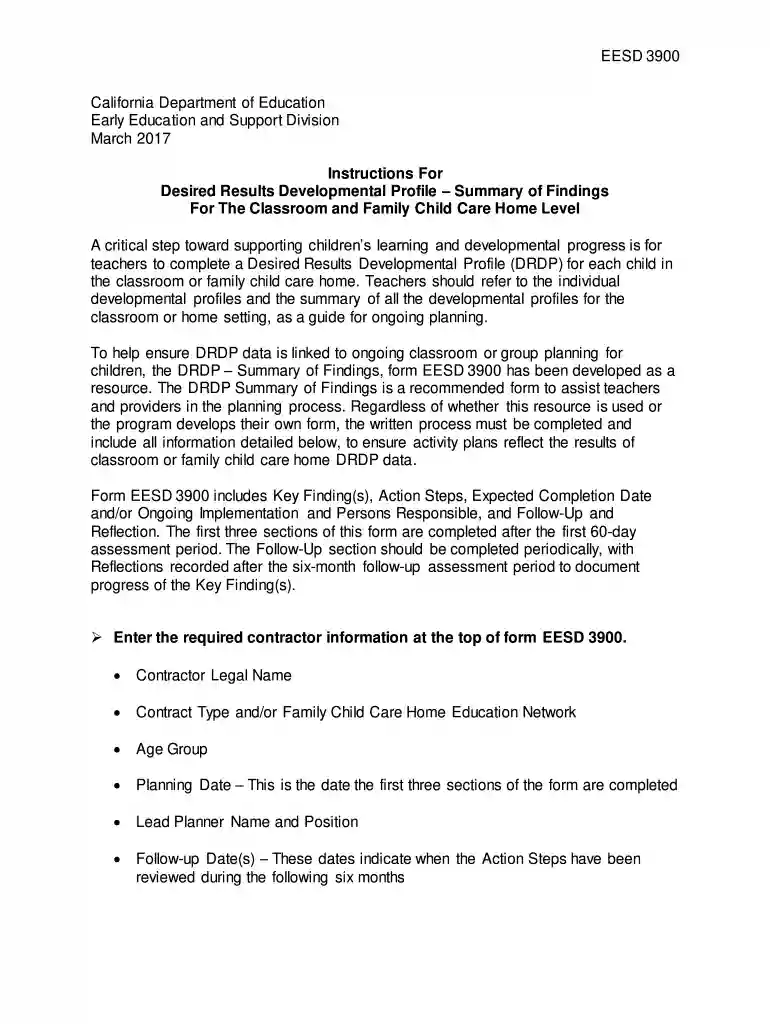
The EESD 3900 is a document issued by the California Department of Education's Early Education and Support Division, designed to help educators complete the Desired Results Developmental Profile (DRDP). The DRDP is an assessment tool used to evaluate children’s development in classroom and family child care settings. EESD 3900 includes guidance on using DRDP data to inform planning and development, ultimately aiming to improve educational outcomes for young learners.
Teachers and educators use the EESD 3900 to systematically observe and record children's developmental progress. This is essential for creating personalized learning plans and adapting educational strategies to meet the diverse needs of children.
The EESD 3900 can typically be obtained directly from the California Department of Education's website or through specific training sessions aimed at certificated childcare providers.
Completing the EESD 3900 involves several crucial steps that should be followed diligently to ensure accuracy.
The use of the EESD 3900 supports educators in systematically measuring and understanding child development, aiding in tailored instructional planning.
The primary users of the EESD 3900 are educators working in early childhood settings, including teachers in preschools, kindergartens, and family child care providers.


The EESD 3900 is structured to include various sections that guide educators through the assessment process.
Legally, the EESD 3900 must be used in compliance with the procedures outlined by the California Department of Education. Ensuring that the document is completed according to these standards is critical for its acceptance in formal educational evaluations.
At DocHub, your data security is our priority. We follow HIPAA, SOC2, GDPR, and other standards, so you can work on your documents with confidence.

M3900 Phase III Virtual Office Enhancement (EESD) timer expires. If the far end is not ready EESD 0 - (1024) - 4992. End-to-End Signaling Delay
California State University HIGH SCHOOL SUCCESS. Elementary School District EESD Redding 96002-0749 95340-3900 Independence High (Alter.)
Form EED-3900 includes Key Finding(s), Action Steps, Expected Completion Date and/or Ongoing Implementation and Persons Responsible, and Follow-up andRead more


