(0531e) Statement of Voluntary Participation and Consent for Private 2026

Get Form
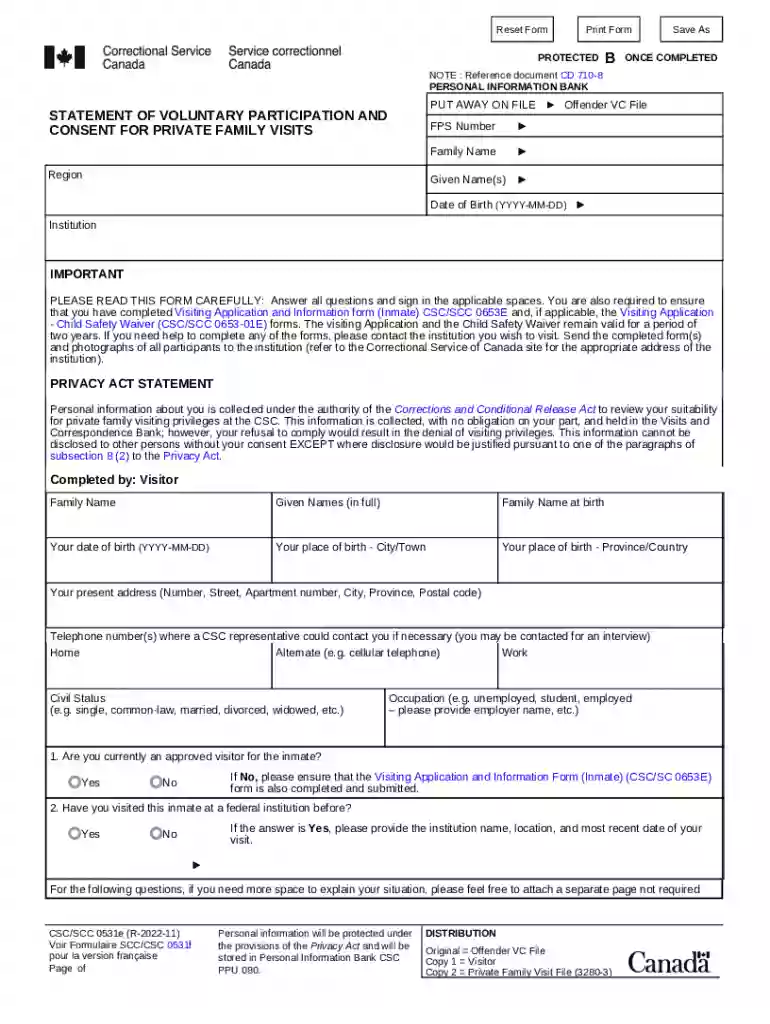
0531e form Preview on Page 1

Here's how it works

01. Edit your 0531e form online
Type text, add images, blackout confidential details, add comments, highlights and more.

02. Sign it in a few clicks
Draw your signature, type it, upload its image, or use your mobile device as a signature pad.

03. Share your form with others
Send it via email, link, or fax. You can also download it, export it or print it out.

Definition & Meaning

The (0531e) Statement of Voluntary Participation and Consent for Private is a formal declaration that enables individuals to voluntarily participate in private family visits with inmates in Canadian federal institutions. This document confirms the visitor's understanding of the institution's rules and regulations and acknowledges the potential risks involved. The form is an essential part of the visitation process, ensuring both parties are aware of their responsibilities and the terms of participation. By signing, the visitor consents to provide necessary personal information and agrees to adhere to the conditions set forth in the document.

Key Elements of the (0531e) Statement

The form comprises various critical components that facilitate the consent and participation process:

  • Personal Information: Requires visitors to provide their full name, address, and contact details to verify their identity and purpose.
  • Relationship to Inmate: This specifies the visitor's connection to the inmate, which is essential for granting approval for the visit.
  • Acknowledgment of Risks: Visitors sign to acknowledge and accept any inherent risks associated with the visitation.
  • Consent and Privacy Statement: Details how personal information will be handled, ensuring compliance with privacy regulations.
  • Signature Section: Confirms that the visitor voluntarily agrees to all terms stated in the form.

Steps to Complete the (0531e) Statement

  1. Read the Document Thoroughly: Before filling out the form, carefully read all sections to understand what is being requested.
  2. Fill in Personal Details: Complete the sections requiring your personal information, including your contact details and relationship to the inmate.
  3. Acknowledge Understanding: Make sure to check-off any boxes or initial sections indicating that you understand the risks and privacy information.
  4. Sign the Document: Add your signature to legally affirm your consent and understanding of the form’s contents.

How to Obtain the Form

The (0531e) form can usually be obtained through multiple channels:

  • Federal Institution Directly: Often available at the public information desk of the institution where the inmate is held.
  • Online Platforms: Law enforcement or departmental websites may provide downloadable versions.
  • Mail Requests: Contacting the institution by mail and requesting a paper form is often an option, especially for those unable to visit in person.

Legal Use of the (0531e) Statement

The form serves as a legal consent mechanism allowing the processing of private family visits. It ensures compliance with federal regulations regarding inmate visitation and privacy laws. By completing and signing the document, visitors legally bind themselves to the terms and conditions outlined, which can include conduct expectations and information sharing consent. This legal framework protects both the institution and the visiting party.

Who Typically Uses the (0531e) Statement

The form is primarily utilized by family members and close acquaintances of inmates in Canadian federal institutions. It is specially designed for those who wish to engage in private visiting arrangements, facilitating a controlled and legally sound interaction with the incarcerated individual. Legal representatives or spiritual advisors might also use similar documents if their visit qualifies for private terms.


decoration image ratings of Dochub

Important Terms Related to the Form

Several terms essential for understanding the document include:

  • Voluntary Participation: Participation based on free will without any obligation.
  • Consent: Providing approval to proceed with the visit under the agreed terms.
  • Private Family Visits: Visits allowing more intimate and less monitored interactions between inmates and their visitors.
  • Privacy Statement: Assurance of the confidentiality and protection of personal information.

Examples of Using the (0531e) Statement

Imagine a scenario where a family member wants to visit an incarcerated loved one. The (0531e) form is the first step to facilitate this visit, ensuring that the family member agrees to the visit's terms and understands the privacy handling of their personal data. Another example could involve an inmate’s sibling wanting a private visit to discuss family matters, for which the form serves as a conduit to initiate that process securely.

Penalties for Non-Compliance

Not adhering to the terms set out in the (0531e) statement can lead to various consequences, including:

  • Revocation of Visitation Rights: Non-compliance can result in losing the privilege to participate in private family visits.
  • Legal Repercussions: Providing false information or breaching agreed conditions may result in legal action or fines.
  • Institutional Penalties: This includes being barred from entering the facility or involvement in future visitations.
be ready to get more

Complete this form in 5 minutes or less

Get form

Got questions?

We have answers to the most popular questions from our customers. If you can't find an answer to your question, please contact us.
Contact us
Inform the individual providing you with their consent about: the purpose of the consent and the specific personal information involved. wholl be asked to provide personal information. the reason why the information is being collected indirectly.
Voluntarism is defined as the ability of an individual to judge, freely, independently, and in the absence of coercion, what is good, right, and best subjected to his/her own situation, values, and prior history. [10] For an ethical and valid consent, the subjects decision has to be a voluntary one.
Informed consent is a voluntary agreement to participate in a study, experiment, intervention, or treatment. To give informed consent, participants must be aware of the nature of the procedure, the possible benefits, any available alternatives, and the potential risks.
Voluntary participation means the people answering questions have made a free choice to be involved in the gathering of information. They should not be coerced into being involved in any way. It is crucial they are able to stop the questions, or change their mind about being involved, at any time.
For consent to be informed, participants need to have an understanding of the purpose, methods, potential risks and benefits of the research. For consent to be voluntary, participants need to know how they can withdraw from a project and that there are alternatives to being participants.

Security and compliance

At DocHub, your data security is our priority. We follow HIPAA, SOC2, GDPR, and other standards, so you can work on your documents with confidence.
Learn more
ccpa2
pci-dss
gdpr-compliance
hipaa
soc-compliance

People also ask

Informed consent is one of the founding principles of research ethics. Its intent is that human participants can enter research freely (voluntarily) with full information about what it means for them to take part, and that they give consent before they enter the research.

Related links