Toxicological Analysis Request Form DFS-59 - DUI 2026

Get Form
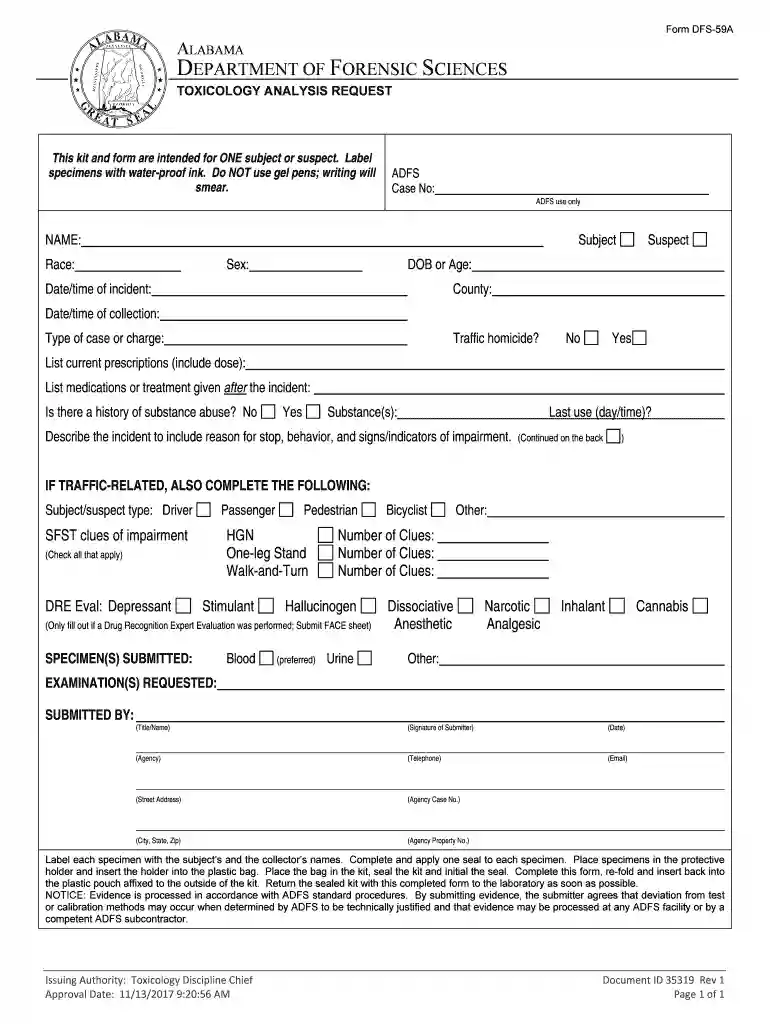
Toxicological Analysis Request Form DFS-59 - DUI Preview on Page 1

Here's how it works

01. Edit your form online
Type text, add images, blackout confidential details, add comments, highlights and more.

02. Sign it in a few clicks
Draw your signature, type it, upload its image, or use your mobile device as a signature pad.

03. Share your form with others
Send it via email, link, or fax. You can also download it, export it or print it out.

Definition & Meaning

The Toxicological Analysis Request Form DFS-59 - DUI is a critical document used by the Alabama Department of Forensic Sciences for conducting toxicology testing related to DUI investigations. This form facilitates the submission of biological specimens for laboratory analysis to detect the presence of alcohol or drugs in individuals suspected of driving under the influence. Through test results, it helps establish the level of impairment, supporting law enforcement and legal proceedings.

Key Benefits of the Form

  • Collects vital information for accurate analysis.
  • Aids in legal enforcement for DUI cases.
  • Provides standardized instructions for sample handling.

Steps to Complete the Toxicological Analysis Request Form DFS-59 - DUI

Completing the DFS-59 form requires careful attention to detail to prevent delays or errors in processing. Here’s a detailed guide:

  1. Personal Information: Fill in the subject’s personal details, including name, address, and date of birth. Accuracy is critical to match test results with the correct individual.

  2. Incident Details: Describe the scenario leading to the DUI investigation, including the date, time, and location of the incident. This context aids the laboratory in understanding the urgency and nature of testing required.

  3. Substance History: Indicate any known substance use by the suspect. This can include alcohol, prescription medications, or illicit drugs known to affect driving behavior.

  4. Specimen Submission Instructions: Follow the guidelines for labeling and packaging specimens. Incorrect submission could contaminate the sample or invalidate results.

  5. Contact Information for Law Enforcement: Include the investigating officer's contact details, enabling efficient communication for case updates.

Key Considerations

  • Ensure all forms are legible and double-check for completeness.
  • Adhere to chain-of-custody procedures to maintain sample integrity.

Key Elements of the Toxicological Analysis Request Form DFS-59 - DUI

The DFS-59 form comprises several essential sections that must be completed accurately:

  • Personal Identification: Ensures that the results relate to the correct individual.
  • Incident Summary: Provides contextual background necessary for analysis.
  • Substance Use Information: Guides analytical focus, ensuring comprehensive testing.
  • Contact and Legal Information: Facilitates communication between law enforcement and forensic personnel.
  • Specimen Handling and Transport Instructions: Critical for maintaining sample integrity from collection to analysis.

Legal Use of the Toxicological Analysis Request Form DFS-59 - DUI

The DFS-59 form serves a legal purpose within the DUI investigation process:

  • Evidence Collection: The form documents the chain of custody for specimens, ensuring they follow legal protocols.
  • Court Proceedings: The results obtained from the form are admissible in court, providing empirical evidence of impairment.
  • Regulatory Compliance: Adhering to prescribed procedures ensures compliance with state DUI regulations and forensic standards.

Who Typically Uses the Toxicological Analysis Request Form DFS-59 - DUI

Several parties are typically involved in the use of this form:

  • Law Enforcement Officers: Initiate and complete the form as part of standard DUI investigation protocols.
  • Forensic Laboratories: Analyze the submitted specimens to detect and quantify substances.
  • Legal Professionals: Use the results as part of evidence in prosecutions or defense in DUI-related cases.
  • Policy Makers: May refer to compiled data from these forms for public safety and policy decisions.
decoration image ratings of Dochub

State-Specific Rules for the Toxicological Analysis Request Form DFS-59 - DUI

While the form is widely used, specific regulations in Alabama affect its implementation:

  • Chain-of-Custody Protocols: Adherence to exclusive state procedures ensures evidence is viable in judicial proceedings.
  • Reporting Requirements: Strict timelines for submission and reporting may vary slightly based on case urgency.
  • Handling and Transport: Complying with state-prescribed methods prevents sample degradation during transportation to the lab.

Form Submission Methods (Online / Mail / In-Person)

Submitting the DFS-59 form requires choosing appropriate methods:

  • Mail: Traditional option, ensuring proper documentation of chain-of-custody.
  • In-Person: Direct drop-off maintains custody integrity but may depend on proximity to labs.
  • Online: Emerging digital options reduce paperwork but must ensure encrypted and secure data transfer.

Advantages & Disadvantages

  • Mail: Well-documented but slower.
  • In-Person: Immediate but not always feasible.
  • Online: Fast and efficient if secure portals are implemented.

Penalties for Non-Compliance

Failing to comply with submission and procedural standards of the DFS-59 form can result in serious consequences:

  • Case Dismissal: Errors in form submission or specimen handling could lead to dismissal of charges.
  • Legal Challenges: Improperly documented toxicology results may not hold up in court.
  • Operational Delays: Incorrect submissions can cause backlog in forensic labs, impacting other ongoing cases.

Preventive Measures

  • Maintain up-to-date training for officers handling these forms.
  • Conduct audits to ensure adherence to protocols.
be ready to get more

Complete this form in 5 minutes or less

Get form

Security and compliance

At DocHub, your data security is our priority. We follow HIPAA, SOC2, GDPR, and other standards, so you can work on your documents with confidence.

Learn more
ccpa2
pci-dss
gdpr-compliance
hipaa
soc-compliance
be ready to get more

Complete this form in 5 minutes or less

Get form