01. Edit your form online
Type text, add images, blackout confidential details, add comments, highlights and more.

Type text, add images, blackout confidential details, add comments, highlights and more.

Draw your signature, type it, upload its image, or use your mobile device as a signature pad.

Send it via email, link, or fax. You can also download it, export it or print it out.
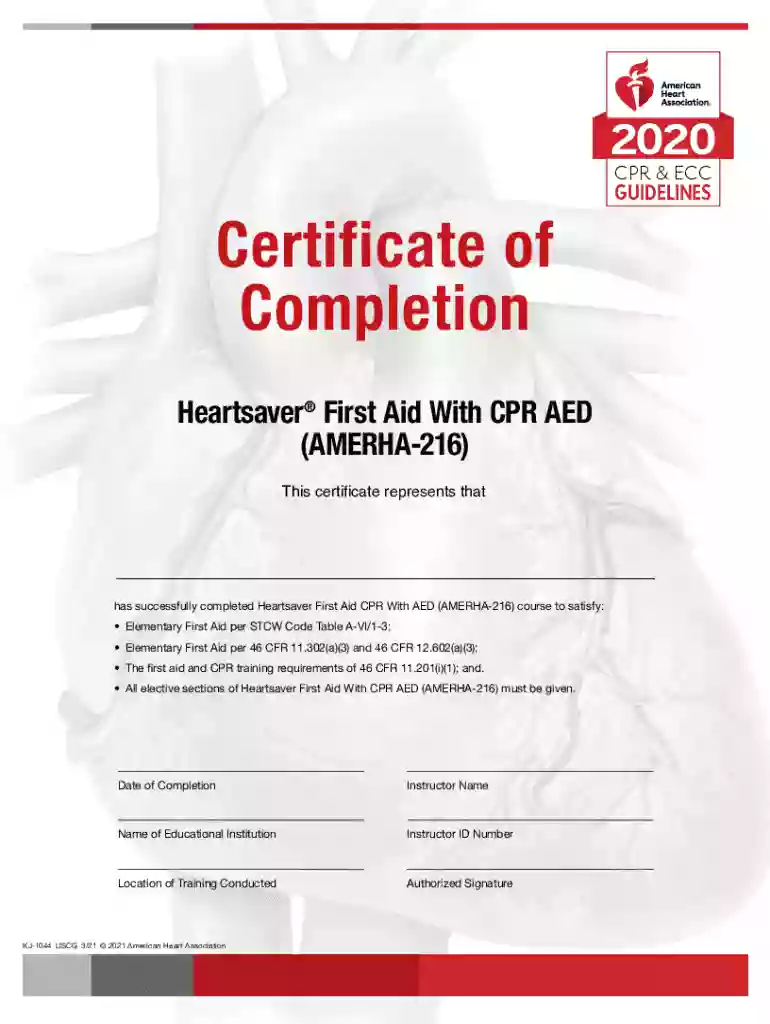
The Heartsaver First Aid CPR AED Certificate is a document awarded to individuals who have successfully completed a course focused on basic first aid, cardiopulmonary resuscitation (CPR), and the use of automated external defibrillators (AEDs). This certification verifies that the holder has met the training requirements necessary to perform elementary first aid and CPR as outlined by various health and safety regulatory entities. With this credential, individuals are recognized as qualified to respond to common emergencies involving cardiac and breathing emergencies among adults, children, and infants.
Once you have obtained the Heartsaver First Aid CPR AED Certificate, it serves as proof of your skills and knowledge in handling first aid and CPR situations. Holders can present this certificate to demonstrate their capability in emergency response during job applications or performance evaluations. Many employers, particularly those in the healthcare, childcare, and education sectors, may require staff to be certified in first aid and CPR. In addition, some organizations may display this certificate within their facilities to assure clients and visitors of the staff's preparedness to handle medical emergencies.
Register for the Course: Find an accredited provider offering the Heartsaver First Aid CPR AED course. This could be through community colleges, medical training centers, or online platforms.
Attend the Training Sessions: Participate actively in all required sessions. The curriculum typically covers topics like managing sudden illnesses, performing CPR, using AEDs, and addressing breathing emergencies.
Complete Practical Assessments: Engage in hands-on practice and practical assessments conducted during the course to demonstrate your proficiency in the learned skills.
Pass the Knowledge Test: Successfully complete a written or online test to confirm your understanding of first aid and CPR principles.
Receive Your Certificate: Upon meeting all course requirements, receive your certificate of completion, which may also include a wallet-sized version for convenience.
To enroll in a course leading to the Heartsaver First Aid CPR AED Certificate, participants generally need to meet a few basic criteria. Most courses are designed for non-healthcare professionals and are typically open to anyone interested in learning lifesaving skills. Participants should be physically able to perform CPR compressions and operate an AED. There are usually no prerequisites regarding age or prior health-related training, making it accessible to a wide audience, including workplace employees, educators, and community volunteers.

While the Heartsaver First Aid CPR AED Certificate itself is not directly relevant to tax software like TurboTax or QuickBooks, keeping digital records of your certifications can be beneficial. For instance, if you require the certification for employment purposes, electronic documentation can be integrated into employment records within business management software. These records can provide easy access for compliance checks and professional audits.
Certificates can be issued both digitally and in hard copy. The digital version offers convenience as it can be stored on a computer or mobile device, ensuring quick access whenever needed. Many employers and organizations accept digital certificates for verification, as long as they are official and bear necessary marks such as watermarks or verified signatures. The paper version serves as a physical record and can be displayed in locations where clients or customers may wish to see credentials visually.
In the United States, the legal use of the Heartsaver First Aid CPR AED Certificate extends primarily to employment and educational settings where proof of training must often be shown to meet legal, regulatory, or organizational requirements. Obtaining such a certificate can help ensure compliance with workplace safety standards and health regulations. In some instances, it may be used in legal settings to demonstrate preparedness in emergency response, which can be crucial during assessments of workplace incidents or accidents.
At DocHub, your data security is our priority. We follow HIPAA, SOC2, GDPR, and other standards, so you can work on your documents with confidence.