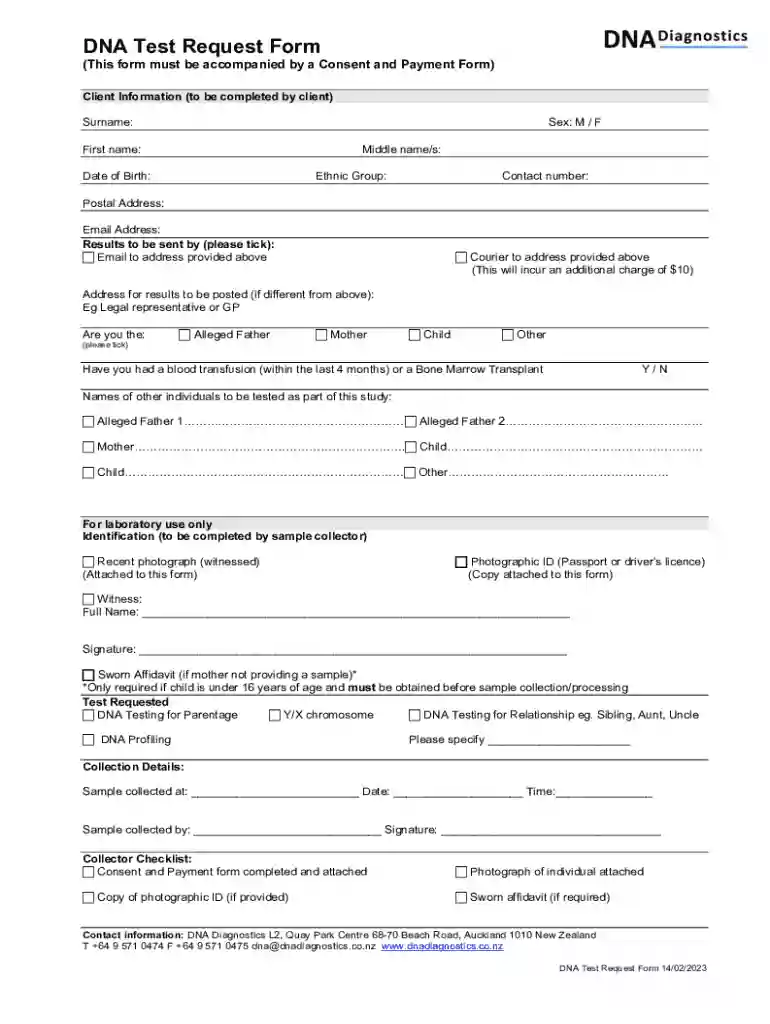
'Peace of Mind' DNA Test Request Form 2026

Get Form
'Peace of Mind' DNA Test Request Form Preview on Page 1

Here's how it works

01. Edit your form online
Type text, add images, blackout confidential details, add comments, highlights and more.

02. Sign it in a few clicks
Draw your signature, type it, upload its image, or use your mobile device as a signature pad.

03. Share your form with others
Send it via email, link, or fax. You can also download it, export it or print it out.

Definition & Meaning

The "'Peace of Mind' DNA Test Request Form" is primarily designed for individuals seeking to verify biological relationships, typically for parentage or family lineage confirmation. This form is essential for those who prefer a discreet approach without having the results reported to official registries or databases. The test offers an opportunity for individuals to obtain clarity regarding familial ties in a private manner, often utilized by individuals seeking assurances or resolutions to personal inquiries about genetic connections.

This DNA test request form encompasses various sections that gather detailed personal information from the requester and the person to be tested. Users provide consent for the DNA analysis, which is crucial for ensuring ethical compliance and privacy rights. The form also includes options for selecting which DNA testing services are needed, with possibilities ranging from basic ancestry information to sophisticated relationship assessments.

How to Use the 'Peace of Mind' DNA Test Request Form

To effectively utilize the "'Peace of Mind' DNA Test Request Form," individuals should follow these comprehensive steps:

  1. Download or Access the Form: Typically available through service providers’ websites or main offices, ensuring easy access in either digital or hard copy formats.
  2. Provide Personal Information: Fill out all sections related to personal data for both the client and the sample contributor, which includes names, addresses, and contact information.
  3. Select Test Type: Indicate the type of DNA test required, which could range from simple ancestry information to specific kinship confirmations.
  4. Consent Agreement: Carefully read and understand consent sections stipulating permissions for sample collection and subsequent analysis. Sign to agree to the terms outlined.
  5. Arrange Sample Collection: Coordinate with certified sample collectors or testing centers to ensure proper collection procedures are followed, safeguarding the integrity of the samples.
  6. Include Payment Details: Complete the financial information section to facilitate payment processing for services rendered, with details on additional fees if required.
  7. Submit Form and Sample: Send the completed form along with the DNA samples to the specified address or upload them online if the service supports electronic submissions.

Key Elements of the 'Peace of Mind' DNA Test Request Form

  • Personal Information Sections: Captures critical data of the requester and sample donor, ensuring accuracy and compliance.
  • Consent Clause: Legally binding section requiring signatories’ acceptance to proceed with genetic analysis.
  • Provider Details: Includes information about the testing service provider, helping to establish transparency and trust.
  • Sample Collection Instructions: Provides guidelines on how samples should be collected, preserved, and submitted, ensuring consistent quality standards.
  • Payment Processing Information: Details regarding payment methods and any additional costs for supplementary services like expedited analysis or courier services.

Important Terms Related to 'Peace of Mind' DNA Test Request Form

  • Locus: Specific location of a gene or DNA sequence on a chromosome.
  • Allele: Various versions of a gene found at the same locus.
  • Genotype: Individual’s collection of genes, crucial for personal DNA analysis.
  • Chain of Custody: Protocol ensuring sample integrity during transfer.
  • Blinding: Masking identities to reduce bias during analysis and results interpretation.

Legal Use of the 'Peace of Mind' DNA Test Request Form

When utilizing the "'Peace of Mind' DNA Test Request Form," it is imperative to adhere to legal guidelines:

  • Use for Informational Purposes Only: Results should not be used for legal purposes such as custody battles unless specifically authorized.
  • Consent is Critical: All involved parties must willingly consent to the testing, assuring ethical compliance.
  • Confidentiality Policies: Providers must uphold strict confidentiality, utilizing security measures like encryption to protect personal data.
  • Regulatory Compliance: Adherence to local laws governing genetic testing, including state-specific privacy laws in the United States.

Steps to Complete the 'Peace of Mind' DNA Test Request Form

  1. Download the Latest Version: Ensure you have the most updated form to prevent any compliance issues.
  2. Complete Personal and Sample Information: Accurately fill in required fields, double-checking for errors.
  3. Select the Desired Test: Clearly mark the DNA test(s) you want to conduct.
  4. Read Terms and Conditions: Familiarize yourself with all terms to avoid misunderstandings regarding test outcomes and confidentiality.
  5. Arrange for Sample Collection: Plan collection by a certified professional if required, maintaining sample integrity.
  6. Finalize Consent Documents: All participants should review and sign consent sections, clarifying their understanding and agreement to the testing process.
  7. Review and Submit: Double-check for completeness before submission, ensuring all relevant attachments and payments are enclosed.

Examples of Using the 'Peace of Mind' DNA Test Request Form

Real-world applications for the "'Peace of Mind' DNA Test Request Form" often include:

  • Parents verifying paternity: Utilizing the form to confirm biological relationships without involving legal proceedings.
  • Reconnecting with Relatives: Assisting adopted individuals in finding biological parents through concise, private testing.
  • Ethnic Ancestry Analysis: Understanding ethnic background and genetic health risks.
  • Private Investigations: Discreetly verifying familial claims under sensitive circumstances.

Who Typically Uses the 'Peace of Mind' DNA Test Request Form

The form's primary users include:

  • Individuals Seeking Assurance: Using personal investigation to answer personal questions of relationship.
  • Families in Transition: Clarifying biological ties within blended or adoptive families.
  • Private Investigators: Conducting discreet investigations into familial claims.
  • Researchers: Using non-conclusive DNA data for educational purposes, ensuring all ethical standards and consent are respected.
decoration image ratings of Dochub

Version or Alternatives to the 'Peace of Mind' DNA Test Request Form

While the form suits many users, alternatives exist for specialized needs:

  • Legal DNA Test Forms: Required for court admissible results, involving stricter compliance guidelines.
  • Ancestry Kits: General background without a focus on parental confirmation.
  • Health-based DNA Forms: For those seeking medical insights rather than relationship verification.

Alternative versions exist for those needing additional privacy or those who prefer at-home testing kits, which allow for sample collection in the privacy of one's own home. The choice of form depends on the individual's specific requirements and intended use of test results.

be ready to get more

Complete this form in 5 minutes or less

Get form

Got questions?

We have answers to the most popular questions from our customers. If you can't find an answer to your question, please contact us.
Contact us
Give them the space to process their emotions and thoughts. Listen actively to their concerns and address them with empathy. Provide Information: Explain how the DNA test works, its accuracy, and the process involved. You can also offer to take the test together to show that you are committed to finding the truth.
Asking for a DNA test when unsure about paternity can bring clarity to a situation, helping to establish biological relationships. However, it should be approached with open communication and empathy, as it can impact relationships, emotions, and potentially have legal and financial consequences.
If the person has not been buried or embalmed, the most reliable method of collecting DNA is using a blood card, hair follicles, or fingernail clippings. A coroner can help you with the blood card. If hair or fingernails are collected, it is important to provide at least a dozen or more samples.
4 Things to Do When Asking Relatives to Take a DNA Test Show Them Your Research. Explain Why I Need Their DNA. Offer to Pay for the Tests. Respect Their Decisions.
A legal paternity test (with court-admissible results), typically costs $300 to $500.

Security and compliance

At DocHub, your data security is our priority. We follow HIPAA, SOC2, GDPR, and other standards, so you can work on your documents with confidence.

Learn more
ccpa2
pci-dss
gdpr-compliance
hipaa
soc-compliance
be ready to get more

Complete this form in 5 minutes or less

Get form

People also ask

Consent is essential for DNA testing. It is a legal obligation for all individuals involved in the testing process to give their agreement.

Related links