Application for Emergency Admission Application for Emergency Admission 2026

Get Form
dmhas 0025 Preview on Page 1

Here's how it works

01. Edit your dmhas 0025 online
Type text, add images, blackout confidential details, add comments, highlights and more.

02. Sign it in a few clicks
Draw your signature, type it, upload its image, or use your mobile device as a signature pad.

03. Share your form with others
Send it via email, link, or fax. You can also download it, export it or print it out.

Definition and Meaning

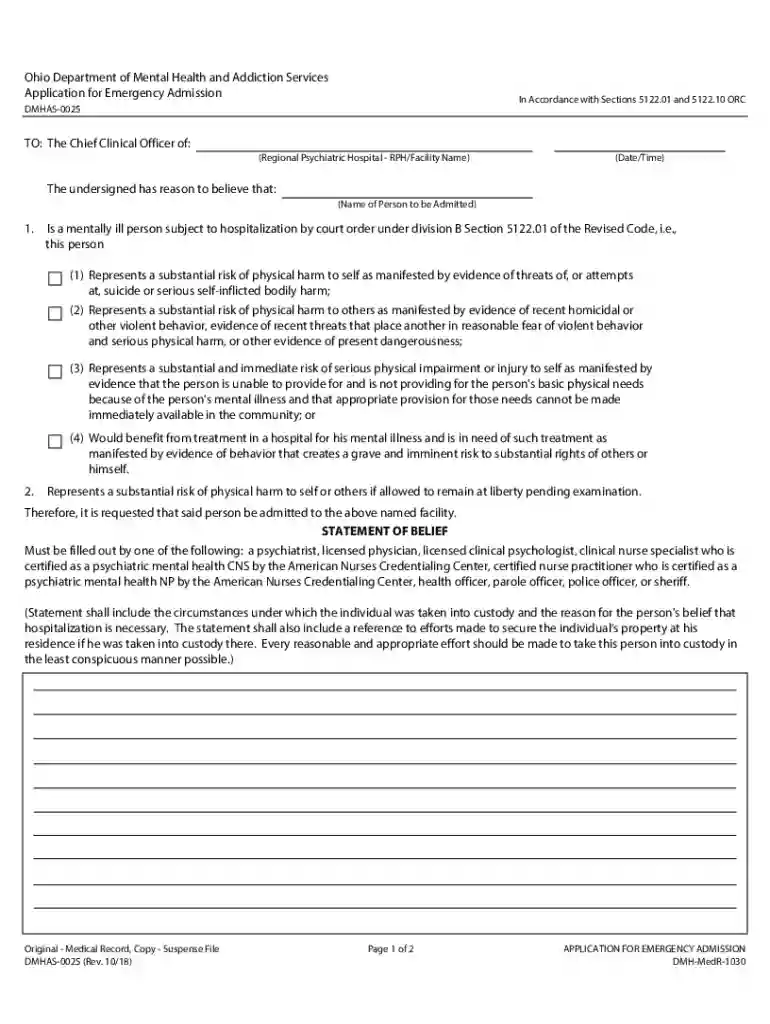
The Application for Emergency Admission is a critical document used for admitting individuals to a psychiatric hospital in Ohio under emergency circumstances. It is intended for those who are deemed mentally ill and pose a significant risk to themselves or others. The form lays out the specific criteria for hospitalization as outlined by the Ohio Revised Code. It requires a statement of belief from qualified professionals affirming the necessity of the emergency admission.

How to Use the Application

The Application for Emergency Admission is used by mental health professionals and authorized individuals within the healthcare system to initiate the process of emergency hospitalization. It serves as a formal request for the admission of a person who meets the criteria of posing a substantial risk. The form is filled out by detailing the individual's condition, the observed behaviors that indicate risk, and statements from the experts involved in the decision to pursue emergency hospitalization.

Steps for Proper Usage

  1. Identify the Need: Recognize symptoms or situations that may qualify as an emergency under the Ohio Revised Code.
  2. Complete the Form: Gather detailed information about the individual, including medical history and current mental health status. Provide a comprehensive statement from a qualified mental health professional.
  3. Submit the Application: The completed form should be submitted to the relevant psychiatric facility or authority handling emergency admissions.

Steps to Complete the Application

Filling out the Application for Emergency Admission requires careful attention to ensure all necessary information is accurately provided.

  1. Gather Information: Collect personal identification details of the individual, such as name, age, and contact information.
  2. Describe Condition: Provide a detailed description of the mental health condition and specific behaviors that justify emergency admission.
  3. Include Professional Statements: Attach a statement from a qualified mental health professional, such as a psychiatrist or psychologist, supporting the admission based on medical evaluations.
  4. Review Criteria: Ensure compliance with Ohio Revised Code criteria for emergency admissions.
  5. Submit for Review: Once completed, the form must be submitted to the appropriate facility for processing and admittance.

Key Elements of the Application

The Application for Emergency Admission contains several critical elements that need thorough completion:

  • Patient Information: Name, age, and contact information.
  • Detailed Description: Specific behaviors or symptoms indicating substantial risk.
  • Professional Endorsement: Statement from a licensed mental health professional.
  • Legal Compliance: Adherence to the specific sections of the Ohio Revised Code.
  • Submission Details: Information on where and how to submit the form.

Legal Use of the Application

The legal framework surrounding the Application for Emergency Admission is based on sections of the Ohio Revised Code that specify conditions under which an emergency admission is warranted. The form is legally binding and must be used in accordance with these rules to ensure the rights of the individual are protected while providing necessary care.

Key Legal Considerations

  • Professional Judgment: The form requires assessment and declaration by a licensed mental health professional.
  • Criteria Compliance: Adherence to legal definitions of risk and mental illness.
  • Documentation and Records: Accurate record-keeping is essential for legal validity and future reference.

State-Specific Rules

In Ohio, the procedures and criteria for emergency psychiatric admissions are governed by state laws. It is crucial for the authorized professionals using the Application for Emergency Admission to be familiar with these rules.

Notable State Requirements

  • Qualification of Professionals: Only certain licensed individuals are authorized to complete and submit the form.
  • Facility Admission Standards: Facilities must comply with state regulations regarding the treatment and care of admitted individuals.

Examples of Using the Application

The Application for Emergency Admission is often used in scenarios where an individual exhibits behaviors that are imminently dangerous to themselves or others. For instance, if a person is experiencing suicidal ideation with a specific plan, or if they are engaging in violent behavior towards others, this form would be used to expedite admission into a secure and supportive environment.

Case Study

A 30-year-old individual, recently diagnosed with severe depression, is exhibiting signs of acute distress and expressing intentions of self-harm. A psychiatrist, after evaluation, uses the Application for Emergency Admission to admit the patient into a psychiatric hospital for immediate stabilization and treatment.

Who Typically Uses the Application

The Application for Emergency Admission is primarily used by:

  • Mental Health Professionals: Psychiatrists, psychologists, and social workers who assess and determine the necessity for emergency admission.
  • Hospital Staff: Administrators and healthcare personnel responsible for the intake and processing of emergency admissions.
  • Law Enforcement: Officers involved in transporting individuals to facilities when necessary.

These users ensure that individuals who pose a significant risk receive timely and appropriate care within the legal framework.


decoration image ratings of Dochub
be ready to get more

Complete this form in 5 minutes or less

Get form

Got questions?

We have answers to the most popular questions from our customers. If you can't find an answer to your question, please contact us.
Contact us
Patients admitted to hospital when admission is unpredictable and at short notice because of clinical need.
An emergency admission occurs when a patient has a life-threatening injury or illness that requires immediate medical attention. Common examples are heart attack, stroke and extreme trauma or blood loss.
Involuntary treatment is typically applied under the following conditions: The individual has a severe mental illness. They are assessed as being at significant risk of harming themselves or others. No less restrictive treatment options are available.
Emergency: The patient requires immediate medical intervention as a result of severe, life threatening or potentially disabling conditions. Generally, the patient is admitted through the emergency room. Urgent: The patient requires immediate attention for the care and treatment of a physical or mental disorder.
Inpatient commitment law LAW 9.27(a). The director of a hospital may receive and retain therein as a patient any person alleged to be mentally ill and in need of involuntary care and treatment upon the certificates of two examining physicians, accompanied by an application for the admission of such person.

Security and compliance

At DocHub, your data security is our priority. We follow HIPAA, SOC2, GDPR, and other standards, so you can work on your documents with confidence.

Learn more
ccpa2
pci-dss
gdpr-compliance
hipaa
soc-compliance
be ready to get more

Complete this form in 5 minutes or less

Get form

People also ask

The most common are Elective Admissions, Direct Admissions, Holding Admissions, and Emergency Admissions. Depending on the needs, these admissions bring different levels of medical care.
Unplanned (urgent) admission If your condition is unexpected and you need urgent treatment, you will be admitted through the emergency department on arrival at hospital this is done through a process known as triage.

Related links