Chain Of Custody 5 0 092222 xlsx - SPL 2026

Get Form
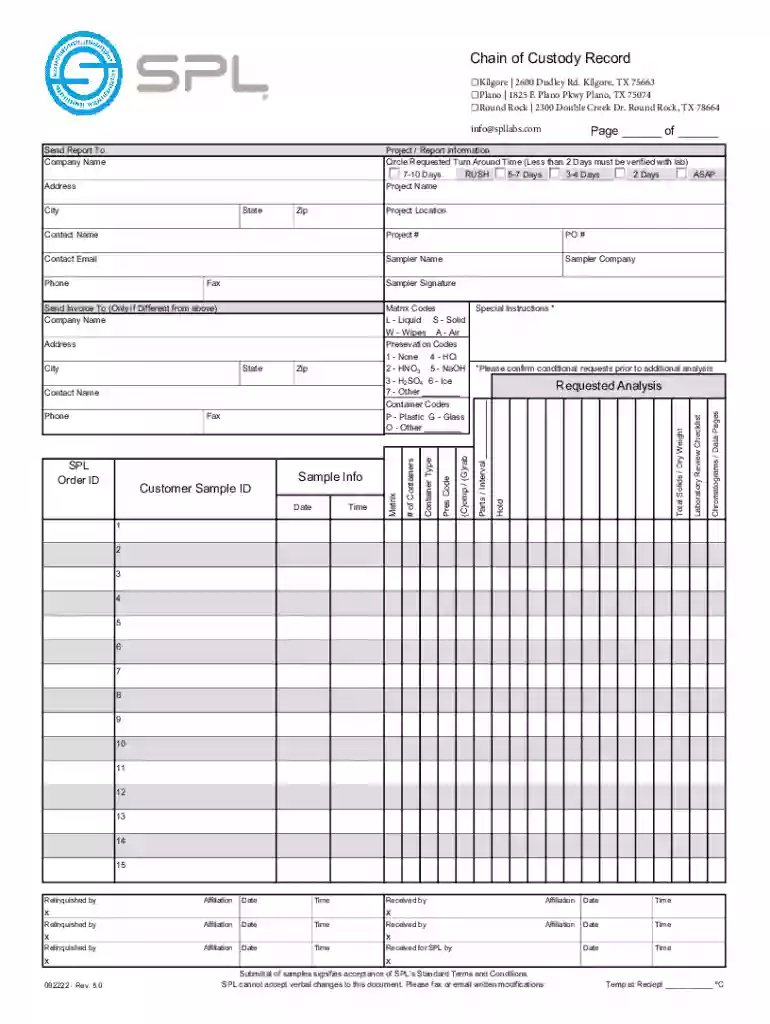
Chain Of Custody 5 0 092222 xlsx - SPL Preview on Page 1

Here's how it works

01. Edit your form online
Type text, add images, blackout confidential details, add comments, highlights and more.

02. Sign it in a few clicks
Draw your signature, type it, upload its image, or use your mobile device as a signature pad.

03. Share your form with others
Send it via email, link, or fax. You can also download it, export it or print it out.

Definition and Purpose of Chain Of Custody 5 0 092222 xlsx - SPL

The "Chain Of Custody 5 0 092222 xlsx - SPL" is a critical document used to track and manage samples submitted for laboratory analysis. This record ensures proper documentation of a sample's journey from collection to analysis by including sections for project information, sample details, contact information, and instructions for handling samples. It safeguards the integrity of the sample data by documenting each stage of custody with precise timestamps and signatures.

Key Elements of the Document

  • Project Information: Provides a comprehensive overview of the project associated with the samples.
  • Sample Details: Lists specifics such as sample type, collection date, and unique identifiers.
  • Contact Information: Includes details of individuals involved in sample collection and analysis.
  • Handling Instructions: Offers guidelines to ensure proper sample management throughout the process.

How to Use Chain Of Custody 5 0 092222 xlsx - SPL

To effectively use the Chain Of Custody (CoC), follow these steps:

  1. Initiate the Document: Begin by filling out the project and sample details.
  2. Record Custody Transfers: Each time the sample changes hands, document the transfer details.
  3. Ensure Signatures are Obtained: Collect signatures from involved personnel at each transfer stage.
  4. Manage Handling Instructions: Review and follow any specific handling protocols outlined in the document.
  5. Complete Final Submission: Once analysis is complete, finalize the document by obtaining necessary end-stage signatures.

Practical Scenarios of Usage

  • Environmental Testing: Tracking water samples from collection sites to testing facilities.
  • Medical Analysis: Ensuring proper transit of clinical samples between hospitals and labs.
  • Food Safety: Documenting the process of food samples undergoing contamination checks.

Steps to Complete the Chain Of Custody 5 0 092222 xlsx - SPL

Completing the CoC document involves several key steps to ensure accuracy and compliance:

  1. Gather Initial Data: Compile all project-related data and sample specifics.
  2. Fill Out the Initial Sections: Enter project information, sample details, and contact data.
  3. Document Each Custody Transfer: With each handover, log the recipient's details and obtain signatures.
  4. Ensure Handling Compliance: Verify that handling instructions are followed at each stage.
  5. Finalize the Document: Upon completion of analysis, wrap up with final signatures and dates.

Step-by-Step Guidelines

  • Preparation Phase: Prioritize accuracy by verifying all input data.
  • Transfer Documentation: Encourage thorough checking at each handover.
  • Compliance Verification: Regularly audit the document for compliance with predefined procedures.

Legal Use and Compliance

Using the Chain Of Custody document legally involves adhering to established protocols and maintaining a transparent record. The document serves:

  • As Evidence of Proper Handling: Ensures samples have been maintained under requisite conditions.
  • For Legal Verification: Acts as a legitimate record in case of disputes or inquiries.

Legal Considerations

  • Signature Validation: Ensure all signatures are legitimate and authenticated.
  • Accurate Record Keeping: Maintain precise and truthful entries to withstand legal scrutiny.

Who Typically Uses the Chain Of Custody 5 0 092222 xlsx - SPL

A wide array of professionals and organizations utilize the Chain Of Custody document:

  • Laboratories: For systematic sample management.
  • Research Institutions: Conducting studies requiring controlled sample environments.
  • Regulatory Agencies: Ensuring compliance with standards and regulations.
decoration image ratings of Dochub

Common Users

  • Environmental Scientists: For field data collection and monitoring.
  • Healthcare Professionals: In pharmacological and clinical testing environments.
  • Food Safety Inspectors: In auditing and quality assurance processes.
decoration image

Important Terms Related to Chain Of Custody 5 0 092222 xlsx - SPL

Understanding certain key terms is essential for properly managing the Chain Of Custody:

  • Custody Transfer: The point at which control of the sample is passed to another entity.
  • Signatory: An individual who signs the document to acknowledge receipt or release of a sample.
  • Sample Identifier: Unique label or code used to distinguish each sample.

Glossary of Terms

  • Timestamp: The recorded date and time of a sample handover.
  • Custodian: Person or entity responsible for maintaining sample integrity during the custody period.
  • Analysis Date: The date when the sample analysis is initiated within a laboratory setting.

Why Should You Use Chain Of Custody 5 0 092222 xlsx - SPL

Utilizing the Chain Of Custody document is crucial for ensuring reliability and accuracy in sample handling and analysis. It helps:

  • Maintain Sample Integrity: By minimizing unauthorized access or handling.
  • Provide Accountability: Through documentation and sign-off of each transfer.
  • Enhance Data Reliability: By ensuring that samples are treated according to required standards.

Benefits of Use

  • Risk Mitigation: Reduces the likelihood of mishandling errors.
  • Improved Transparency: Offers a clear trail of custody and handling.
  • Streamlined Operations: Facilitates smooth transitions between stages and personnel.
be ready to get more

Complete this form in 5 minutes or less

Get form

Got questions?

We have answers to the most popular questions from our customers. If you can't find an answer to your question, please contact us.
Contact us
WHAT IS CHAIN OF CUSTODY? Chain of custody is a process used to track the movement and control of an asset through its lifecycle by documenting each person and organization who handles an asset, the date/time it was collected or transferred, and the purpose of the transfer.
If there are discrepancies in the evidences handling or unexplained changes in the physical evidence, it means that there is a breaking of the chain of custody. For instance, the records show that the evidence was missing for a certain period.
In forensic science, the chain of custody is the chronological documentation or paper trail that records the seizure, custody, control, transfer, analysis, and disposition of physical or electronic evidence.
The chain of custody is a recorded means of verifying where the evidence has travelled and who handled it before the trial. The reason for establishing a chain of custody is to prevent substitution of, tampering with, mistaking the identity of, damaging, altering, contaminating, misplacing or falsifying the evidence.
The term Chain of Custody form is commonly referred in acronym usage as a CCF or CoC, and references a document or paper trail showing the seizure, custody, control, transfer, analysis, and disposition of physical and electronic evidence of a human specimen test.

Security and compliance

At DocHub, your data security is our priority. We follow HIPAA, SOC2, GDPR, and other standards, so you can work on your documents with confidence.

Learn more
ccpa2
pci-dss
gdpr-compliance
hipaa
soc-compliance
be ready to get more

Complete this form in 5 minutes or less

Get form

People also ask

The chain of custody is the process of following materials through every step of the supply chain as they go through various stages of sourcing, production, processing, shipping, and retail. This is done through a series of procedures, technologies, and documents that track materials from source to end product.
A process that tracks the movement of evidence through its collection, safeguarding, and analysis lifecycle by documenting each person who handled the evidence, the date/time it was collected or transferred, and the purpose for the transfer.