




01. Edit your form online
Type text, add images, blackout confidential details, add comments, highlights and more.

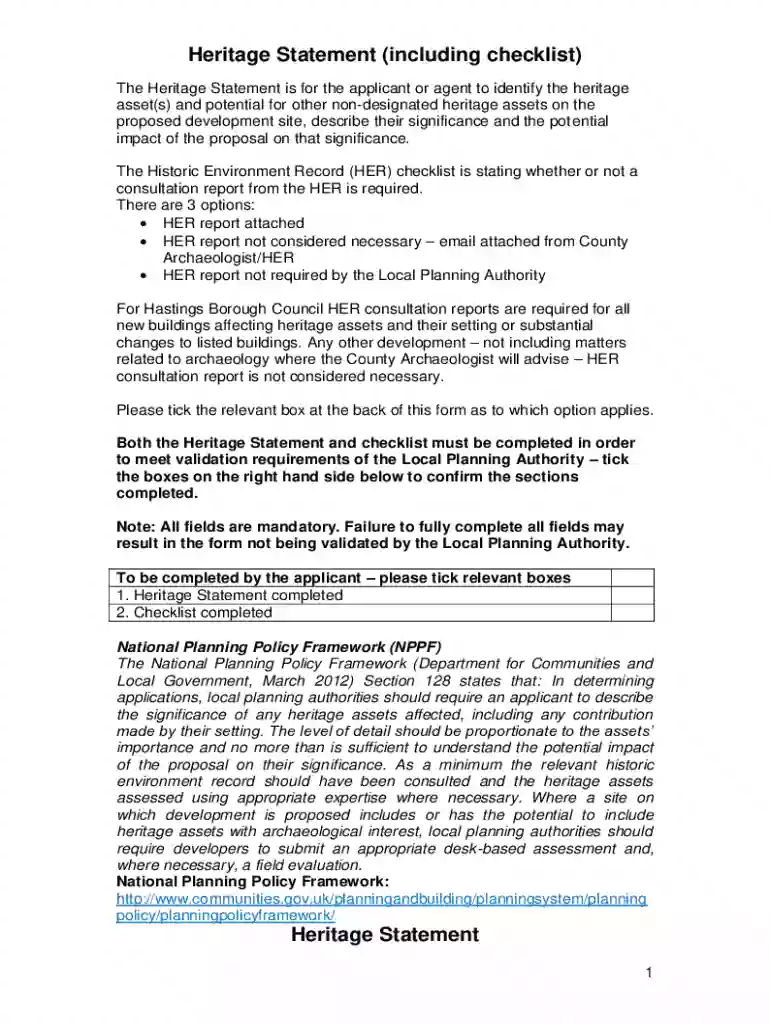
Type text, add images, blackout confidential details, add comments, highlights and more.

Draw your signature, type it, upload its image, or use your mobile device as a signature pad.

Send it via email, link, or fax. You can also download it, export it or print it out.
The Heritage Statement Template Sussex serves as a formal document used for proposing developments on sites with heritage assets. This template allows applicants to identify and evaluate the significance of these assets, detailing potential impacts of proposed works. It aligns with the National Planning Policy Framework to ensure proper management and preservation of cultural heritage. Typically, it's utilized during the planning permission application process, allowing developers to demonstrate an understanding of heritage considerations and outline measures to mitigate any adverse effects on the site's historic value.
When utilizing the Heritage Statement Template Sussex, developers must comprehensively describe the affected heritage assets and their significance. To effectively complete the document, follow these steps:
Each section of the template requires careful analysis and detailed justification of the proposals in relation to the heritage context.
The Heritage Statement Template Sussex comprises several essential elements. These include:
Each element ensures that the development respects and preserves the unique character of heritage sites.
Completing the Heritage Statement Template Sussex involves a series of methodical steps:
Careful adherence to each step guarantees a comprehensive heritage evaluation incorporated into the planning process.
Using the Heritage Statement Template Sussex is vital for several reasons:
Overall, the template plays a critical role in integrating heritage considerations into development projects.
Certain terms are crucial when working with the Heritage Statement Template Sussex:
Understanding these terms is necessary for accurately completing and validating the heritage statement.
The Heritage Statement Template Sussex is grounded in legal requirements to protect heritage sites. It adheres to:
Non-compliance could result in legal challenges or declined planning applications, highlighting the need for thorough documentation.
In Sussex, particular rules guide the use and completion of the Heritage Statement Template:
These state-specific guidelines ensure that heritage assessments are tailored to local historical contexts and preservation standards.
We've got more versions of the Heritage Statement Template Sussex form. Select the right Heritage Statement Template Sussex version from the list and start editing it straight away!
At DocHub, your data security is our priority. We follow HIPAA, SOC2, GDPR, and other standards, so you can work on your documents with confidence.
Architect/ engineer James Wolfe Sussex was born in Dunlap, Illinois on March 22, 1878 and grew up Galesburg, Illinois. He received his formal training fromRead more
Mission Statement and Strategic Plan Goal Heritage Council. technical support, the IDR Template provides key sections of assessment [IDR Template].


