
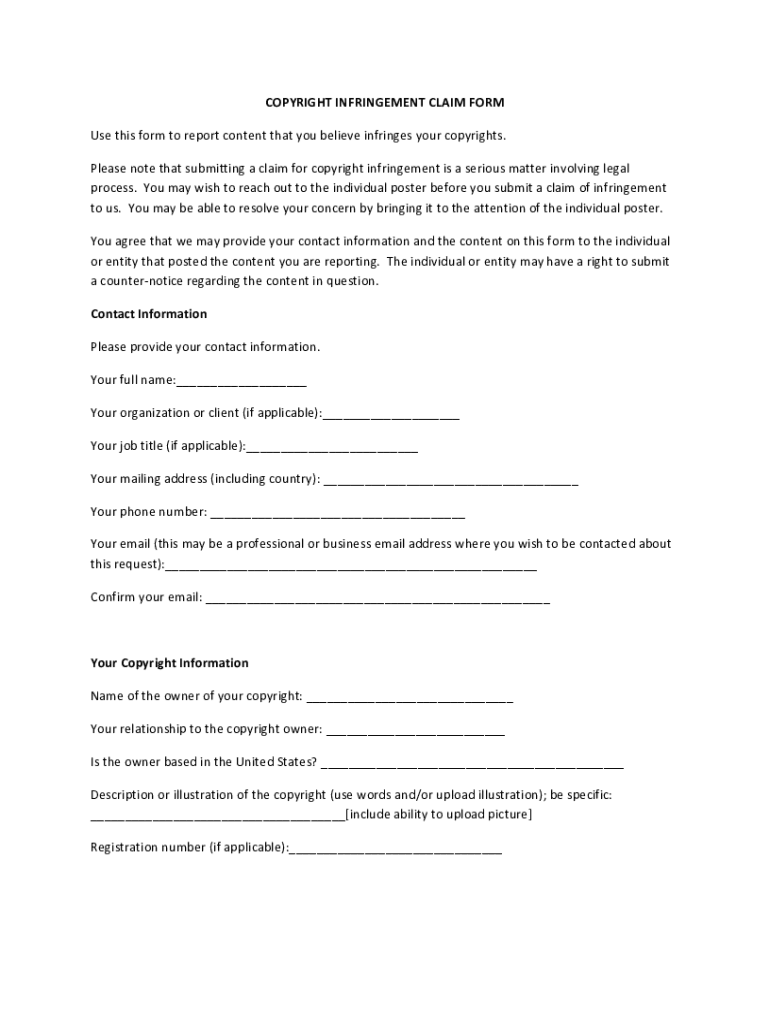







Definition & Meaning
The COPYRIGHT INFRINGEMENT CLAIM FORM is a legal document used by individuals or entities to report unauthorized use of their copyrighted work. The primary purpose of the form is to provide a standardized way for the copyright holder to submit a claim against infringing content, requesting its removal or for actions to be taken against the infringer. This form is essential in asserting one's legal rights and helps in protecting intellectual property by formalizing the complaint process.
Elements of the Form
- Claimant Information: This section requires the complainant to provide their personal details, such as name, address, and contact information.
- Identification of Copyrighted Work: A description of the original work that is allegedly infringed must be included, along with evidence such as registration numbers if applicable.
- Details of Infringement: Clear identification of where and how the work is being used without permission, including URLs or other relevant locations.
- Declaration: A statement affirming that the complaint is made in good faith, under penalty of perjury, acknowledging the serious nature of the submission.
Steps to Complete the COPYRIGHT INFRINGEMENT CLAIM FORM
- Gather Necessary Information: Compile all relevant information about the copyrighted work and evidence of the alleged infringement.
- Complete Claimant Details: Fill in your personal and contact details accurately for proper identification and follow-up.
- Describe the Copyrighted Work: Provide a concise description of the work and any registration details.
- Detail the Infringement: Clearly indicate how your work is being infringed upon, supplying URLs or other identifiers.
- Sign and Submit Declaration: Verify the information provided, sign the declaration, and submit under penalty of perjury.
Practical Tips
- Document Everything: Retain copies of all documentation and correspondence related to the infringement.
- Clearly State Your Case: Use precise language to describe the nature of the infringement to avoid ambiguity.
- Consider Legal Advice: Especially for complex cases, consulting a legal professional may prevent facing countersuits or other legal complications.
Legal Use of the COPYRIGHT INFRINGEMENT CLAIM FORM
The form is recognized as a legally binding complaint when properly submitted, initiating processes such as takedown notices under the Digital Millennium Copyright Act (DMCA) in the United States. It provides a framework for copyright holders to assert their rights and obligates platforms or infringers to respond to the claim, adhering to specified legal procedures.
Key Considerations
- Validity and Accuracy: Ensure that all information is correct; false claims can lead to legal penalties or damages.
- Procedural Compliance: Follow the precise procedure outlined within the jurisdiction of the alleged infringement.
- Penalties for Misuse: Submitting a false claim can lead to legal action against the claimant, reinforcing the importance of accurate and honest disclosure.
Important Terms Related to the COPYRIGHT INFRINGEMENT CLAIM FORM
Understanding the terminology associated with copyright law is essential when completing this form. Key terms include:
- Copyright Owner: The individual or entity that holds the rights to the original work.
- Infringement: Unauthorized use of copyrighted work that violates the rights of the owner.
- DMCA Takedown Notice: A request issued under the DMCA to remove infringing content.
- Penalties of Perjury: Legal consequences faced if false claims are made knowingly.
Who Typically Uses the COPYRIGHT INFRINGEMENT CLAIM FORM
This form is primarily used by:
- Individual Creators: Artists, authors, photographers, or musicians protecting their work.
- Businesses and Corporations: Companies or organizations ensuring the protection of proprietary content.
- Legal Representatives: Lawyers acting on behalf of clients to enforce copyright laws.


Key Elements of the COPYRIGHT INFRINGEMENT CLAIM FORM
The form comprises several critical sections that need to be completed with accuracy:
- Claimant’s Personal Information: Vital for verifying the identity and authenticity of the claim.
- Detailed Account of Infringement: This persuades the recipient or regulatory body of the claim's validity.
- Evidence Submission: Accompanied by documentation or metadata substantiating the claim.
- Official Declaration: Underscoring the seriousness and legality of the submission process.
Examples of Using the COPYRIGHT INFRINGEMENT CLAIM FORM
Real-world scenarios demonstrate the utility of this form in protecting digital assets:
- A Photographer Discovering Unlicensed Use: A photographer finds their images used on a commercial website without permission, prompting the submission of a claim form.
- An Author Spotting Unauthorized Distribution: An author notices their ebook distributed on pirate websites, leading to the use of this form to halt distribution.
- A Company Noting Replication of Proprietary Designs: A business finds its product designs duped on competing platforms, using the form to enforce IP rights and seek removals.
Software Compatibility and Integration
While the COPYRIGHT INFRINGEMENT CLAIM FORM itself is relatively straightforward, managing and submitting it can be streamlined using document management platforms like DocHub. These platforms allow efficient editing, signing, and sharing of the form, integrating with cloud storage services to ensure a seamless workflow for both individuals and legal professionals dealing with copyright infringements.




